
A sturdy-looking shelf is not a capacity specification. For box section stainless steel shelving, check the stated UDL, or Uniformly Distributed Load, to assess how much weight each shelf can carry when the load is spread evenly. Match that rating to the weight and distribution of the items you plan to store, rather than judging suitability by appearance.
In a commercial kitchen, shelving also needs to fit the workflow. Adjustable heights can accommodate different containers and equipment, while an accessible, cleanable design helps keep storage practical in food preparation areas. The right choice depends on the available space, what you will store and how the shelves will be used.
This guide explains how to compare shelving prices and availability, assess capacity and adjustable layouts, and care for stainless steel correctly. It also compares open-wire and box-section designs, including access, air circulation and everyday use, to help you specify storage for a UK kitchen.
Key Takeaways
- Use the stated uniformly distributed load rating to judge capacity, and match it to the weight and spread of the items each shelf will hold.
- Plan shelf positions around the dimensions of stored items so adjustable layouts support an efficient kitchen workflow.
- Compare availability and delivery times before planning installation, and understand the ordering terms for made-to-order shelving.
- Choose a cleaning routine that protects the finish: avoid corrosive or abrasive cleaners and dry shelves thoroughly after damp cleaning.
- Consider the kitchen environment and cleaning needs when assessing stainless steel grades, shelving design and suitability for food preparation.
Product prices and stock availability
Compare the listed price, VAT and delivery details before planning a commercial kitchen installation. Check whether the shelving is standard or made to measure, and account for its ordering terms when setting your project schedule.
Product prices in GBP
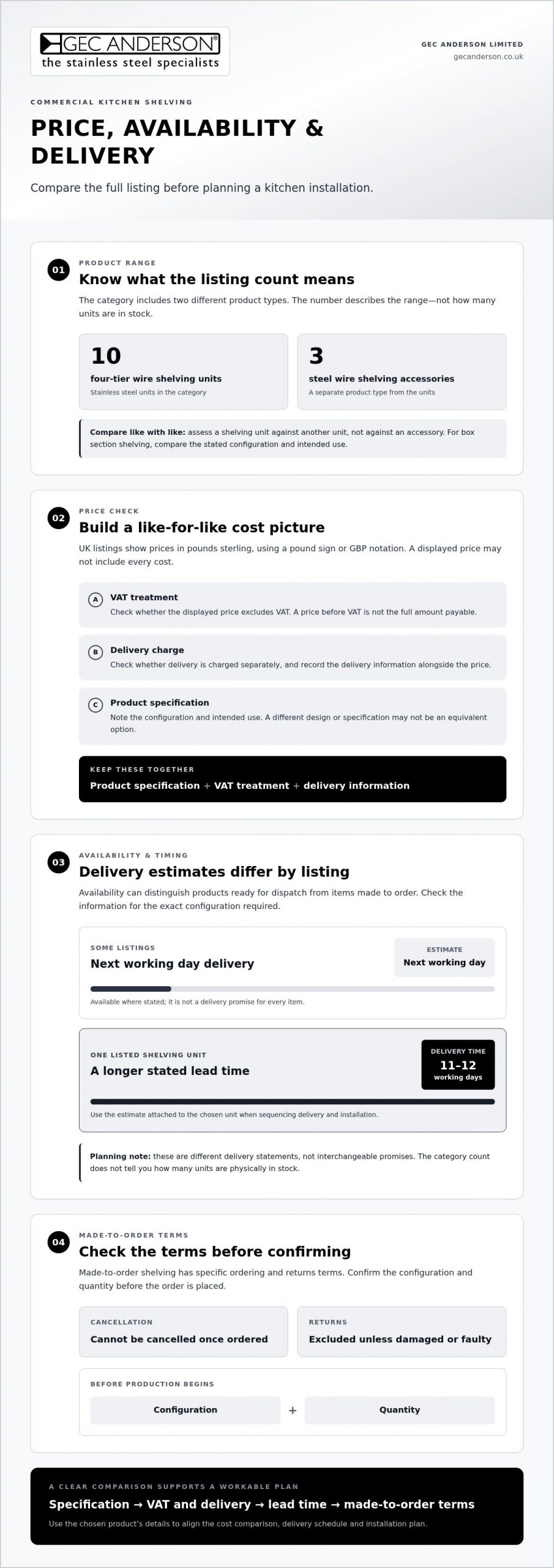
UK listings show prices in pounds sterling, using a pound sign or GBP notation. Compare like with like: check whether the displayed price excludes VAT and whether delivery is charged separately. A price before VAT is not the full amount payable. For a useful budget comparison, record the product specification, VAT treatment and delivery information together.
Specifications matter alongside the currency. The category includes 10 stainless steel four-tier wire shelving units and 3 steel wire shelving accessories. These are distinct product types, so compare a unit with another unit rather than an accessory. For box section shelving, compare the stated configuration and intended use; a different design or specification may not represent an equivalent option.
Stock availability
Availability information can distinguish products ready for dispatch from items made to order. The category listing covers 10 four-tier wire units, but that count describes the range, not how many units are physically in stock. Read the availability and lead-time information for the particular configuration you need, especially when several units must arrive together.
Some listings state that next working day delivery is available, whilst a listed shelving unit has a delivery time of 11-12 working days. These are different delivery statements, not interchangeable promises for every item. Use the estimate attached to the chosen unit when scheduling kitchen work, and allow its stated working-day period to guide the sequence of delivery and installation.
Price and delivery
Delivery timing affects project planning even when the displayed price is clear. Compare the product’s stated delivery estimate with the date the storage is needed, then account for the practical work that follows, such as placing and organising the unit. A next working day option applies only where offered; the listed 11-12 working day estimate indicates a longer wait for that unit.
Made-to-order shelving has important ordering terms: it cannot be cancelled once ordered, and made-to-order items are excluded from returns unless damaged or faulty. Confirm the chosen configuration and quantity before placing an order. That step helps prevent avoidable changes after production begins and keeps the delivery plan aligned with the kitchen’s storage requirements.
Adjustable shelf heights
Adjustable shelves let a storage layout respond to changing items and tasks. Set the spacing to suit what each shelf needs to hold, rather than settling for a fixed arrangement.
Plan clearances around stored items
Group items by height and handling needs first. For example, keep tall ingredient containers together and shorter tubs on another shelf. This makes better use of the available vertical space.
Measure the items and note the clearance needed to lift them out comfortably. Include lids, handles and the movement required during service. A container that fits tightly may be awkward to remove, especially when staff need to reach it repeatedly.
Use those measurements to plan shelf positions before loading the unit. Leave practical clearance above frequently used items and keep heavier containers at accessible levels. This gives each shelf a clear purpose and avoids unused gaps.
Match shelf positions to kitchen tasks
Different storage tasks need different spacing. A shelf for low ingredient tubs can sit closer to the shelf above, while tall stock containers need more vertical room. Grouping similar items also makes it easier to see where supplies belong.
Consider the route between storage and preparation. Place frequently used items where staff can reach them without moving other containers. Less frequently used stock can go further away, provided it remains visible and easy to retrieve.
A four-tier wire unit offers several levels for organising items, but the number of tiers alone does not determine the best arrangement. Let the stored items and work sequence guide the layout. Before choosing a system, check how its shelves can be adjusted and where each level can sit.
Review the layout as needs change
Commercial kitchens handle different containers, ingredients and equipment across preparation tasks. An adjustable system can be reorganised as storage needs change, rather than keeping every shelf at its original spacing. Before altering the layout, remove the contents and plan new positions around the items to be stored.
Keep a simple shelf plan for shared storage areas. Label each level by its intended contents, such as dry ingredients or preparation containers. Staff can then return items consistently, keeping the layout useful as shifts and tasks change.
For box section stainless steel shelving, distinguish the frame design from its adjustment options. Do not assume every model offers the same shelf movement or configuration. Compare the stated specification with your measurements, item dimensions and access needs. This helps establish whether adjustable heights will solve a practical storage problem.
Commercial kitchens and food preparation
UK kitchens must meet applicable food hygiene, food safety and workplace safety requirements. Shelving should support clean storage, safe access and orderly work as part of the wider cleaning and handling procedures.
Stainless steel wire shelving is used in commercial kitchens, catering environments and cold rooms where cleanliness, durability and corrosion resistance matter. Its open-wire design supports air circulation and makes the structure accessible for cleaning. These features can suit storage for preparation containers, packaged ingredients and equipment, provided the arrangement fits the room and task.
Plan the shelving position around the food preparation sequence. Keep frequently used containers near the relevant work area without obstructing staff movement or access to other equipment. Arrange items so staff can retrieve them without shifting unrelated stock. This reduces unnecessary handling and helps keep the workspace organised.
A four-tier unit provides several levels for separating items by use. One level might hold clean, lidded containers, while another holds packaged ingredients. Keep each shelf’s contents clear and consistent. Do not place items where they restrict cleaning access or interfere with nearby preparation work.
- Choose a position that allows staff to reach stored items without crossing a preparation task.
- Leave practical access around the unit so its surfaces and nearby floor can be cleaned.
- Organise containers by type, such as ingredient tubs or clean preparation equipment.
- Keep the storage arrangement stable, with items placed securely rather than balanced near edges.
Make cleaning access part of the layout decision. Open-wire shelves expose their structure for wiping, while the gaps allow air to circulate around stored goods. They still need regular cleaning: staff must be able to reach shelf surfaces, joints and surrounding areas. Placing a unit tightly against other equipment can make routine cleaning more difficult.
Stainless steel wire shelving is also used in medical and laboratory settings, where hygiene is critical. That does not make every product suitable for every room. Match the shelving design to the work, stored items and cleaning routine. In a food preparation area, consider whether containers sit securely, staff can reach them safely, and the unit’s position supports the kitchen’s cleaning process.
Before arranging storage, map the preparation route from delivery or cold storage to the work surface. Give each shelf a clear purpose, then check that staff can retrieve its contents without disrupting another task. This connects the shelving layout with everyday kitchen work.
In UK kitchens, shelving arrangements must support applicable food hygiene, food safety and workplace safety requirements. Keep shelves and surrounding areas accessible for cleaning, store items securely, and arrange stock so staff can retrieve it safely without disrupting preparation or movement.
Heavy-duty stainless steel shelving capacity
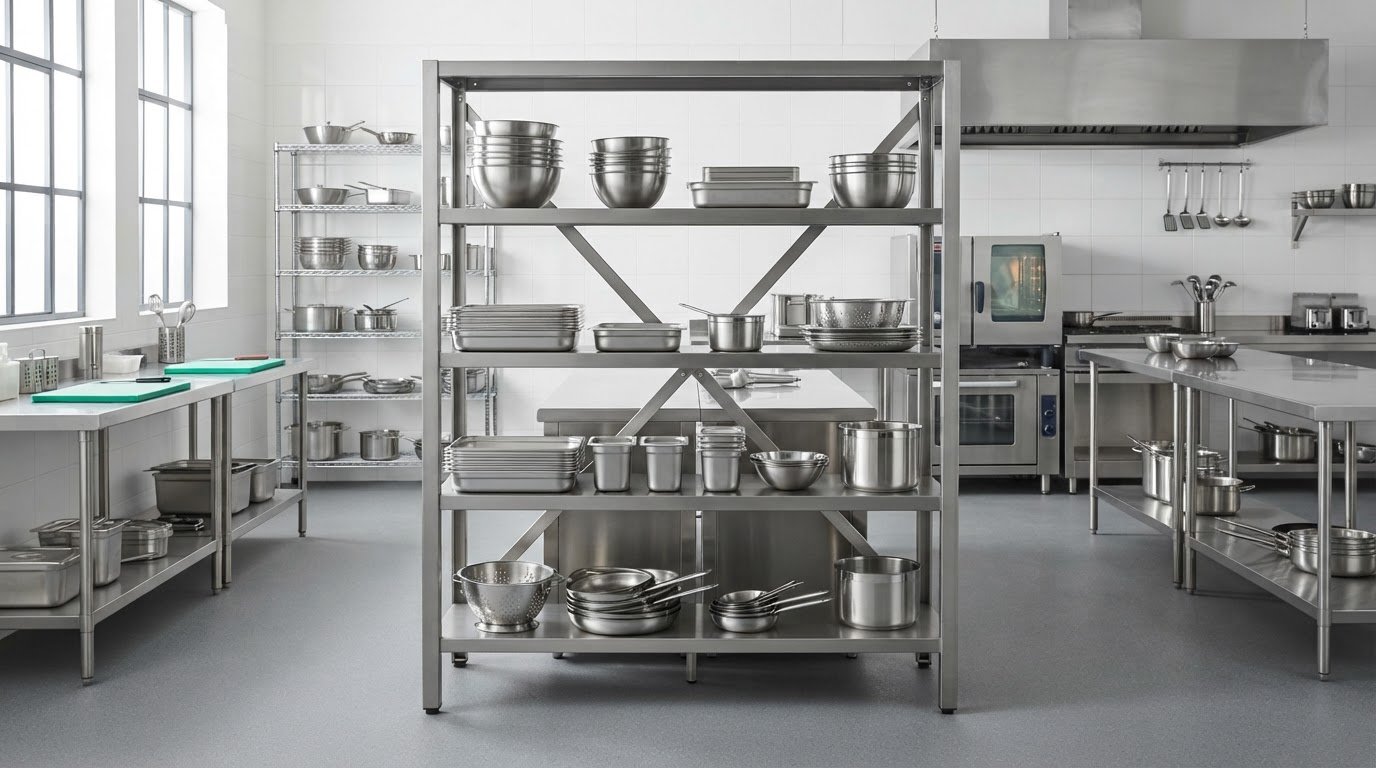
Box section shelves use formed sections to create a more enclosed, rigid structure than open-wire shelves. Wire designs favour visibility and airflow, angle systems use open supporting members, and solid shelves provide a continuous surface. The right comparison depends on the items stored, cleaning routine and required load rating.
To assemble and secure a unit, follow its supplied instructions and use the specified fixings. Position it on a suitable, level floor, assemble the components in sequence, then check stability before loading. Any wall restraint or other securing method should suit the unit design and building surface.
Corrosion, overloading and poor installation can shorten service life or make shelving unstable. Reduce these risks by cleaning spills, removing corrosive residues promptly, observing the stated load rating and assembling the unit correctly.
Capacity is not determined by the label “heavy-duty” or the appearance of a stainless steel frame. Check the stated load rating for each shelf and the complete unit, including the loading conditions it describes. UDL means Uniformly Distributed Load: the weight is spread evenly across the shelf rather than concentrated in one place.
That distinction matters in a kitchen. Evenly spaced containers distribute weight differently from a heavy piece of equipment placed near the centre or edge. If a rating specifies UDL, do not assume it permits the same total weight anywhere on the shelf. Arrange items across the surface and follow the stated limits.
Assess the actual contents before selecting a unit. Group stored items by weight and footprint, then identify the heaviest shelf load and where it will sit. Consider whether staff may add stock during service or temporarily place equipment on the shelving. These everyday patterns can create uneven loading, even when the planned layout appears balanced.
For box section shelving, the frame’s construction alone cannot establish a safe capacity. Shelf dimensions, supports, joints and the complete assembly all affect how loads are carried. Check the rating for the specific configuration, not a similar-looking unit or different shelf arrangement. If the product gives separate shelf and overall limits, observe both.
Installation quality affects capacity in use. Assemble the frame squarely, seat connections fully and ensure the unit does not rock before adding stock. Where restraint is required, use the specified anchoring approach; unsuitable fixings can damage a wall or fail to secure the shelving. Recheck stability after positioning and loading.
Stainless steel resists corrosion but still needs appropriate care. Remove food residues, rinse with cold water and dry the surfaces with a soft cloth. Avoid abrasive or corrosive cleaners, which can damage the finish. A sound selection process is straightforward: match the stated load rating to the contents, distribute weight appropriately and install the unit as designed.
What grades of stainless steel are used for box section shelving, such as 304 and 316?
Grade affects how stainless steel responds to its working environment, not the shelf’s stated load capacity. Grades 304 and 316 are common examples in stainless steel specifications. Compare the material grade with the kitchen’s cleaning routine, exposure to moisture and any corrosive substances.
Grade 304 is widely used for general-purpose stainless steel equipment, including applications where regular cleaning is expected. It suits many indoor environments, provided the surface is maintained appropriately. For example, shelving in a dry store has different exposure from shelving beside frequent wash-downs or food preparation involving salty ingredients.
Grade 316 contains molybdenum, which improves resistance to corrosion from chlorides compared with grade 304. That distinction can matter where salt, cleaning chemicals or persistent moisture are present. It doesn’t make 316 immune to corrosion: residues, damage and poor cleaning practices can still affect stainless steel.
Let the environment guide your comparison. Consider what will contact the shelving, how often it will get wet and which cleaning products staff use. A kitchen storing sealed dry goods may have different material demands from a preparation area exposed to saline ingredients or frequent cleaning. Choose a grade that suits those conditions, rather than selecting by number alone.
- Check the specification: identify the stated grade for the shelves and supporting frame.
- Review the environment: note moisture, salt, cleaning agents and possible chemical residues.
- Match care to material: remove residues, avoid corrosive or abrasive cleaners, and dry surfaces well.
- Assess the complete unit: check material details for components, joints and fixings, not just visible shelf surfaces.
Grade and construction answer different questions. A 316 specification doesn’t tell you how much a shelf can carry, while a heavy-duty frame doesn’t establish its corrosion resistance. Check the load rating separately, and review the material grade independently. For box section shelving, both details help establish whether the unit suits its intended kitchen location.
Also consider fabrication and finish. Cut edges, joints and surface damage can affect how easily a unit is cleaned and maintained. Follow an appropriate care routine: wipe away food residues, rinse thoroughly with cold water after cleaning and dry with a soft cloth. Avoid abrasive or corrosive cleaners, which can damage the finish.
There is no universal grade choice for every commercial kitchen. Compare the expected exposure and cleaning process with the stated material specification, then consider the cost and practical needs of the project. Grade 304 may suit general indoor use; grade 316 may be more appropriate where chloride exposure is a concern. Neither grade replaces correct cleaning, suitable loading or careful installation.
GEC Anderson Limited: Stainless Steel Worktops
GEC Anderson Limited supplies stainless steel storage and preparation products for commercial kitchen projects. Its box section stainless steel shelving is available in standard, modular and made-to-measure formats, to suit different spaces and project scales. Once you have assessed capacity, cleaning needs and shelf positioning, GEC Anderson Limited can help you coordinate the shelving with the wider kitchen design.
For a connected preparation area, Stainless Steel Worktops, Stainless Steel Sinks and Stainless Steel Cabinets & Doors can also form part of the specification. The appropriate combination depends on the room, workflow and storage requirements. Explore the stainless steel options at gecanderson.co.uk, or contact GEC Anderson Limited to discuss your project.
Shape your next kitchen specification
Choosing shelving can also prompt a wider review of how preparation, storage and cleaning connect across the kitchen. Consider how box section stainless steel shelving will work alongside adjacent surfaces and storage, so the finished layout supports daily tasks rather than treating each item in isolation.
GEC Anderson Limited also supplies Stainless Steel Worktops, Stainless Steel Sinks and Stainless Steel Cabinets & Doors for commercial kitchen projects. These products can help you plan a coherent working environment around the shelving, guided by the room and its practical requirements.
Bring your priorities together before settling the specification: how staff use the space, what needs to be stored and how the kitchen should function during service. A clear brief gives the project a sound starting point. Contact GEC Anderson Limited to discuss your kitchen requirements and take the next step with confidence.
Frequently Asked Questions
What is box section stainless steel shelving?
Box section stainless steel shelving uses enclosed, hollow metal sections in its supporting frame, rather than slender open-wire members. This construction gives the frame a clean-lined appearance and a defined structural profile. Shelf surfaces vary by design, so check whether they are solid or another format. The frame description alone does not establish the shelf material, finish, adjustability or load rating.
What are typical dimensions and load capacities of stainless steel box section shelves?
There is no single standard dimension or load capacity for every unit. Shelf length, depth, support arrangement and material thickness all affect the specification. Measure the intended location, including access routes and clearance from doors, sinks and work surfaces. Then compare the stated load limit with the actual weight and footprint of stored items. Do not infer capacity from dimensions or frame appearance.
How much does stainless steel box section shelving cost in the UK?
UK shelving prices depend on dimensions, material specification, shelf arrangement and whether the product is standard or made to measure. Delivery and VAT treatment also affect the amount payable. To compare options, match the specification first, then review the full quoted price and delivery terms. A lower listed figure may describe a different configuration, so compare equivalent units.
Is box section stainless steel shelving suitable for commercial kitchens, food storage and wet areas?
Box section shelving can suit commercial kitchens and food storage when its material, finish and construction fit the environment and cleaning routine. In a wet area, consider how often water or cleaning solutions contact the shelving, and whether chloride-containing residues may occur. Stainless steel resists corrosion but is not immune to damage. Keep containers stable and leave access for cleaning around and beneath the unit.
How should stainless steel box section shelving be cleaned and maintained?
Apply a general-purpose cream cleaner with a damp cloth or sponge, rubbing gently along the grain. Rinse thoroughly with cold water, then dry carefully with a soft cloth; never leave the surface to air dry. Remove salt or other chloride-containing residues immediately. Avoid abrasive or corrosive cleaners. If rust appears, it may come from iron or carbon steel that has contacted the stainless steel surface.