
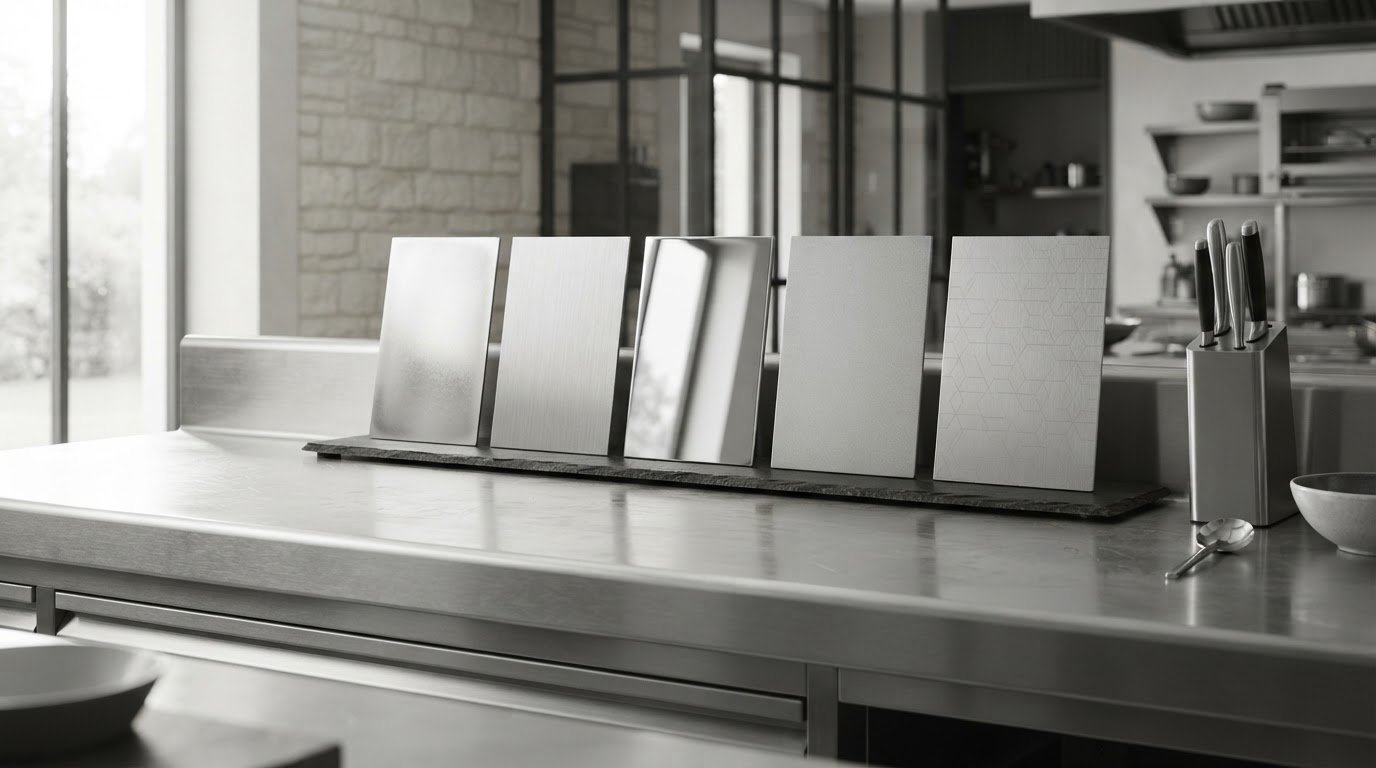
Choosing the right stainless steel finish means matching the surface to its setting, appearance and cleaning demands. Options range from mill finishes such as 1D, 2D and 2B to brushed, polished, blasted, patterned and coloured surfaces. Each can affect how the steel looks, how readily it can be cleaned and how its surface performs over time.
If you’re choosing the right stainless steel finish, start by considering how the surface will look and perform in everyday use. A finish is the surface texture or treatment that shapes a material’s appearance and practical qualities. A surface suited to a decorative feature may not be the best fit for a frequently cleaned work area.
This guide explains how stainless steel finishes differ, from the relatively subtle appearance of mill finishes to the texture of brushing and the reflectivity of polishing. You’ll learn how surface finish relates to corrosion resistance, cleanability and upkeep, and which considerations help narrow the options for kitchens, washrooms and architectural settings. The aim is a clear, informed choice based on how the stainless steel will be seen and used.
Key Takeaways
- Match the finish to the setting and its cleaning demands, not appearance alone.
- Compare mill, brushed and polished surfaces to understand how texture and reflectivity shape the result.
- Consider how surface texture affects cleanability and the potential for contaminants to collect.
- Look beyond smoothness: the environment and stainless steel grade also influence corrosion resistance.
- For a consistent specification, consider finish designation, grain direction and how visible joins will appear.
How finishes affect appearance, corrosion resistance, cleanability and maintenance
A stainless steel finish affects how a surface looks, feels and responds to cleaning. Choose one by balancing appearance, exposure and upkeep, rather than relying on finish alone.
Surface roughness and corrosion resistance
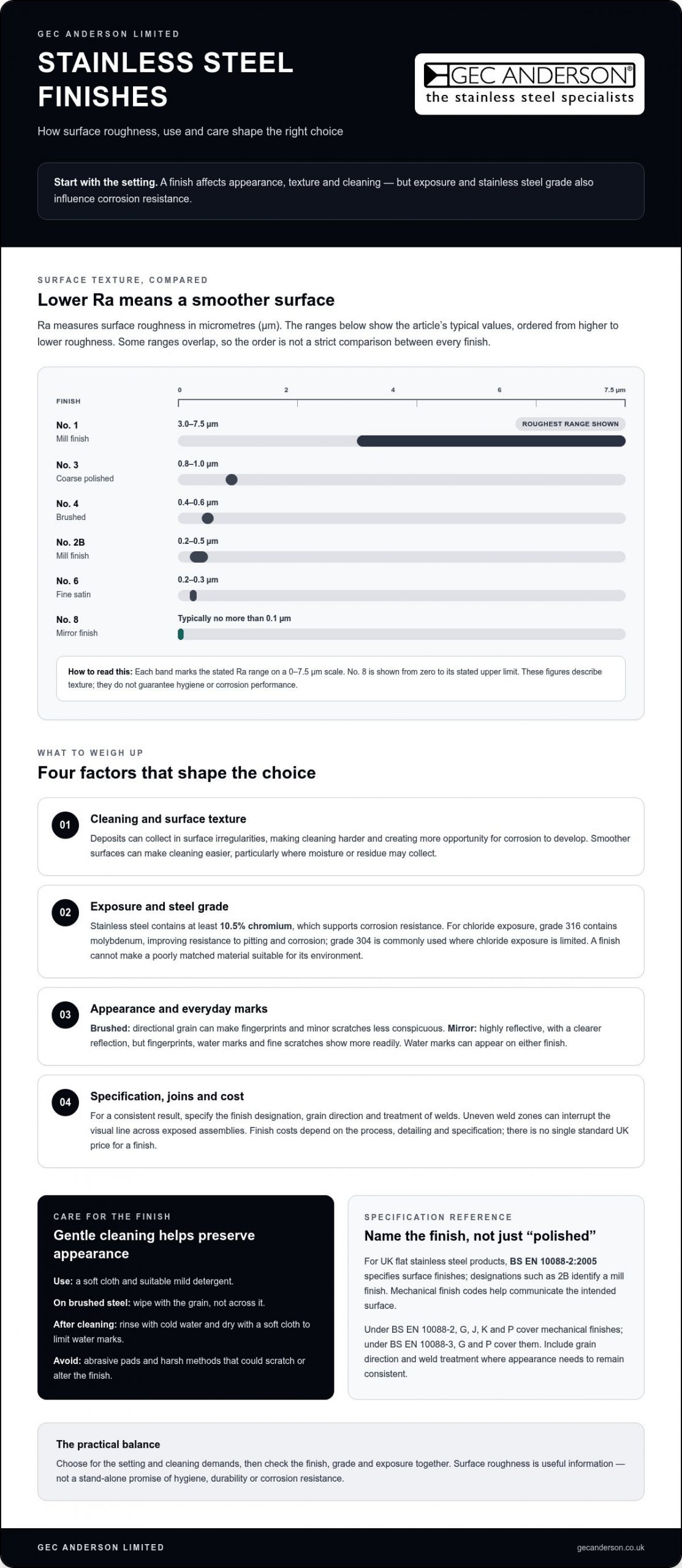
Surface roughness describes the small peaks and valleys on steel and is commonly measured as Ra in micrometres. Deposits can collect in surface irregularities, making cleaning harder and creating more opportunity for corrosion to develop.
Stainless steel contains at least 10.5% chromium, which supports its corrosion resistance. A rough surface can weaken the surface’s resistance; typical Ra values illustrate the difference, with No. 1 at 3.0-7.5 µm and No. 2B at 0.2-0.5 µm. Smoother finishes can help with hygiene, but exposure and steel grade remain important.
Appearance and upkeep of brushed and mirror finishes
A brushed finish has a visible directional grain, while a mirror finish is highly reflective and produces a clearer reflection. Brushing can make fingerprints and minor scratches less conspicuous, but it does not prevent wear or remove the need for regular cleaning.
Mirror finishes can show fingerprints, water marks and fine scratches more readily, so keeping them looking their best may take more frequent attention. Neither finish alone determines durability or corrosion resistance. A brushed surface in a busy interior and a mirror surface on a decorative panel both need care suited to their use and exposure.
Marks, cleaning and finish care
Brushed stainless steel is generally more forgiving when it comes to fingerprints and minor scratches, although water marks can show on either finish. When cleaning brushed steel, follow the grain rather than wiping across it to reduce visible cleaning marks.
Use a soft cloth and suitable mild detergent, following the grain on brushed steel. Rinse with cold water and dry with a soft cloth to limit water marks. Avoid abrasive pads and harsh cleaning methods that could scratch or alter the finish. Gentle wiping is especially important on mirror surfaces, where scratches and streaks are more visible.
Finish grades, specifications and costs
For chloride exposure, grade 316 contains molybdenum, which improves resistance to pitting and corrosion; grade 304 is commonly used where chloride exposure is limited. A coastal location calls for attention to both grade and finish, since a finish cannot compensate for a material poorly matched to its environment.
For UK flat stainless steel products, BS EN 10088-2:2005 specifies surface finishes; designations such as 2B identify a mill finish. Finish costs depend on the required process, detailing and specification, so compare the added finishing work rather than assuming a particular finish has one standard UK price.
For hygiene-sensitive uses, smoother surfaces can make cleaning easier by reducing irregularities where moisture or residue may collect. No. 4 brushed finish typically has Ra 0.4-0.6 µm, whilst No. 8 mirror finish is typically no more than 0.1 µm. These figures describe surface texture, not a guarantee of hygiene or corrosion performance; grade, exposure and cleaning practice also affect the result.
Mechanical finishes: polishing, brushing and abrasive blasting
Mechanical finishing changes stainless steel through processes such as rolling, abrasion or impact. The appropriate method depends on the intended appearance, the surface condition and the application.
Mechanical polishing and abrasive grit sizes
Mechanical polishing uses abrasives to remove surface irregularities and create a smoother, more reflective finish. Abrasive grit size affects the result: coarser abrasives remove marks more quickly, while finer abrasives refine the surface. The sequence matters because each stage reduces marks left by the previous one.
Specify the required finish rather than relying on a vague term such as “polished”. No. 3 is a coarse polished finish, typically with Ra 0.8-1.0 µm; No. 6 is a fine satin finish, typically with Ra 0.2-0.3 µm. These designations help distinguish texture and appearance in a specification.
Abrasive blasting uses particles to clean or texture metal, or prepare it for a coating. Shot blasting can remove rust and old paint, while blasting stainless steel can create a uniform, low-reflectivity texture. Keep finishing media clean, as contaminated abrasives can leave rust staining on mechanically polished stainless steel.
Brushing, buffing and polished finishes
Brushing creates a directional grain, while buffing uses polishing media to refine the surface and change its reflectivity. Brushed surfaces can suit contemporary interiors; dull-polished stainless steel is used in catering, architectural and pharmaceutical applications. The finishing method affects how marks and grain direction appear across connected components.
Polished stainless steel can provide a smooth, low-reflectivity surface for handrails, columns and exposed structural elements. Mirror polishing creates a highly reflective look for architectural and decorative features. On exposed assemblies, consistent finishing and weld quality matter: uneven weld zones can interrupt the visual line.
Mechanical finish codes help communicate the intended surface. Under BS EN 10088-2, G, J, K and P cover mechanical finishes; under BS EN 10088-3, G and P cover them. A complete specification can identify the finish code, grain direction and treatment of welds, rather than leaving the appearance to interpretation.
Mill, polished and electropolished finishes
Mill finishes are produced during steel manufacture, rather than by later decorative polishing. For example, 1D is hot rolled, annealed and pickled; 2D is cold rolled, annealed and pickled; 2B adds a skin pass after pickling. No. 2B is also commonly used as the base material for mechanical polishing.
Electropolishing differs from mechanical abrasion: it removes a microscopic layer to produce a smoother, more uniform surface. It can be useful where an even finish and cleanability matter, including on patterned floor plates. Because its process and appearance differ from brushed or buffed finishes, specify the required finish clearly.
For visible architectural work, compare a sample against adjacent surfaces and welds before finalising the specification. For kitchen projects, stainless steel worktops can be considered alongside the required finish and the way the surface will be used.
Patterned, bead-blasted, electropolished and coloured finishes
Different surface treatments alter stainless steel’s texture, reflectivity or colour. Patterned sheet adds relief, bead blasting creates a matte surface, electropolishing smooths the metal, and colour treatments change its visual character. Specify the process as well as the desired appearance to avoid differing interpretations of terms such as “textured” or “satin”.
Patterned or embossed stainless steel has a stated roughness range of 0.6-1.2 µm. The raised pattern creates a distinctive appearance and can help reduce distortion and oil canning, the visible waviness that may occur across sheet surfaces. This makes patterned finishes relevant to architectural applications where a broad exposed panel needs visual texture. The profile also affects cleaning, so consider how dirt or residue might sit within the pattern.
Bead-blasted and sand-blasted finishes typically have a roughness of 0.8-1.0 µm. Bead blasting produces a low-reflectivity, non-directional surface, which can reduce glare where a reflective finish would be distracting. Shot blasting is a related surface-treatment method: abrasive particles are propelled at the metal to remove impurities, rust or old paint. Blasting can also clean and texture metal or prepare it for a later coating. The precise result depends on the abrasive and treatment, so specify the intended texture and appearance.
Electropolishing works differently from abrasive blasting: it removes a microscopic layer of stainless steel to create a smoother, more uniform surface. Electropolished surfaces have a roughness of 0.2 µm or less. On patterned floor plates, this treatment can facilitate in-process cleaning while retaining the underlying pattern. It may be appropriate where a more uniform surface is important, but its smooth appearance differs from the matte texture created by bead blasting.
Coloured stainless steel provides another way to alter appearance without relying on a conventional brushed or mirror surface. The designation 2L is identified for coloured stainless steel finishes, and BS EN 10088-2 includes 2L among its special flat-product finish designations. Colour and surface texture should be considered together: a reflective finish presents colour differently from a matte or patterned one. Review the specification against the intended lighting and adjacent materials.
BS EN 10088-2 does not cover electropolished, shot-blasted, bead-blasted or peened finishes. These treatments therefore need clear descriptions beyond a mill-finish designation. For an exposed architectural panel, for example, specify the required pattern or blast appearance, whether reflectivity should be low, and how consistent the finish must look across adjoining pieces. That detail makes the expected result clearer to everyone working from the specification.
Decorative, textured and coloured finishes
Decorative stainless steel finishes shape the character of architectural surfaces, from understated textures to coloured panels. Selection involves more than matching a sample to a colour scheme: lighting, adjacent materials, exposure and cleaning access all affect the result. An indoor feature wall faces different conditions from an outdoor panel exposed to weather and airborne contamination. Choose a treatment that suits both the design and its setting.
For coloured stainless steel, 2L is the universal designation identified for coloured finishes. BS EN 10088-2 includes 2L amongst its special stainless steel flat-product finish designations. This gives specifiers a useful reference point, but a designation alone may not communicate the exact colour or appearance required. Include the intended colour, surface character and relationship to adjoining panels in the project specification. Reviewing a representative sample beside materials such as glass, stone or timber helps reveal how colour and reflectivity interact.
Powder coating is a separate finishing approach, generally applied by electrostatic spray deposition and then cured in an oven. Curing forms a durable, chip-resistant layer, creating a different surface from one that relies on the steel’s own texture. This distinction matters in design discussions: a coating is an added layer, while a mechanical or mill finish describes the steel surface. A coated panel and a brushed panel may both look matte, but their treatments differ.
Textured finishes can give large architectural surfaces a deliberate visual rhythm. Pattern and texture influence how light moves across a panel, while non-directional surfaces avoid the grain alignment of brushed steel. For a broad wall or cladding scheme, consider how the finish will appear across corners, joins and changes in direction. Specifying the finish and orientation consistently helps maintain visual continuity.
For outdoor projects, assess exposure as well as appearance. Marine and outdoor stainless steel finishes need to suit the conditions and cleaning demands of the setting. A sheltered entrance panel, for instance, may face different exposure from an open coastal façade. Finish alone does not determine material suitability, so coordinate the surface specification with the intended environment.
At specification stage, record the finish designation, colour or texture, and the panels to which it applies. Include a sample reference if the appearance needs to match across separate components. For a coloured architectural screen, state whether the treatment continues around returns and visible edges. Clear details reduce ambiguity during fabrication and installation and help preserve the intended look across the completed assembly.
Stainless steel finish options
Stainless steel finishes range from mill-produced surfaces to polished, grained, patterned and coloured treatments. Comparing their appearance with the conditions of use helps narrow the options.
Finish choices for kitchens, bathrooms and outdoors
Choosing the right stainless steel finish for a kitchen, bathroom or outdoor area means weighing exposure, cleaning demands and visual effect together. A brushed No. 4 surface offers directional texture, with typical roughness of Ra 0.4-0.6 µm. In outdoor or coastal environments, consider the steel grade as well as its surface finish, since chloride exposure can affect corrosion resistance.
For indoor spaces, cleaning routines and the desired aesthetic may guide selection. A bright mirror finish can suit a feature or trim, whilst a lower-reflectivity texture may be preferable where glare matters. Grade 316 contains molybdenum, improving resistance to pitting and corrosion in chloride environments. The finish itself cannot make a grade suitable for an exposure it cannot withstand.
In a kitchen, assess how lighting and surrounding materials affect the finish’s appearance. In a bathroom, consider how visible water marks may be and how easily the surface can be wiped. These practical differences help identify a suitable finish for each area instead of applying one aesthetic choice throughout.
Identifying and specifying a finish
A finish can be identified by its designation or a description of its process, texture and appearance. BS EN 10088-2 lists mill finishes including 1D, 2D, 2B and 2R, and special finishes such as 2L. For example, 1D is hot rolled, annealed and pickled, while 2B also receives a skin pass after pickling.
When choosing the right stainless steel finish for a fabrication brief, state the designation, grit range, surface roughness, grain orientation and post-weld treatment. This clarifies how panels, joins and edges should look together. If colour or texture is central to the design, include a sample reference and identify where the treatment applies.
Keep material grade and surface finish as separate requirements: the grade relates to environmental and chemical resistance, while the finish describes the surface. For a kitchen project, compare these details with the intended use of stainless steel worktops, so the material and finish specification support the same practical requirements.
Consider intended environment, desired lifespan, aesthetic requirements and budget. Mill finishes suit structural fabrication when appearance and hygiene aren’t critical and conditions aren’t particularly aggressive. Grained finishes include 240G and 240S specifications; 2R suits household appliances, builders’ materials and uses where reflectivity is essential. Reflective finishes suit trims, signage, marine and pharmaceutical applications. ASTM A480 and EN 10088 group finishes by process and texture.
GEC Anderson Limited: Stainless Steel Worktops
GEC Anderson Limited supplies stainless steel worktops for kitchen projects where finish, layout and daily use need to work together. Its products include standard, modular and made-to-measure options for projects of different scales. Stainless steel sinks, cabinets and doors, and shelving can also form part of a coordinated interior specification.
Consider GEC Anderson when turning finish requirements into a practical kitchen or washroom scheme. A clear brief covering appearance, cleaning demands and the intended setting can help guide your product choices.
Visit gecanderson.co.uk to discuss your project.
Make the finish work for the whole project
A finish needs to work beyond the sample board. Consider how it will look beside surrounding materials, how the surface will be used each day and whether its upkeep suits the space. Choosing the right stainless steel finish is a design decision grounded in practical use, so bring these priorities together before finalising the specification.
For a kitchen or washroom project, consider the finish alongside the stainless steel worktops, sinks and cabinets that shape the space. GEC Anderson supplies these products, offering a starting point for aligning surfaces with the wider scheme. A considered brief helps turn preferences for texture, appearance and maintenance into a coherent choice.
Take the next step with your project. Contact GEC Anderson Limited to discuss your stainless steel requirements and move forward with confidence.
Frequently Asked Questions
What are metal finishes?
Metal finishes are surface treatments or textures that influence a material’s appearance and practical performance. They may result from manufacturing processes such as rolling, or later work such as brushing, polishing or coating. The same metal can look matte, directional or mirror-like depending on its finish. Naming the finish in a specification distinguishes the visible surface requirement from the metal’s grade or composition.
What are the main stainless steel finishes, such as brushed, satin, mirror and matte?
Common stainless steel finishes include brushed or satin, mirror, matte, patterned and coloured surfaces. Brushed and satin usually describe a directional grain; mirror means highly reflective, while matte has subdued reflectivity. These terms describe appearance, not a universal performance ranking. For panels in a reception area, for example, compare samples under the project’s lighting: reflections can change how a finish looks beside glass or stone.
How do stainless steel finish grades and roughness values (Ra) compare?
Finish designations identify processes or surface types, whilst Ra measures average surface roughness in micrometres; they are related, but not interchangeable. Typical values include No. 1 at 3.0-7.5 µm, No. 2D at 0.8-1.6 µm, No. 2B at 0.2-0.5 µm, No. 4 at 0.4-0.6 µm and No. 8 at no more than 0.1 µm. Compare both designation and Ra where texture matters.