

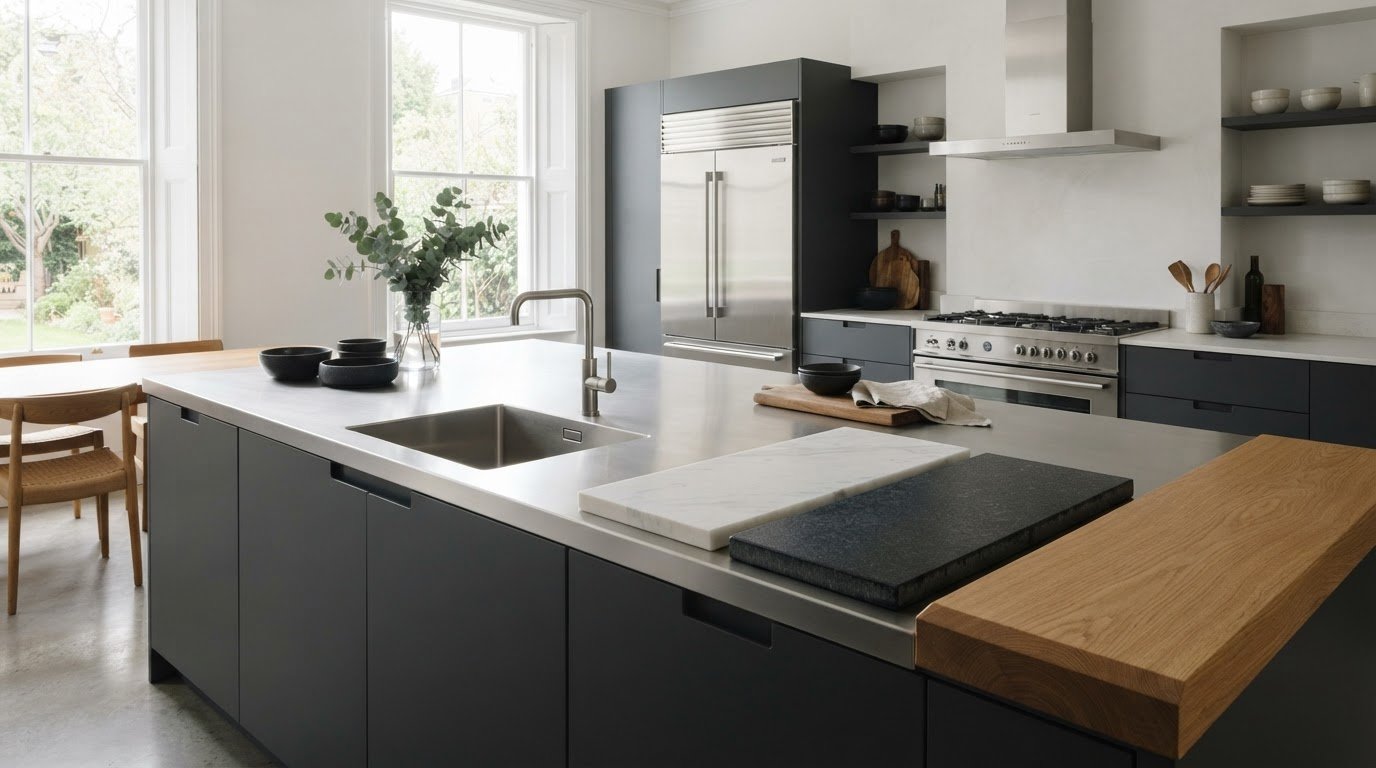
The most durable worktop is not automatically right for every kitchen. The best high-end kitchen worktop options balance appearance with everyday care: solid wood needs regular oiling, while quartz resin can be damaged by high temperatures. Material, finish and construction all affect how a surface looks and performs over time.
Choosing a premium worktop involves more than picking a colour. Compare materials by price, care requirements, colour range, thickness, edge profiles and resistance to everyday wear, then weigh those trade-offs against how you use your kitchen. Practical details also shape the finished result, from the visual weight of an edge to the maintenance a surface needs. For homeowners planning broader property renovations or bespoke residential builds, such as those created by vancouvercustomhomes.ca, selecting the right surfaces from the outset ensures lasting quality. This guide compares the main options and helps you identify which qualities matter most for your project.
Key Takeaways
- Compare worktop materials by more than appearance: maintenance, warranties and everyday use can shape long-term value.
- Assess colour in the context of your cabinetry, lighting and the overall kitchen scheme.
- Use thickness and edge profile to control the worktop’s visual weight and how it relates to the kitchen design.
- Consider how each surface responds to heat, wear and routine care before settling on a material.
- Explore stainless steel worktops when a precise, functional surface is central to your kitchen plans.
Material prices and warranties
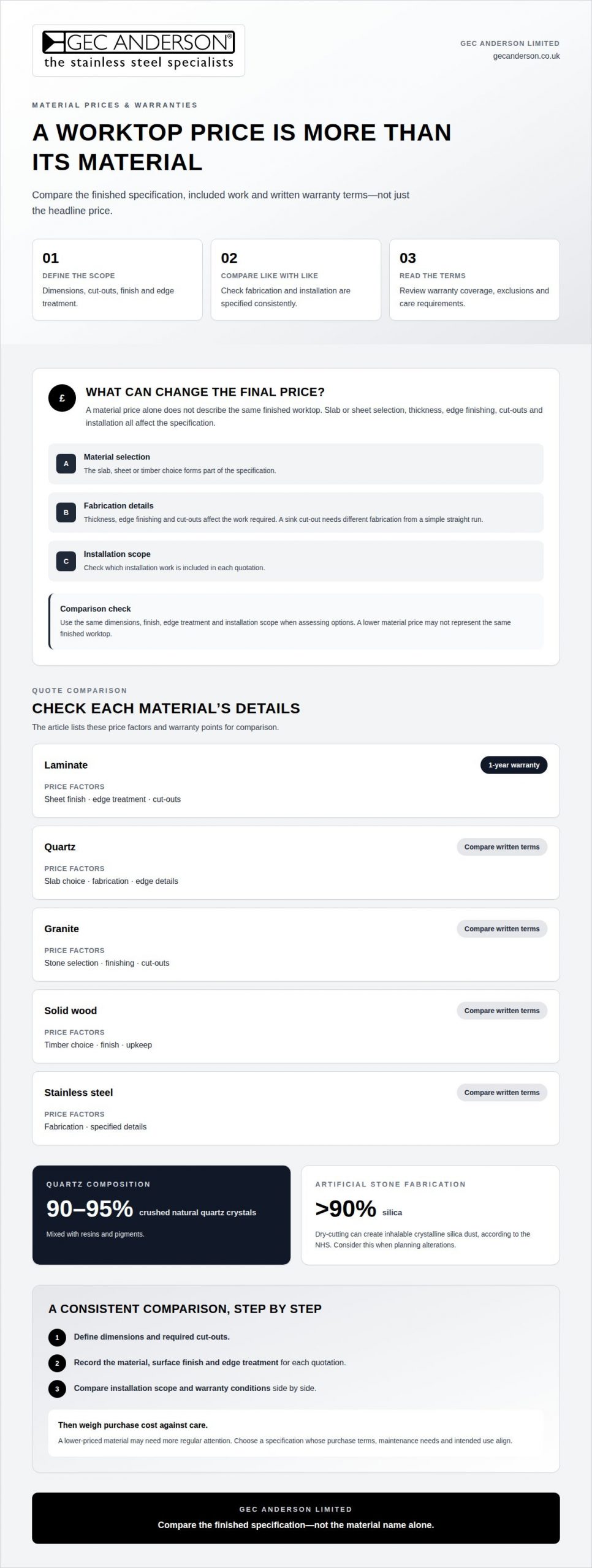
Worktop prices in the UK depend on more than the material. Slab or sheet selection, thickness, edge finishing, cut-outs and installation all affect the final specification. A sink cut-out, for example, requires different fabrication from a simple straight run. Compare like with like: include the same dimensions, finish, edge treatment and installation scope when assessing options. A lower material price may not represent the same finished worktop.
Premium materials also differ in how they are made. Quartz worktops contain 90-95% crushed natural quartz crystals mixed with resins and pigments. Natural stone, solid wood, laminate and stainless steel each involve different material and fabrication choices. Those choices influence the finished surface and the work required to prepare it. A detailed quotation should identify the material and finish, alongside the work included, rather than relying on a material name alone.
| Material | Price factors to compare | Warranty point |
|---|---|---|
| Laminate | Sheet finish, edge treatment and cut-outs | One-year warranty |
| Quartz | Slab choice, fabrication and edge details | Compare the written terms |
| Granite | Stone selection, finishing and cut-outs | Compare the written terms |
| Solid wood | Timber choice, finish and upkeep | Compare the written terms |
| Stainless steel | Fabrication and specified details | Compare the written terms |
Compare the quotation scope and written warranty terms against your intended use, rather than choosing on headline price alone.
Warranty length is only one part of the comparison. Read what the warranty covers, how claims are handled, and which care requirements apply. The available market information gives laminate worktops a one-year warranty. For other materials, compare the written terms for the specific product, including coverage for defects and any exclusions. Keep the purchase details and care instructions together, so the warranty conditions remain clear after installation.
Fabrication deserves attention with artificial stone. Artificial stone contains over 90% silica, and dry-cutting it can create inhalable crystalline silica dust, according to NHS. This is relevant when planning alterations, not simply when comparing surface appearance. Cut-outs and shaping are part of fabrication; they should be included in the specification rather than treated as incidental finishing work.
Use a consistent comparison process. First, define the worktop dimensions and required cut-outs. Then record the material, surface finish and edge treatment for each quotation. Finally, compare installation scope and warranty conditions side by side. A quartz quotation and a granite quotation are meaningfully comparable only when they describe the same finished dimensions and included work. This helps show whether a price difference comes from the material, fabrication or project scope.
Finally, weigh the purchase cost against the care the surface will need. A lower-priced material may require more regular attention, while a higher-priced specification may suit a kitchen where appearance and fabrication details matter more. Choose the option whose purchase terms, maintenance needs and intended use align.
Worktop colours
Colour affects how a worktop relates to cabinetry, flooring and natural light. A pale surface beside white cabinets can create a calm, continuous scheme, while a dark worktop against pale doors makes a stronger contrast. Consider the worktop as part of the whole kitchen palette, rather than choosing a sample in isolation. The same grey can look softer beside oak and sharper beside black cabinetry.
Start with the finishes that are already fixed. Note the cabinet colour, floor tone, wall finish and prominent metal details, then compare worktop samples against them. Warm cream cabinets and timber flooring, for example, may pair well with a beige or softly veined surface. Cool grey cabinetry may work with crisp white, charcoal or concrete-inspired tones. These are starting points, not rules: undertones can change the overall effect.
Light changes how colour looks throughout the day. A sample viewed under showroom lighting may look different beside a north-facing window or beneath warm pendant lights. Place samples horizontally where the worktop will sit and view them in morning and evening light. Compare them beside a cabinet door, not just against a photograph. A phone screen cannot reliably reproduce subtle veining or finish depth.
Pattern matters as much as base colour. A fine, restrained pattern can complement detailed doors, while pronounced veining can become a focal point against plain cabinetry. For instance, bold veins in a marble-effect worktop may compete with patterned tiles. A quieter surface can balance the tiles and let them remain the feature. Also consider how joins and cut-outs will cross visible patterns along a long run.
When choosing a colour, consider how the kitchen is used and maintained. Crumbs and spills may be more noticeable on very pale, uniform finishes; heavily patterned surfaces can visually soften minor marks. Neither is universally better. Compare samples in the kitchen’s actual lighting and beside its existing finishes, then decide whether the worktop should blend in or provide contrast. Using a consistent finish on the island and perimeter can connect different zones.
A silver-toned surface offers a distinct alternative to stone-like colours. For a scheme built around crisp metal tones, consider how stainless steel worktops relate to cabinetry, flooring and surrounding finishes. Choose the colour direction first, then assess the material’s pattern, finish and sample appearance in the intended room. That order keeps a striking sample from driving a decision that conflicts with the wider kitchen scheme.
Worktop thicknesses and edge profiles
Thickness affects a worktop’s visual weight and its relationship with the cabinetry. The edge treatment then determines how that thickness appears along the finished surface.
Worktop thicknesses
Common UK worktops are typically 30 to 40 millimetres thick, but slimmer formats create a different effect. Contemporary kitchens may use 12 mm compact laminate, 27 mm wood, or 30 mm quartz and granite. Ultra-slim worktops can be 20 mm thick. By contrast, 40 mm solid wood gives a traditional kitchen more visual substance.
Material and thickness should be considered together. A 38 mm laminate worktop offers an alternative to 40 mm solid wood in a farmhouse-style kitchen, whilst 30 mm laminate, quartz and solid worktops provide another familiar profile. These comparisons concern the visible depth, not a universal measure of strength. The construction and support beneath each surface also affect how it functions.
Thickness also contributes to the finished working height. A commonly used UK kitchen worktop height is 910 mm, formed by an 870 mm base unit and a 40 mm worktop. Changing to a thinner surface alters that total unless the base units or installation arrangement also change. Set the intended height before choosing a thickness, especially where the worktop meets windowsills, appliances or adjoining surfaces.
Worktop edge profiles
An edge profile is the shape of the worktop’s exposed perimeter. A square edge creates a clean, defined line; a rounded edge softens the outline, while a bevel adds an angled detail. Each changes how the thickness looks from the side. A simple edge can emphasise a slim surface, while a shaped edge can give a thicker worktop a more decorative finish.
Consider the edge alongside the kitchen’s other lines. Flat-fronted cabinetry and minimal handles often suit a restrained, square profile. Shaker doors or a farmhouse scheme may feel more cohesive with a softened edge. These are design relationships, not fixed rules. Compare an edge sample with a door front and drawer handle to assess the detail up close.
The material affects which edge details are possible and how they look. A pronounced profile changes the visible perimeter, while a simpler finish keeps attention on the surface. Sink and hob cut-outs also interrupt the edge, so consider how the chosen profile meets those areas. Before finalising the specification, review a sample or drawing that shows the worktop from above and from the side.
For a balanced result, decide the working height first, then choose thickness and edge together. A 20 mm surface with a defined square edge reads differently from a 40 mm surface with a rounded perimeter, even in the same colour. Comparing those details beside the cabinetry helps establish whether the worktop should feel visually light or substantial.
Buying worktops
Begin with an accurate plan of the kitchen, not a material sample. Record each run’s length and depth, plus corners, wall returns and interruptions. A standard off-the-shelf worktop in the UK is typically 2.4 metres or 3 metres long, depending on the supplier. Those stock lengths help indicate where joints may fall, but the room layout determines the finished specification.
Measure the installed cabinets and note where the worktop meets walls, windowsills and tall units. The average kitchen worktop width is between 600 mm and 650 mm, but actual depth depends on the layout and design. For example, a 2.4-metre section at 0.6 metres wide covers 1.44 square metres. That calculation describes area only; it does not account for cut-outs or offcuts.
Use a consistent measurement process for every run:
- Map each section: write down length and depth, including separate island dimensions.
- Mark cut-outs: show sink and hob positions, alongside the direction each unit faces.
- Locate joins: identify corners and places where stock lengths meet.
- Record edges: specify which sides remain visible and which meet walls or cabinetry.
A clear drawing helps bring these details together. For instance, a sink close to a corner may affect where a joint can sit. An island may also need a different piece length from the perimeter run. Mark the intended finished edges so a wall-facing side is not mistaken for an exposed end.
Next, compare the material format with the plan. Stock worktops commonly come in 2.4-metre or 3-metre lengths, whilst made-to-measure planning can address project-specific dimensions. The best fit depends on the number of runs, visible joins and cut-out positions. A long uninterrupted run may require different planning from a compact galley with several corners.
Check the complete specification before purchase. It should record the material, colour, finish, thickness, edge profile, measurements and cut-out locations. Confirm that the drawing reflects the finished kitchen, not an early cabinet plan. A change to an appliance position or unit depth can alter the required worktop dimensions.
Finally, compare quotations against the same drawing and project scope. One may include fabrication details that another omits, making headline totals difficult to compare. Check each stated length, cut-out, edge and installation item before deciding. This keeps the comparison grounded in the actual kitchen, whether the design uses standard lengths or needs a tailored layout.
Durability and everyday wear
Natural stone has distinctive veining, while engineered stone offers a manufactured pattern. Natural stone may need sealing and careful stain management; resin in engineered quartz can be damaged by high temperatures.
Care depends on the material, rather than following one routine for every UK worktop. Near a hob, protect heat-sensitive surfaces. Around a sink, wipe standing water and follow the material’s care instructions.
Everyday durability depends on how the kitchen is used. A busy household may often put down hot pans, prepare food directly on the surface or leave water around the sink. These habits expose different weaknesses. Quartz, for example, is not fully heat-resistant because its resin can be damaged by high temperatures. Use a trivet rather than treating any worktop as a pan rest.
Solid wood needs a different maintenance routine. Regular oiling helps maintain its appearance, so include this task in your decision. Standing water around a sink can also affect timber. Wipe spills promptly and maintain the surface, particularly near joints and cut-outs where moisture can collect.
Natural and engineered stone each have practical strengths and trade-offs. Granite and marble have individual mineral patterns, while engineered quartz combines crushed natural quartz with resin and pigments. Natural stone varies from slab to slab, but some types need sealing and prompt attention to spills. Engineered stone offers a more controlled pattern, although its resin content makes heat protection important.
Stainless steel suits a different set of kitchen conditions. Its practical, continuous surface works well where water and food preparation meet, including around an integrated sink. Like other finishes, it can show signs of use; cleaning and everyday handling influence its appearance. Choose it based on the marks you consider acceptable, as well as your cooking and cleaning needs.
Build a simple care routine around the material and where it is used:
- Beside a hob: use a trivet for hot cookware, especially on quartz.
- At a sink: wipe standing water from timber and attend to spills promptly.
- For solid wood: oil the surface regularly to maintain its appearance.
- For stone: follow the surface’s care guidance and respond promptly to spills.
Look beyond scratch or heat resistance. A surface’s long-term condition also depends on cleaning products, maintenance habits and how it is used. A household that often cooks with hot pans, for example, should prioritise heat management, while frequent sink use makes moisture care more relevant. Matching those routines to the material is more useful than relying on the word “durable” alone.
To weigh material performance against your kitchen’s daily demands, plan your worktop specification around its main preparation and sink areas.
GEC Anderson Limited: Stainless Steel Worktops
GEC Anderson Limited supplies stainless steel worktops for kitchens where a practical metal surface suits the design and everyday use. Pairing a worktop with stainless steel sinks can create a coordinated preparation and washing area. The right specification depends on the kitchen layout, surrounding materials and how the surface will be used.
For a more coordinated scheme, GEC Anderson Limited also supplies stainless steel cabinets and doors, shelving and splashbacks. These products can help create a consistent stainless steel interior, rather than making the worktop a standalone feature. Consider the worktop alongside adjoining surfaces, storage and sink placement as you finalise the design.
To discuss stainless steel worktops for your kitchen, contact GEC Anderson Limited or visit gecanderson.co.uk.
Make the choice that fits your kitchen
The best high-end kitchen worktop options support the way you want the room to function and feel. Before settling on a design, decide what you want the surface to contribute: a restrained backdrop, a distinctive architectural detail or a strong material presence. That priority can guide the final decisions and help keep the overall scheme coherent.
Think beyond the first impression. A considered worktop should still feel at home as the kitchen changes, from new accessories to different lighting or refreshed cabinetry. Focus on the quality you value most, then ensure the final specification serves that intention. A clear design direction makes it easier to settle on a choice. For homeowners and investors looking at how modern kitchen designs feature in luxury residential properties and new construction homes, team239.com showcases the high-end finishes currently popular across contemporary builds.
If you’re considering a stainless steel specification, contact GEC Anderson Limited to discuss your project. Take the next step towards a kitchen shaped around your priorities and a worktop you’ll be pleased to live with.
Frequently Asked Questions
What are the best high-end kitchen worktop materials available in the UK?
The main high-end kitchen worktop options include natural stone, engineered quartz, porcelain, solid wood and stainless steel. The right material depends on your priorities: distinctive natural pattern, controlled colour, tactile timber or a functional metal surface. Consider how the kitchen is used, the care you are prepared to provide and how the worktop will sit with the cabinetry. Compare actual samples against the room’s finishes before deciding.
What is the typical UK price per square metre for luxury kitchen worktops, including installation?
A per-square-metre comparison can mislead because the finished cost depends on more than surface area. Material, thickness, cut-outs, joins, edge details and installation all affect the project total. A sink opening and shaped corner, for example, require different fabrication from a simple straight run. Compare quotations using the same dimensions and specification, and check whether each includes fabrication, delivery and installation.
Which premium worktop materials are most heat-resistant, scratch-resistant and stain-resistant?
No single material leads in every measure of resistance. Quartz resin can be damaged by high temperatures, so use a trivet rather than putting hot cookware directly on it. Natural stone varies by type and finish. Stainless steel is another option for a working kitchen, although its surface can show signs of use. Assess heat, scratching and staining separately, then match those priorities to your cooking habits.
How much maintenance do marble, granite, quartz and porcelain worktops need?
Care varies by material and finish. Wipe spills from marble promptly, particularly after contact with acidic foods. Protect quartz from heat and use cleaning methods suited to its resin content. Porcelain is generally maintained with routine cleaning, but products can differ. Keep the care instructions with the kitchen documents for future reference.
What edge profiles, finishes and bespoke options are available for luxury worktops?
Common edge profiles include square, rounded and bevelled designs. Polished or matt finishes also affect the surface’s appearance. Made-to-measure specifications can tailor dimensions, corners, joins and sink or hob openings. An integrated bowl, for example, can create a more continuous relationship between sink and work surface. Confirm how the selected edge meets cut-outs and exposed ends, as these details affect the finished appearance.
What should homeowners check when choosing a worktop supplier and installer?
Check that the specification records the material, dimensions, cut-outs, edges and installation scope, and that drawings reflect the final kitchen layout. Clarify who measures, fabricates and installs the worktop, and what the written warranty covers. GEC Anderson provides CAD drawings and offers supply-only or measuring and installation options for its stainless steel products. This helps align the design information with the work involved.
What are the main risks of expensive worktops, including cracking, staining and warranty exclusions?
A high purchase cost does not remove the risk of damage. Heavy impact or stress around cut-outs can harm a surface, while spills may stain some materials if left unattended. Heat can affect quartz resin. Warranty terms may exclude damage linked to misuse, unsuitable cleaning or installation conditions, so read them alongside the care instructions. Plan sink and hob openings carefully, and use protective habits suited to the chosen surface.