

The best alternative to laminate depends on which environmental trade-offs matter most. Recycled terrazzo, sintered stone, responsibly sourced timber and stainless steel are options to compare. Terrazzo can incorporate recycled materials, sintered stone is made from natural minerals, and timber may carry FSC or PEFC certification. Each has different implications for durability and care.
It’s reasonable to want a worktop that lasts without overlooking how it is made or what happens at the end of its useful life. This guide compares eco-friendly kitchen worktop materials in the UK with laminate, covering practical strengths, environmental benefits and limitations. It also looks at recycled glass and paper, reclaimed wood and bamboo, so you can assess materials against how you use your kitchen and the finish you want.
Key Takeaways
- Compare alternatives to laminate by considering how they are made, how long they may serve your kitchen and what care they require.
- Recycled terrazzo and sintered stone offer distinct material choices, but their composition and practical trade-offs differ.
- For timber, responsible sourcing matters alongside protection from water and heat; certification can help inform your choice.
- Recycled glass, recycled paper, reclaimed wood and bamboo each approach sustainability differently, so consider the material’s origin and intended use.
- Look beyond a material’s environmental appeal: maintenance, resistance to staining and the finish you want all affect its suitability.
1. What is a Sustainable Alternative to Laminate?
A sustainable alternative to laminate could be recycled terrazzo, sintered stone, responsibly sourced timber or stainless steel. Each offers a different balance of recycled content, raw materials, durability and end-of-life options. For a bespoke kitchen, assess the whole surface and its intended use, not just its appearance.
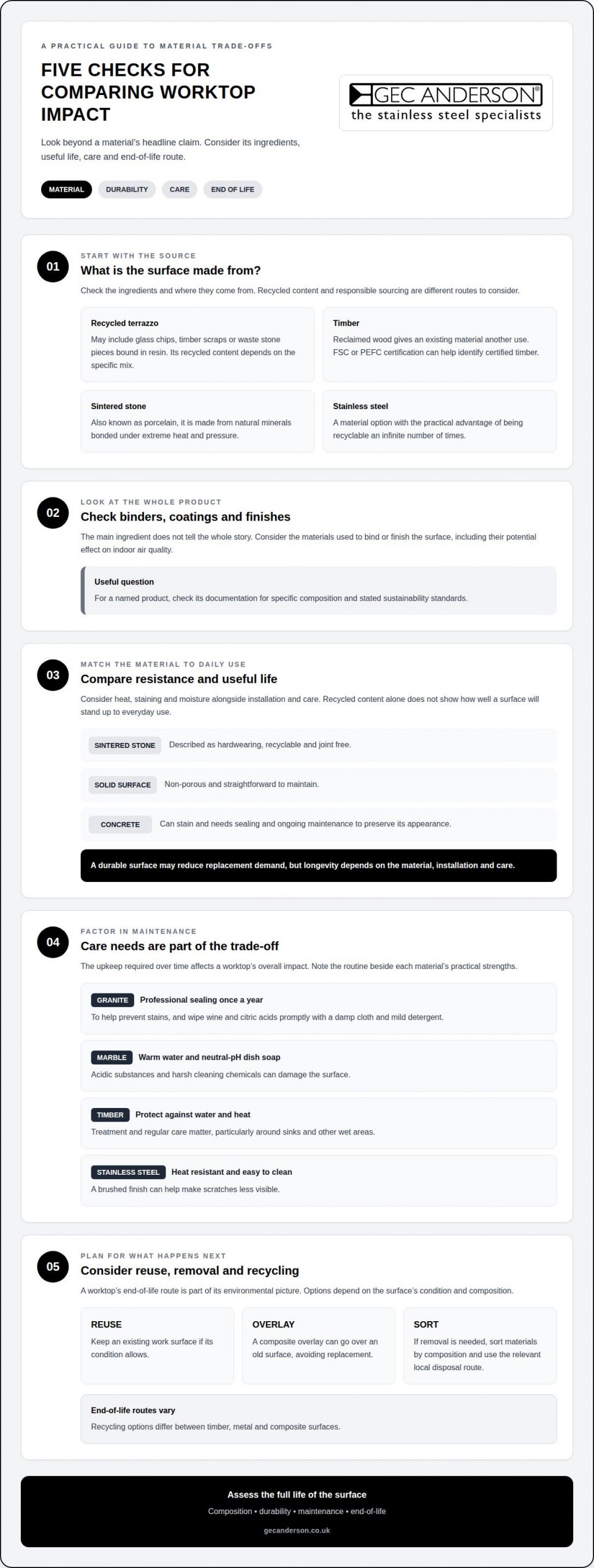
Recycled terrazzo can incorporate glass chips, timber scraps or waste stone pieces bound in resin. Its recycled content depends on the specific mix. Sintered stone, also known as porcelain, is made from natural minerals bonded under extreme heat and pressure. It offers a different approach, using minerals rather than reclaimed fragments. These distinctions matter when comparing the environmental profile of a sustainable kitchen.
Timber offers a warmer finish. Oak, beech, walnut and ash can be responsibly sourced, with FSC or PEFC certification helping identify certified timber. Reclaimed wood gives an existing surface a second use, while certified new timber provides a traceable sourcing route. Wood needs protection from water, and its appearance and service life depend partly on regular care. Stainless steel is another option, with the practical advantage of being recyclable an infinite number of times.
For a kitchen with heavy daily use, weigh resistance to scratches, heat and staining against each material’s maintenance needs. Concrete, for example, requires sealing and upkeep to preserve its appearance. A brushed finish can help minimise the visibility of scratches on stainless steel. Material selection also affects indoor air quality: consider the binders, coatings and finishes used, not just the main ingredient. Richlite and Quartzforms are names buyers may encounter; assess documentation for the specific product, including its composition and stated sustainability standards.
The installed cost per square metre depends on the material, dimensions, edge details, cut-outs and installation complexity. These factors shape the project’s final cost, so there is no single figure that applies to every worktop.
In the UK, compare recycled terrazzo, reclaimed timber, bamboo and FSC- or PEFC-certified wood. These categories indicate possible sources of recycled content or responsible sourcing, rather than pointing to one supplier as the right choice for every project.
Reuse an existing work surface if its condition allows. A composite overlay can be fitted over an old surface, avoiding replacement. If removal is needed, sort materials by composition and use the relevant local disposal route. Recycling options differ between timber, metal and composite surfaces.
2. Worktop durability and environmental impact
A durable worktop can reduce replacement demand, but longevity depends on the material, installation and care. Recycled content alone doesn’t show how well a surface will withstand daily use. Compare resistance to heat, staining and moisture alongside maintenance needs, then consider how these factors affect its useful life and overall footprint.
Sintered stone is described as hardwearing, recyclable and joint free. Solid surface is non-porous and straightforward to maintain, while stainless steel resists heat and is easy to clean. These properties help with everyday use, but no material is immune to damage. Concrete, for example, can stain and needs sealing and ongoing maintenance to preserve its appearance.
Repairability varies by material and type of damage. A mark or scratch may be easier to manage than a crack or failure around a joint, but repair methods depend on the surface and finish. A brushed finish can help make scratches less visible on stainless steel. Copper develops a patina through use, changing its appearance rather than retaining a uniform new finish.
Care also affects environmental impact. Cleaning a surface with suitable products and avoiding unnecessary treatments can reduce the materials and effort used in upkeep. Granite needs professional sealing once a year to help prevent stains. Wipe wine and citric acids from granite promptly with a damp cloth and mild detergent. Clean marble with warm water and neutral-pH dish soap; acidic substances and harsh cleaning chemicals can damage it.
Timber needs particular attention around sinks and other wet areas. Treating wood helps prevent rot or expansion from water contact, while certified timber should be sealed against heat and water damage. Coatings and regular care are part of the material’s maintenance burden, so factor them into its lifetime impact.
Production and transport contribute to a worktop’s footprint, as do replacements and the resources used for ongoing care. A material that lasts well in the kitchen may avoid premature replacement, but its environmental performance also depends on its composition and end-of-life route. Stainless steel can be recycled an infinite number of times, making recyclability relevant to its overall assessment.
For practical comparison, note the expected care routine beside each material’s strengths: sealing for concrete or granite, careful cleaning for marble, and routine cleaning for stainless steel. This makes the trade-offs clearer than a simple label of “eco-friendly”. If heat resistance and straightforward cleaning are priorities, explore stainless steel worktops as one option for your kitchen.
3. Environmental benefits and trade-offs of materials
Environmental performance depends on more than a worktop’s headline material. Consider what it contains, how it is manufactured, how long it remains serviceable and what happens afterwards. These factors influence its carbon footprint across its life. A recycled ingredient can reduce demand for new raw material, but it doesn’t establish the impact of the finished surface by itself.
Laminate illustrates this balance. It can be made using recycled wood fibres and resin, so its composition may include reused material. Resin remains part of the construction, while the worktop’s lifespan and disposal route also matter. Compare the full material description with the expected use, rather than treating “recycled” as a complete measure of sustainability.
For timber, choose oak, beech, walnut or ash from responsibly managed sources, with FSC or PEFC certification. Reclaimed timber offers another route by giving existing wood a new function. Both options still need to suit the kitchen’s exposure to water and heat. Sealing and routine care are practical considerations when assessing long-term environmental value.
Stainless steel has a distinct end-of-life advantage: it can be recycled an infinite number of times. Its production also does not require rigorous manufacturing stages and therefore consumes less fuel, according to the available market fact. Stainless steel worktops are almost always made from recycled stainless steel. These points make recycled content and future recyclability useful factors when comparing a durable surface.
Natural stone introduces different trade-offs. Granite’s colours depend on where it originates, so its source affects the material selected and its transport route. Marble is a natural material estimated to be some 200 million years old, but it requires care around acidic substances. A worktop’s resistance to wear should be considered alongside extraction, processing and the maintenance needed to preserve its finish.
Sintered stone, also called porcelain, is made from natural minerals and described as recyclable. Solid surface materials, including Corian, are another category to assess by their actual composition and maintenance needs. “Easy to clean” describes a practical quality, not a complete environmental assessment. Compare product-specific details, including recycled content, sourcing, expected service life and end-of-life options.
When selecting materials for a sustainable kitchen, weigh these factors against how the surface will be used. A frequently used preparation area, for example, may call for durability and straightforward care, while a lower-use section may suit a different material. This helps reduce waste through appropriate selection, rather than relying on colour, a “natural” label or a single environmental claim.
4. How do recycled glass, recycled paper, reclaimed wood and bamboo worktops compare on sustainability?
These materials offer different ways to reduce reliance on newly extracted resources. Recycled glass can become visible aggregate in terrazzo, while reclaimed wood gives existing timber another use. Bamboo grows from its roots after harvesting, and recycled-paper worktops use recovered paper as part of a new surface. Their sustainability depends on composition, sourcing, longevity and end-of-life options.
Recycled glass is often used as chips in terrazzo, combined with a binder. The chips may come from glass that would otherwise be discarded. The finished worktop’s environmental profile also depends on its binder and manufacturing. Check what proportion of the surface is recycled glass, and consider whether the design makes those fragments a defining feature or a subtle detail.
Recycled paper takes a different route. Paper is recovered and incorporated into a worktop material, but the finished surface is not simply a sheet of paper. Its composition depends on the product, including its binder and any added materials. Compare the declared recycled content with care requirements and intended use. A high proportion of recycled paper alone cannot show the full impact or expected service life.
Reclaimed timber can be salvaged from industrial furniture, floorboards and scaffolding planks, then adapted for worktops or tabletops. Reusing existing wood gives it a new purpose without relying on newly harvested timber for that piece. Its history may bring natural variation in grain and colour. Check that the timber suits food-preparation areas and can be protected from water and heat with appropriate sealing and care.
Bamboo can regrow quickly from its roots, so it does not need replanting after harvesting. This growth characteristic distinguishes it from reclaimed wood, which depends on finding and preparing suitable existing timber. Bamboo still needs to be assessed as a complete product: construction, finish, transport and maintenance all contribute to its environmental considerations.
For responsibly sourced solid wood, look for FSC or PEFC certification. These certifications help distinguish certified sourcing when comparing new timber with reclaimed boards. They do not, by themselves, describe every aspect of a finished worktop’s environmental performance. Consider sourcing alongside the timber’s condition, required treatment and likely replacement needs.
A practical comparison starts with the material’s origin, then considers its construction and care. Terrazzo containing recycled glass, a paper-based composite, reclaimed oak and bamboo, for example, may all use resources differently. Compare product-specific composition and maintenance information, then match those details to the kitchen’s use. This makes the trade-offs clearer without treating any one material as universally sustainable.
5. What are the environmental impacts and embodied carbon of quartz, granite, ceramic and laminate worktops?
Embodied carbon describes emissions associated with a material’s production and supply. A meaningful comparison considers extraction or recycled inputs, manufacturing, transport, installation and replacement. There is no single figure here that ranks quartz, granite, ceramic and laminate. Their impacts depend on product composition, manufacturing processes and the distance materials travel to a UK kitchen.
Engineered quartz is made from mineral content combined with binders. Its environmental profile therefore reflects both the mineral source and the materials used to bind and finish it. Compare product-specific composition, manufacturing information and transport distance. A long-lasting worktop may avoid early replacement, but durability alone cannot establish its embodied carbon.
Granite is natural stone, and its colour depends on where it originates. Its origin can affect the journey from quarry to kitchen, alongside extraction and processing. Granite also needs professional sealing once a year to help prevent stains. Include this recurring maintenance in a whole-life comparison, rather than assessing the stone only at purchase.
Ceramic worktops include sintered stone, also known as porcelain, which is made from natural minerals bonded under extreme heat and pressure. This heat-intensive manufacturing stage matters when considering production emissions. Sintered stone is described as recyclable and hardwearing, so its service life and end-of-life route also belong in the assessment. Product composition and local recycling access affect the practical picture.
Laminate can contain recycled wood fibres and resin. This recycled content is worth considering, but it does not describe the whole worktop. Resin, manufacturing, expected service life and disposal route also contribute to its environmental impact. Compare the product’s materials and likely replacement needs with stone or ceramic options, rather than assuming recycled content alone makes one choice preferable.
For a fair comparison, use the same boundaries for each material. Include raw materials, manufacturing, transport, installation, care and end of life. A worktop sourced nearby may have a different transport footprint from one shipped further, while complex fabrication can change production impact. Ask for product-specific environmental information where available, then compare like with like. Avoid ranking materials using an embodied-carbon figure unless its scope and units match those of the other products.
Granite, quartz, ceramic and laminate each involve different inputs and processes. Selecting between them means balancing those impacts with appearance, maintenance and the kitchen’s intended use. A material that needs frequent replacement may have a different lifetime profile from one kept in service longer. Explore worktop options as you weigh longevity and material choice.
GEC Anderson Limited: Stainless Steel Worktops
GEC Anderson Limited supplies stainless steel worktops for kitchens where a durable, straightforward-to-clean surface is a priority. Stainless steel is heat resistant and can be recycled an infinite number of times, making recyclability relevant to its environmental profile. A brushed finish can also help minimise the visibility of scratch marks.
For a coordinated kitchen scheme, stainless steel sinks, cabinets and doors, and shelving can complement the worktop. These products suit projects where a consistent industrial material palette supports practical use and considered design. Stainless steel is not the only sustainable choice, but it merits consideration alongside timber, stone and recycled-content surfaces.
To discuss stainless steel worktops for your kitchen, contact GEC Anderson Limited.
Make your next worktop choice with confidence
Choosing eco-friendly kitchen worktop materials in the UK is a chance to shape how your kitchen functions over time, not simply how it looks on installation day. Start with the demands of your space: where preparation takes place, how the surface will be cleaned and which finishes suit the wider design. Clear priorities make the final material choice more purposeful.
For projects where stainless steel fits your priorities, GEC Anderson Limited supplies stainless steel worktops, sinks, cabinets and doors. The right combination can bring a consistent material language to the kitchen while keeping each element suited to its intended use.
Consider the worktop as part of the room’s overall composition, alongside its practical demands and the materials you value. When you’re ready to discuss stainless steel options, contact GEC Anderson Limited. A considered choice can give your kitchen a durable, well-resolved foundation.
Frequently Asked Questions
What is a Sustainable Alternative to Laminate?
Recycled terrazzo, reclaimed timber and bamboo are alternatives to laminate, each with different sourcing and care considerations. Terrazzo, for example, may incorporate recycled glass, while reclaimed timber gives previously used boards a new purpose. Decide whether recycled content, timber reuse or the character of a natural material matters most to your project. Then compare the finished product’s composition, maintenance needs and intended use before choosing.
What is the Healthiest Worktop?
There is no single worktop that can be called the healthiest for every kitchen. For straightforward cleaning, consider surfaces that are easy to maintain, such as stainless steel or non-porous solid surface. The whole installation matters too: keep the worktop clean, dry it after spills and follow the material’s care instructions. If indoor air quality is a priority, consider the product’s binders, coatings and finishes as well as its main material.
What is the Most Eco-friendly Worktop?
No single worktop is automatically the most eco-friendly, because composition, production, use and disposal all affect its environmental profile. Reclaimed wood reuses existing material; certified timber supports responsible sourcing; stainless steel can be recycled repeatedly. Compare products using the same criteria, including material origin, expected care and end-of-life options. A suitable choice fits your kitchen’s use and environmental priorities without relying on a single claim.
What are the most eco-friendly kitchen worktop materials available in the UK?
Options include reclaimed timber, FSC- or PEFC-certified wood, bamboo, recycled-content terrazzo and stainless steel. Their advantages differ: reclaimed timber reuses existing boards, bamboo regrows from its roots, and stainless steel is recyclable. For a UK kitchen, consider how each material will work around sinks, preparation areas and cooking zones. Compare the specific product’s composition and care needs, rather than assuming every version of a material has the same impact.
What certifications should I look for, such as FSC, PEFC or recycled-content labels?
For timber, look for FSC or PEFC certification, which helps identify certified sourcing. For recycled-content claims, examine product information describing which materials are recycled and how they are used. A recycled-content label and a recyclability claim mean different things: one concerns inputs, the other possible end-of-life processing. Keep product documentation with your kitchen records so material details remain available for future repair or replacement decisions.
What should I consider when choosing an eco-friendly worktop for heat, water and stain resistance?
Match the surface to its position and daily tasks. A worktop beside a sink faces regular water exposure, while areas near cooking call for consideration of heat and spills. Timber benefits from protection against water and heat; granite needs attention to staining, particularly from wine or citrus. Consider the care routine you can maintain consistently, and follow the material-specific cleaning guidance to protect the surface’s finish.
Which UK suppliers offer recycled or responsibly sourced kitchen worktops?
GEC Anderson Limited supplies stainless steel worktops. Other options include recycled terrazzo, reclaimed timber, bamboo or FSC- or PEFC-certified wood. For natural stone, look for a supplier certified by the Ethical Stone Register.