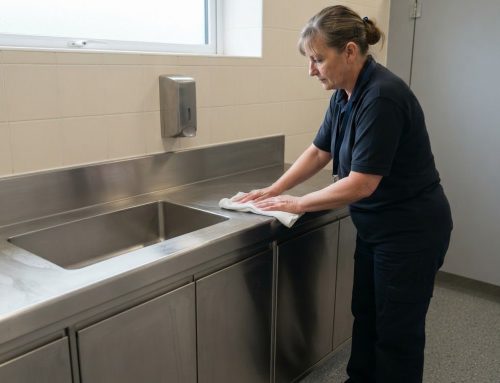

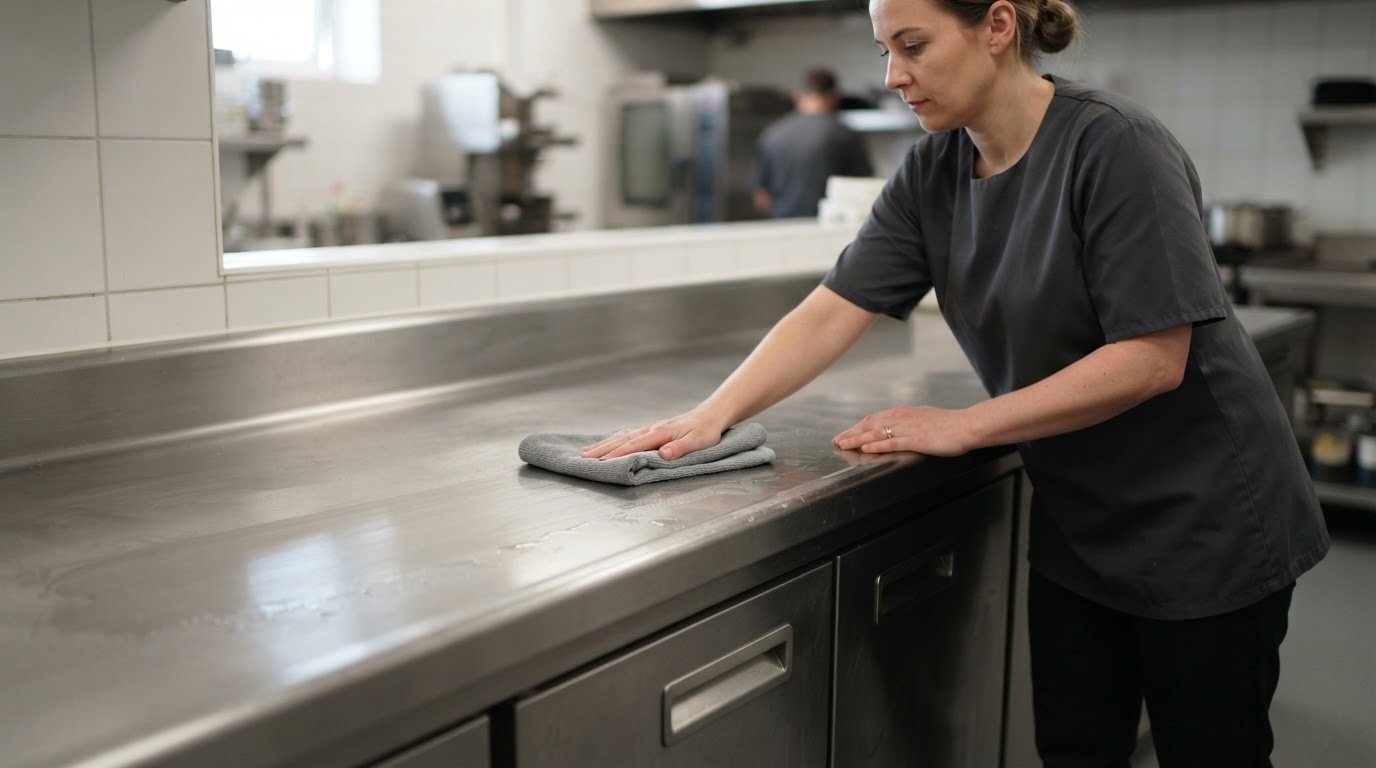
A multipurpose cleaner isn’t automatically suitable for every kitchen finish. For easy to clean commercial kitchen surfaces, follow the material’s care instructions and use only cleaners permitted for that surface. Smooth, impermeable work surfaces support straightforward cleaning, while an unsuitable product or method can leave marks or damage the finish.
A busy kitchen needs routines that are effective and repeatable, but one product or technique won’t suit every wall, worktop and fitting. This matters especially on stainless steel, where residue can dull the finish and streaks can make a cleaned area look unfinished. Choosing a suitable cleaner and cloth helps protect both the surface and its appearance.
This guide explains how to assess whether a multipurpose cleaner is suitable, clean kitchen walls and stainless steel carefully, and use reusable microfibre cloths for a streak-free result. It also covers practical ways to choose surfaces that simplify daily upkeep, without abrasive methods or unnecessary products.
Key Takeaways
- Choose cleaning products and methods to suit each surface, and use a clean microfibre cloth to help reduce streaks.
- Understand how porosity and fluid absorption affect cleaning, residue and the upkeep a worktop requires.
- Clean and polish stainless steel with care to preserve its finish and avoid surface damage.
- Compare worktop materials by their smoothness, impermeability and practical cleaning needs before selecting one for a foodservice setting.
- The UK legislation register identifies the Fire Safety Order (2005) as relevant to demonstrating due diligence for commercial kitchen grease removal.
Avoiding streaks and surface damage
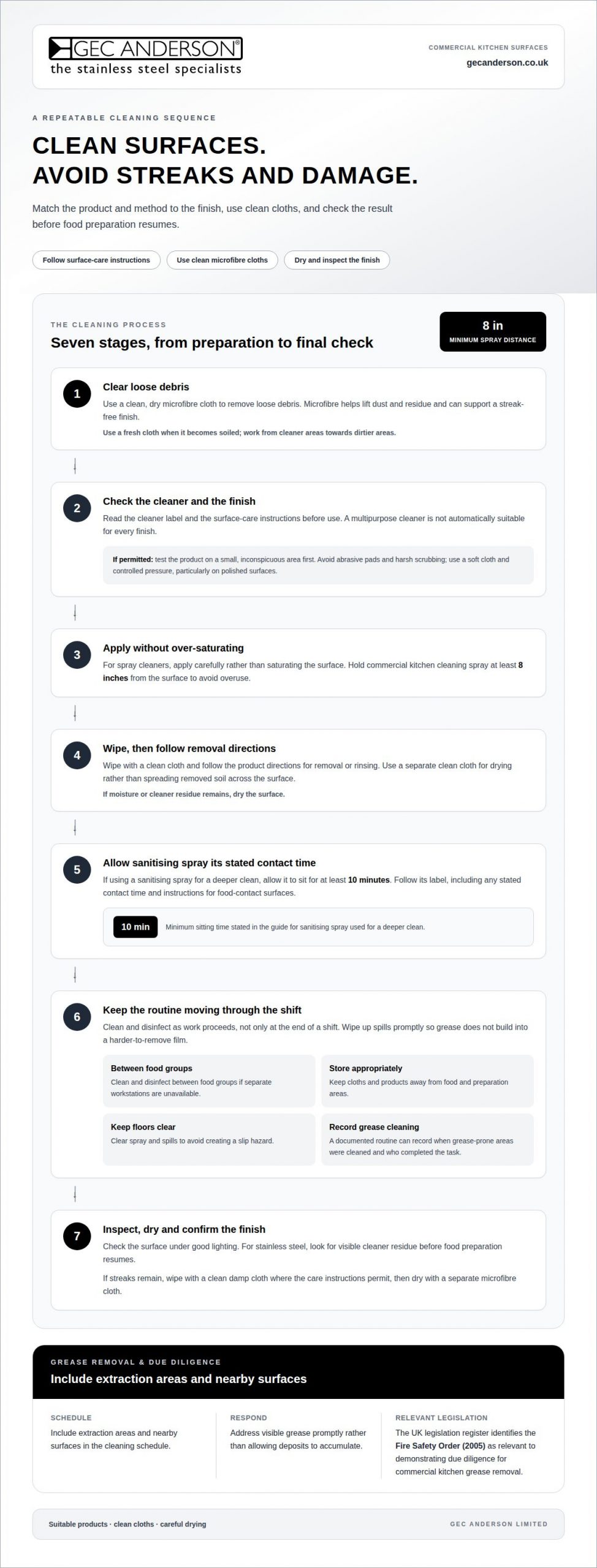
Streaks often remain when cleaner or grease residue is left behind. Remove loose debris with a clean, dry microfibre cloth, then use a suitable cleaning product according to its label. Microfibre helps lift dust and residue and can support a streak-free finish. Use a separate clean cloth for drying, rather than spreading removed soil across the surface.
Multipurpose cleaner is not suitable for every finish by default. Read the product label and surface-care instructions before use. If permitted, test it on a small, inconspicuous area first. Avoid abrasive pads and harsh scrubbing, which can scratch or dull a finish. For routine wiping, use a soft cloth and controlled pressure, particularly on polished surfaces.
For spray cleaners, apply the product carefully rather than saturating the surface. Commercial kitchen cleaning spray should be held at least 8 inches from the surface to avoid overuse. Wipe with a clean cloth, following the product directions for removal or rinsing. If a sanitising spray is used for a deeper clean, allow it to sit for at least 10 minutes. Follow its label, including any stated contact time and instructions for food-contact surfaces.
Clean and disinfect surfaces as work proceeds, not only at the end of a shift. Wipe up spills promptly so grease does not build into a harder-to-remove film. If separate workstations are unavailable, clean and disinfect between food groups. These steps support hygiene and reduce the chance of residue transferring between tasks. Store cleaning cloths and products appropriately, away from food and preparation areas.
- Use a fresh cloth when one becomes soiled, rather than continuing to spread grease.
- Work from cleaner areas towards dirtier areas to limit residue transfer.
- Dry the surface after cleaning if moisture or cleaner residue remains.
- Keep floors clear of spray and spills, which can create a slip hazard.
Grease removal also has a due-diligence aspect. The UK legislation register identifies the Fire Safety Order (2005) as relevant to demonstrating due diligence for commercial kitchen grease removal. A documented cleaning routine can help staff record when grease-prone areas were cleaned and who completed the task. Include extraction areas and nearby surfaces in the schedule, then address any visible grease promptly rather than allowing deposits to accumulate.
Finish by checking the surface under good lighting. For example, a stainless steel panel should be free of visible cleaner residue before food preparation resumes. If streaks remain, wipe with a clean damp cloth where the care instructions permit, then dry with a separate microfibre cloth. Suitable products, clean cloths and careful drying help protect finishes through repeated cleaning.
Porosity and fluid absorption
Smooth, impermeable finishes help limit places where dirt and bacteria can collect. Tight, sealed joints also reduce crevices that trap food residue. Where practical, choose surfaces with continuous edges and keep seams accessible for routine cleaning.
Porosity describes how readily a material allows liquid to enter its surface. On a porous worktop, spilled water, oil or food liquid may penetrate rather than remain on top. This can make marks harder to remove and cleaning more complicated. On a less porous finish, residue remains more accessible to wiping, provided the surface is maintained correctly.
Absorption affects both cleaning and the choice of chemicals. A liquid cleaner can soak into an absorbent material before it can be wiped away, leaving residue behind. On a smooth, impermeable surface, cleaner and soil generally stay at the surface, where the cleaning method can remove them. The same logic applies across wider commercial infrastructure, where surface specialists such as Vic Concrete Polished focus on sealing and preparing floor substrates to prevent liquids from penetrating porous concrete. Always follow the product label and surface-care instructions: even a low-absorption finish can be damaged by an aggressive chemical.
Assess the whole work area, not just its central surface. A joint between a worktop and wall can collect crumbs or splashes if it forms a narrow gap. Rough edges, cracks and damaged sealant can also hold moisture and soil. For example, a smooth panel with an open seam may be harder to keep clean than a sound, sealed surface with an accessible junction.
- Check the finish: favour smooth surfaces without open pores, deep texture or visible damage.
- Inspect joints: look for gaps around edges, wall junctions and fitted components.
- Clean spills promptly: remove liquids before they dry or settle into seams.
- Use suitable products: match chemicals and cloths to the material’s care instructions.
Wood illustrates why porosity matters. Wooden worktops and cutting surfaces can require extensive treatment to improve their hygienic condition. Upkeep depends on the surface treatment and its condition, so a worn or damaged area may need different care from an intact finish. By contrast, smooth, impermeable surfaces support straightforward wiping because spills and residue remain on top rather than entering open pores.
After cleaning, inspect corners, joints and edges for moisture or residue. If a cloth catches on a seam or leaves visible soil behind, use an appropriate tool that reaches the area without abrading the finish. Forcing liquid repeatedly into a gap will not remove the cause of the build-up.
For foodservice layouts, considering surface design for commercial kitchens alongside cleaning routines can help address joints and edges at the planning stage.
Stainless steel cleaning and polishing
For stainless steel and other commercial kitchen surfaces, use a cleaner permitted by the product label and the finish’s care instructions. A soft cloth, careful rinsing where directed and thorough drying help remove soil without leaving abrasive marks or cleaner residue.
Start by checking the surface. Brushed stainless steel has a visible grain, so wipe in the same direction rather than across it. Consistent strokes make remaining smears easier to spot. On a long worktop, for example, follow the grain from one end to the other instead of scrubbing in circles.
- Remove loose soil: lift crumbs and other debris with a clean, soft cloth before applying liquid cleaner.
- Apply a suitable cleaner: use a product labelled for stainless steel, following its dilution and application instructions.
- Wipe methodically: move with the grain and use a fresh section of cloth as it collects grease.
- Rinse if directed: remove cleaner traces as the label instructs, especially where the surface meets food preparation.
- Dry fully: use a separate clean cloth to prevent water marks and reveal any remaining streaks.
Avoid abrasive pads, scouring powders and rough wire wool on polished stainless steel. They can scratch the finish and leave marks that collect soil during kitchen work. A soft microfibre cloth is gentler for lifting dust and residue. If a cloth picks up grease, replace it rather than spreading that residue across the panel.
Polishing is a finishing step, not a substitute for cleaning. First remove food soil and cleaner residue; then use stainless-steel polish only if its label allows the intended application. Apply a small amount to the cloth rather than flooding the surface. Buff evenly with the grain, using a clean part of the cloth to remove excess. Too much polish can leave a film that attracts dust or transfers onto nearby utensils.
Different finishes need different methods. A multipurpose product suitable for a wall may not suit a painted panel, sealed worktop or plastic fitting. Check the product label and surface-care instructions, and test in an inconspicuous spot if permitted. Stop if the surface changes colour, becomes dull or feels tacky, then follow the finish’s recommended cleaning method.
At the end, inspect corners, seams and splash zones under good light. A stainless-steel sink, for instance, may look clean in the centre while grease remains near its rim. Remove the residue with a suitable cloth and cleaner, then dry the area. Consistent strokes with the grain and clean cloths help preserve the finish and support a repeatable hygiene routine.
Which materials are best for commercial kitchen worktops in the UK?
The right worktop material depends on the tasks, cleaning routine and finished construction. For foodservice, prioritise a resistant, smooth, impermeable surface to support hygienic cleaning. When specifying easy to clean commercial kitchen surfaces, assess the material together with details around edges, joins and cut-outs.
Stainless steel is a practical option for a working kitchen. Consider where preparation, washing and storage take place, then plan the worktop around those tasks. The finish and connections to sinks or walls affect routine cleaning. An accessible edge, for example, is simpler to wipe than a narrow gap that traps food residue. Choose a material suited to the work area, not just the kitchen’s overall appearance.
Quartz and granite are examples of man-made and natural stone worktops. Stone worktops have smooth, impermeable surfaces that can increase resistance to viruses and bacteria. Compare the installed finish and junctions as well as the stone itself. A cleanable central area does not remove the need to consider seams, edges and cut-outs, where soil can collect during food preparation.
Solid-surface worktops are another option to assess by finish and construction. Check how adjoining sections meet and whether transitions create ledges or crevices. Cleaning products must also suit the specific finish. Appearance alone does not establish cleaning requirements, so include the care instructions in your material decision.
Wood needs particular consideration. Wooden worktops and cutting surfaces can require extensive treatment to improve their hygienic condition. Their suitability depends on the treatment and the condition the kitchen can maintain. If choosing wood, consider how it will be cared for during regular use, especially in areas exposed to food liquids.
- Compare finishes: prioritise resistant, smooth and impermeable surfaces.
- Assess the whole installation: include edges, joins, cut-outs and wall junctions.
- Match the worktop to its use: account for preparation, washing and cleaning routines.
- Review care requirements: select a finish compatible with the products and methods used.
Easy to clean commercial kitchen surfaces are a design consideration as well as a material choice. First map the work areas and cleaning priorities, then compare stainless steel, stone, solid surface and treated wood against them. This helps identify finishes or construction details that could complicate upkeep. A well-considered specification connects the worktop to its setting and gives staff a practical surface to maintain throughout kitchen operations.
Choose a resistant, smooth, impermeable finish, and assess edges, joins, cut-outs and wall junctions because they affect cleaning. Match the material to the work area and cleaning routine, and check that its care requirements suit the products and methods used.
How do stainless steel, quartz, granite and solid-surface worktops compare for hygiene and cleaning?
Stainless steel, quartz, granite and solid-surface worktops differ in finish, construction and care requirements. Resistant, smooth and impermeable worktop materials support hygienic cleaning. Compare the surface with its edges, joins and cut-outs, since these details affect how easily food residue can be removed.
Stainless steel provides a smooth, wipeable working surface when maintained appropriately. Its visible grain guides the cleaning technique: wiping in the direction of the grain helps keep the finish even. The material is not the only consideration. A worktop with accessible joins and carefully formed edges is easier to clean than one with awkward gaps around a sink or wall.
Quartz and granite are examples of stone worktops. Stone kitchen worktops, whether man-made or natural, have smooth, impermeable surfaces that can increase resistance to viruses and bacteria. Assess the installed finish rather than assuming every stone surface behaves identically. A flat area may be straightforward to wipe, while joints, seams and cut-outs still need attention.
Assess solid-surface worktops by their actual finish and construction. Check how adjoining sections meet and whether transitions create ledges or crevices. Cleaning suitability depends on the surface-care instructions and products used. A cleaner appropriate for one material may not suit another, so follow the relevant product and finish guidance.
- Stainless steel: follow the grain and inspect edges and fitted junctions.
- Quartz: assess the finish and clean around seams and cut-outs.
- Granite: consider its smooth, impermeable surface alongside joint details.
- Solid surface: examine transitions between sections and follow care instructions.
For all four materials, hygiene depends on a consistent cleaning method as well as the worktop choice. Remove food soil, use a suitable cleaner and pay attention to where sections meet. The perimeter around a sink, for example, can collect residue even when the central preparation area looks clean. Avoid abrasive methods that could mark the finish and make routine wiping less straightforward.
Choose according to the kitchen’s tasks, cleaning routine and preferred appearance. Stainless steel may suit a scheme seeking a coordinated metal work surface, while stone offers a different visual character. Solid surface is another material to consider. In each case, smoothness, impermeability, care instructions and the treatment of joints are more useful comparisons than appearance alone.
Planning a foodservice work area? Explore stainless steel worktop options as part of your material comparison.
Regularly cleaning kitchen surfaces is recommended as a hygiene practice. When measuring a stainless-steel splashback, include a 2-3mm gap to allow for expansion. To loosen microwave stains, heat a microwave-safe bowl containing roughly two cups of water on full power for 2-3 minutes. In commercial kitchens, steel toe kicks below equipment do not completely prevent dirt from entering underneath, and deep-cleaning work is accompanied by Commercial Kitchen Hygiene Certification for record keeping. Facilities managing rigorous sanitation regimes often turn to professional commercial cleaning specialists, such as indlovuhygiene.co.za, to handle intensive degreasing and deep-cleaning requirements.
GEC Anderson Limited
GEC Anderson Limited supplies stainless steel surfaces and storage to suit foodservice layouts and cleaning priorities. Its range includes worktops, sinks, cabinets and doors, and shelving, available as standard, modular or made-to-measure products for different project scales.
Consider these products when planning a new preparation area, replacing a worn surface or coordinating worktops with adjoining storage. Thinking through how staff use and clean each area can help shape a practical specification, including sink placement and the relationship between work surfaces and shelving.
For a project where cleanable stainless steel surfaces are a priority, contact GEC Anderson Limited to discuss your requirements.
Plan surfaces around the way your kitchen works
The next step is to turn cleaning priorities into a clear surface specification. Map preparation, washing and storage zones against how staff move through the kitchen. This helps identify where finish, junctions and adjoining fittings need particular attention before decisions are fixed in the layout.
For easy to clean commercial kitchen surfaces, consider how worktops connect with sinks and storage rather than treating each element separately. GEC Anderson Limited supplies Stainless Steel Worktops, Stainless Steel Sinks and Stainless Steel Cabinets & Doors. These products can bring key working areas into one considered specification, whether the project involves a new kitchen or changes to an existing space.
A considered plan gives the team a practical basis for selecting materials and organising cleaning routines around the finished space. If you’re developing a foodservice project, Contact GEC Anderson Limited to discuss your requirements and take the next step with confidence.
Frequently Asked Questions
What commercial kitchen surfaces are easiest to clean and maintain?
Smooth, resistant and impermeable surfaces are generally the most straightforward to clean and maintain. Stainless steel and stone worktops can suit this approach when their finishes and joints remain in good condition. An accessible worktop edge, for example, is easier to wipe than a junction with a narrow gap. Also consider the cleaning products used in your kitchen and select a finish whose care instructions fit your routine.
What are the risks of porous, damaged or poorly sealed kitchen surfaces?
Porous, cracked or poorly sealed surfaces can let liquids and food residue enter gaps or remain in hard-to-reach areas. This makes thorough cleaning more difficult and can increase the risk of contamination if residue is left behind. A damaged edge near a sink, for instance, may collect moisture and soil. Inspect these areas during routine cleaning, and address surface damage or failed seals as part of planned maintenance.
How should you choose commercial kitchen surfaces for durability, heat resistance and easy cleaning?
Choose resistant, smooth, impermeable surfaces with sound, accessible joints so spills and residue are easier to wipe away. Match cleaning products and methods to each material’s care instructions. The material provided does not give a basis for comparing heat resistance.
What are the UK food hygiene requirements for commercial kitchen walls, floors and work surfaces?
Commercial kitchen premises and equipment must be kept clean to prevent contamination under the Food Safety Act and General Hygiene Regulations. Clean and disinfect surfaces as work proceeds, wipe spills promptly, and clean and disinfect between food groups when separate workstations are unavailable.