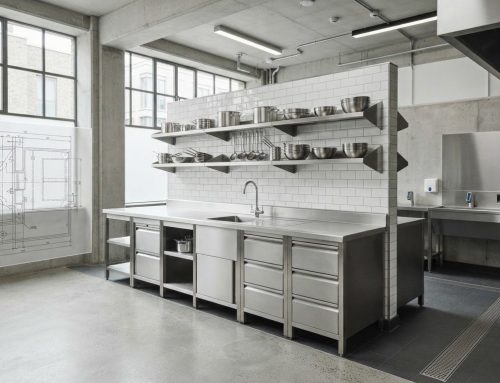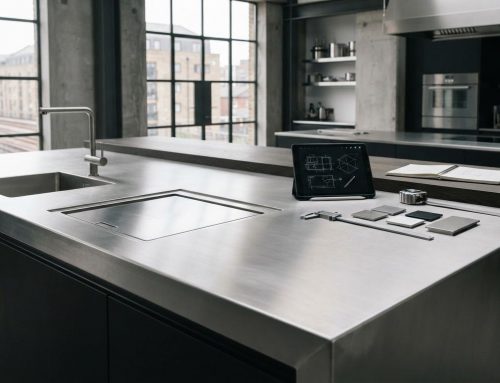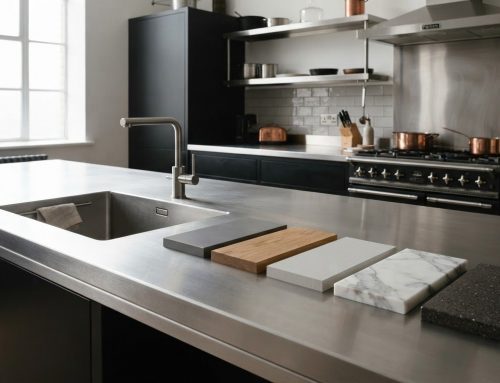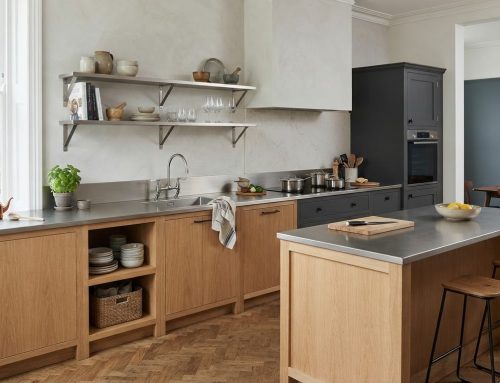

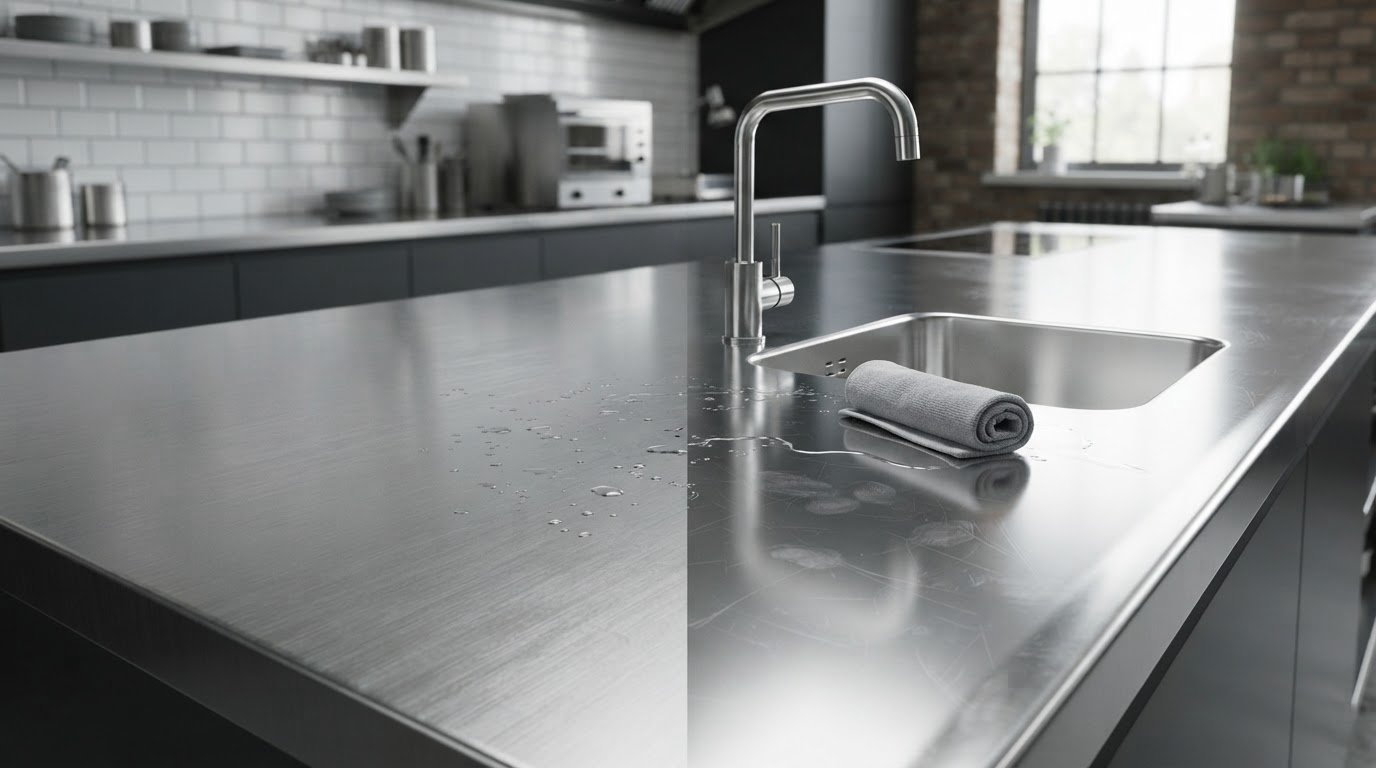
The finish that looks immaculate on installation day may demand the most attention once a sink is in daily use. In the choice between brushed vs polished stainless steel sinks, polished steel offers immediate brightness, but its reflective surface makes fingerprints, water spots and fine scratches more apparent. Brushed satin has a visible grain that helps soften the evidence of everyday use, making it a considered professional standard for longevity.
It’s understandable to weigh the polished finish’s crisp, reflective character against concerns about marks and ongoing care. Neither finish is automatically right for every project: the decision depends on traffic, design intent and the level of maintenance expected. For brushed satin, care is straightforward but precise: rinse with cold water, dry with a soft cloth and clean in the direction of the grain.
This guide explains how the finishes differ in appearance, scratch visibility and upkeep, then applies those distinctions to residential, commercial and high-end settings. You’ll have a clear framework for specifying a sink that suits the architecture and performs reliably over time, including where a sink seamlessly integrated into a made-to-measure stainless steel worktop may support a more cohesive design.
Key Takeaways
- Compare brushed vs polished stainless steel sinks by how each finish handles visible marks and supports the visual intent of your project.
- Understand the distinction between EN 1.4301 (304) and EN 1.4401 (316) to assess which grade suits the environment.
- Match the finish to the demands of healthcare, science, commercial or hospitality settings rather than choosing on appearance alone.
- Maintain brushed satin by rinsing with cold water, drying with a soft cloth and cleaning along the grain.
- Consider how a made-to-measure sink integrated into a stainless steel worktop can create a cohesive, seamless surface.
Defining the Finishes: Brushed vs Polished Stainless Steel
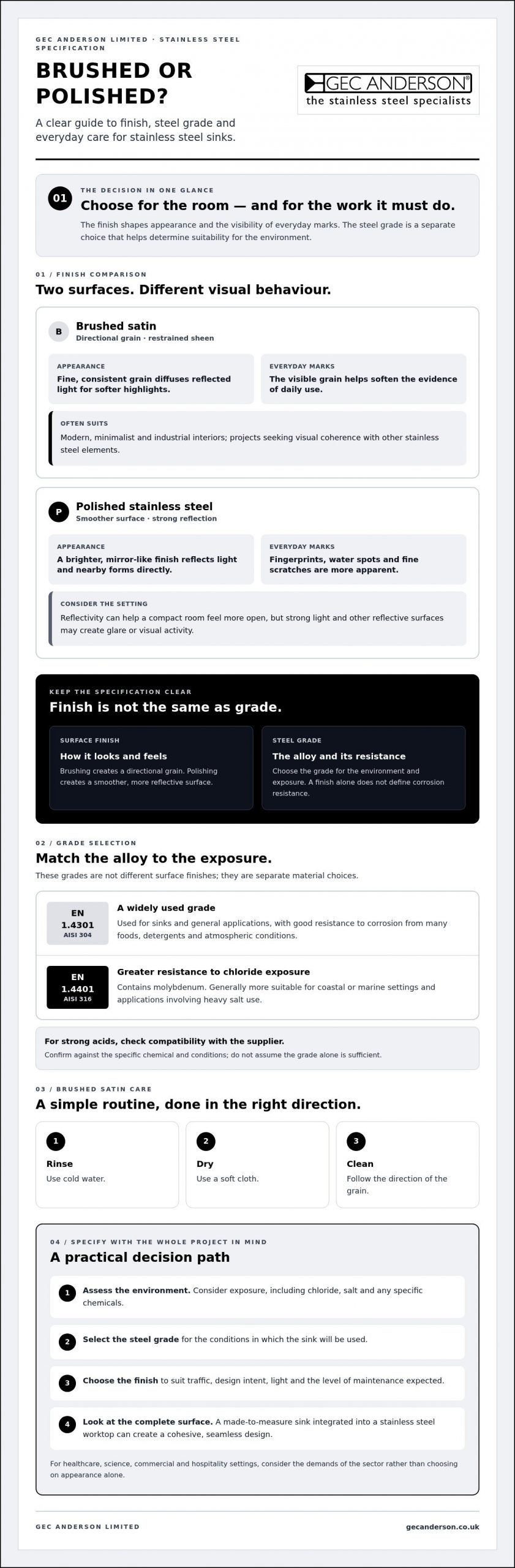
The distinction between brushed vs polished stainless steel sinks is primarily a matter of surface treatment and appearance, not steel grade. Brushed satin has a fine, directional texture; polished stainless steel has a smoother, highly reflective surface. Both can be specified in stainless steel, but they behave differently in the visual composition of a kitchen or washroom.
Brushed metal describes a surface given a consistent grain through mechanical abrasion. On a sink, that grain creates a restrained sheen rather than a mirror finish. Polishing smooths the surface to produce a brighter reflection. The precise process matters: a finish does not, by itself, define the steel’s corrosion resistance, which also depends on the grade and how the material is manufactured and treated.
The Aesthetic of Brushed Satin
A brushed satin surface is identified by its uniform, directional grain. It gives stainless steel visible texture without making the sink visually dominant. Because the grain diffuses reflected light, highlights appear softer and less sharply defined than on a mirror-polished surface.
This measured quality suits modern, minimalist and industrial interiors, where materials are often selected for clarity, function and visual coherence. It also works well alongside other stainless steel elements, such as worktops or splashbacks, creating a consistent material language without introducing a strong reflective focal point. For projects that prioritise a composed appearance over brilliance, brushed satin is widely regarded as the professional standard.
The Impact of Mirrored Polishing
Polished stainless steel reflects light and nearby forms more directly. In a compact room, that reflectivity can contribute to a sense of openness, particularly where the sink receives natural or carefully positioned artificial light. In a residential setting, the bright, mirror-like finish may also suggest a more formal or luxurious character.
That effect requires considered placement. Strong daylight, task lighting or multiple reflective surfaces can create glare, while reflections of taps, objects and surrounding finishes may add visual activity. A polished sink can therefore be an intentional focal point, but it may be less suited to a space designed around subdued finishes and low visual contrast.
For specification, assess the sink as part of the whole room rather than as an isolated sample. Consider the direction and strength of light, the surrounding materials, and whether the design calls for a quiet satin surface or a brighter reflective accent. These aesthetic distinctions set the context for comparing daily performance and maintenance in the sections that follow.
The Technical Distinction: Material Grades and Surface Treatment
Finish and steel grade are separate specification choices. The finish describes the surface texture and appearance; the grade identifies the alloy and its resistance to corrosion. Comparing brushed vs polished stainless steel sinks on appearance alone can therefore miss a critical question: whether the chosen steel suits the environment in which the sink will be used.
Mechanical finishing uses abrasives to create a directional grain or a smoother, more reflective surface. Chemical and electrochemical polishing use chemical processes to alter and smooth the surface rather than forming a grain with abrasion. The exact process varies by manufacturer. Finishing can influence surface condition and how susceptible it is to localised corrosion, but it doesn’t replace the protection provided by choosing an appropriate grade. Stainless steel’s passive surface layer can also be affected by contamination or damage, so manufacturing and care both matter.
Steel Grades for Specialist Environments
EN 1.4301 (AISI 304) is a widely used grade for sinks and general applications, offering good resistance to corrosion from many foods, detergents and atmospheric conditions. EN 1.4401 (AISI 316) contains molybdenum, which improves resistance to chloride exposure. It is generally the more suitable choice for coastal or marine settings and applications involving heavy salt use. For strong acids, confirm compatibility with the supplier against the specific chemical and conditions, rather than assuming a grade alone is sufficient.
Point-etching risk depends on the environment, alloy and surface condition. A smooth, well-finished surface can support cleanability, but neither brushed nor polished treatment makes an unsuitable grade immune to corrosion. Specify the alloy for the exposure first, then select the finish for appearance and use.
Manufacturing Precision and Grain Direction
On a brushed surface, grain direction is a deliberate part of the finish. Abrasive work that crosses it can leave visible marks, so the grain should be considered during manufacture and followed during cleaning. For GEC Anderson’s made-to-measure worktops and sinks, ask how the finish will be aligned across adjoining surfaces and around the bowl. Internal corners are particularly demanding: their geometry makes it harder to maintain an even appearance than on a broad, flat panel.
Sheet thickness is another specification, not a finish. In the 1 mm to 2 mm range, gauge affects stiffness and the way a component may respond to forming; it doesn’t determine whether the surface is brushed or polished. The appropriate thickness depends on the component’s design and construction, so confirm it for the particular specification rather than using gauge as a proxy for finish quality.
For made-to-measure stainless steel worktops and sinks, review the intended grade, finish and junction details together. GEC Anderson stainless steel products provide a starting point for considering how these choices can be coordinated.
Maintenance and Longevity: The Reality of Daily Use
Daily use leaves traces on every stainless steel sink. On brushed satin, the directional grain helps disguise fine scratches, allowing small marks to blend into the surface and develop as a restrained patina. Polished steel reflects more sharply, so fingerprints, water spots and scratches tend to stand out. That difference in visibility affects the sink’s appearance over time, not the underlying grade of steel.
Stainless steel can serve for decades with appropriate care. GEC Anderson gives a typical product life-cycle of 50 years, but preserving the finish depends on consistent maintenance. The following protocol is specific to its products and should take precedence over generic cleaning advice.
The GEC Anderson Care Protocol
- Rinse with cold water only. Never use warm or hot water. Follow this instruction to help prevent discolouration.
- Dry with a soft cloth. Don’t leave the surface to air-dry, as remaining water can leave visible marks or deposits.
- Clean along the grain. Wiping in the direction of the brushed finish helps maintain its uniform appearance; cleaning across it can create conspicuous marks.
These habits are simple, but consistency matters. Rinse away residue with cold water, then dry the sink rather than allowing droplets to evaporate on the surface.
Dealing with Scratches and Rust Stains
Rust-coloured marks on stainless steel may come from carbon steel objects, such as metal utensils or tools, that leave iron particles behind. The stain can therefore be surface contamination rather than corrosion originating in the sink itself. Remove the foreign source and address the mark carefully, rather than reaching immediately for an abrasive cleaner.
For persistent stains on a brushed surface, use a dry nylon-fibre brush gently and work with the grain. Avoid scrubbing across the grain, which can leave a visible change in texture. If the mark remains, seek product-specific guidance before trying a stronger method.
Polished surfaces need particular restraint. Attempting to buff out a scratch can change the surrounding sheen, leaving a dull or uneven patch that’s more noticeable than the original mark. Don’t assume the surface can be restored with a household polishing product; check the manufacturer’s care advice first. In the practical comparison of brushed vs polished stainless steel sinks, brushed satin is often the more forgiving choice for busy spaces because everyday marks are less visually prominent.
Choosing the Right Finish for Your Sector
Finish selection should reflect how a sink will be used, cleaned and seen in its setting. Brushed satin is often a practical choice where frequent use makes marks and reflections distracting; polished steel may suit a residential design where a bright, reflective accent is intentional. Neither finish alone determines hygiene or durability. Steel grade, detailing, cleaning procedures and exposure to chemicals all matter.
Healthcare, Science and Public Environments
In healthcare and laboratory settings, specify for cleanability and compatibility with the intended cleaning regime, rather than assuming a particular finish is inherently aseptic. Brushed satin offers a consistent, low-glare surface that can be easier to live with under strong task lighting. Stainless steel is used in demanding environments, but cleaning performance depends on sound design and maintenance as well as the material itself.
Where a sink meets a worktop, carefully detailed seamless integration can minimise crevices where residue may collect. It doesn’t remove the need for established cleaning procedures, and the selected steel grade and finish should be checked against the chemicals used on site. In education, transport and other public spaces, a subdued surface can also reduce distracting reflections. Stainless steel is robust, but no finish should be described as vandal-proof; specify for the expected level of use and maintenance.
Commercial and Hospitality Settings
Busy kitchens and wash-up areas put surfaces under repeated use and cleaning. Brushed satin helps make minor scratches and water marks less conspicuous, supporting a consistent appearance between cleaning cycles. For more corrosive conditions, such as heavy salt exposure, consider whether EN 1.4401 (316) is appropriate; finish and grade are separate decisions. Polished steel can provide a striking feature, though visible marks may call for more frequent attention.
Residential Refinement
At home, the choice is often a balance between visual effect and everyday practicality. Brushed satin has a softer, more tactile character that sits comfortably with contemporary materials and can feel warmer than a mirror-like surface. Polished steel creates a crisp, luminous accent, but can appear visually cool and reflect nearby objects and light. Architects often favour brushed satin where the aim is an enduring rather than highly reflective finish.
For a coordinated scheme, consider how bespoke stainless steel kitchen worktops can relate to the sink in finish, grain direction and detailing. A carefully planned junction can give the kitchen a coherent material expression.
Assess the intended use, lighting, cleaning products and design language together before specifying. Explore stainless steel sinks and worktops when considering brushed satin for your project.
The GEC Anderson Standard: Excellence in Brushed Satin
GEC Anderson specialises in brushed satin stainless steel sinks and worktops, treating the finish as part of the specification rather than a decorative afterthought. Its directional grain gives the surface a consistent, restrained appearance across adjoining elements. For architects comparing brushed vs polished stainless steel sinks, this focus on finish quality and visual continuity is central to the brand’s approach.
The company’s Series A bowls can be considered alongside made-to-measure worktops, allowing the sink and surrounding surface to be planned as one composition. Integration can reduce the visual interruption of a separate rim and create a cleaner junction. The precise construction and cleaning implications depend on the design, so confirm how the bowl meets the worktop and how the junction should be maintained for the intended environment.
Seamless Engineering
Where sink and worktop are designed together, attention to the junction helps determine both appearance and practical cleanability. A carefully resolved connection can avoid prominent breaks in the surface and support a coherent brushed grain. The finished result depends on accurate fabrication and control of the surface treatment around the bowl, where curves and internal corners make consistency more demanding than on a flat panel.
Explore made-to-measure stainless steel sinks as part of the worktop specification. Before finalising a project, request drawings that show dimensions, junction details and grain direction, then check these against the surrounding layout and cleaning requirements.
Specifying Your Project
A robust specification should identify more than the sink’s overall dimensions. Confirm the stainless steel grade, brushed satin finish, sheet thickness and intended method of integration. Thickness affects the component’s construction, but an assumed gauge range shouldn’t be treated as a universal standard. Ask which options apply to the particular sink and worktop design.
For a bespoke unit, review fabrication drawings before production to verify bowl position, edge details and interfaces with adjoining surfaces. Clarify how the grain will run across connected components and how the finished junction is intended to be cleaned. These checks help resolve practical details early, while the design can still accommodate them.
GEC Anderson has specialised in stainless steel products since 1962. To discuss how brushed satin, bowl selection and worktop integration might suit a project, contact GEC Anderson about stainless steel sinks and worktops.
Specify a Finish That Performs for the Long Term
The choice between brushed vs polished stainless steel sinks is more than an aesthetic decision. Brushed satin softens the visibility of everyday marks and offers a composed, practical finish; polished steel brings greater reflectivity, but calls for more attention to fingerprints, water spots and scratches. Specify the steel grade for the environment, then assess the finish alongside lighting, use and maintenance requirements.
For projects where continuity matters, a made-to-measure sink integrated with a stainless steel worktop can create a considered, cohesive surface. GEC Anderson’s ISO 9001-certified manufacturing and experience supplying projects including Guy’s Hospital and the National Gallery provide relevant context for specification. Its typical product life-cycle is 50 years, reinforcing the value of considering long-term performance as well as the initial appearance.
Ready to discuss dimensions, finish and integration for your project? Request a technical quotation for bespoke brushed stainless steel sinks. With the right specification and careful maintenance, you can select a sink that serves its setting with lasting clarity and purpose.
Frequently Asked Questions
Is brushed or polished stainless steel better for hiding scratches?
Brushed stainless steel is generally better at disguising fine scratches because its directional grain softens their appearance. On a polished surface, the stronger reflections can make scratches and other marks more noticeable. Neither finish prevents damage, and results depend on use and care. If a sink will see frequent daily use, brushed satin is often the more forgiving choice for maintaining a consistent appearance over time.
Why does GEC Anderson recommend only cold water for rinsing sinks?
Cold water is the specified rinsing method in GEC Anderson’s care instructions, so use it after cleaning or applying a permitted treatment. Rinse thoroughly to remove cleaning material or residue, then dry the sink carefully with a soft cloth. Don’t use warm or hot water, and don’t leave the surface to air-dry. Following the prescribed method helps you care for the surface consistently and avoid residue-related discolouration.
Can I use vinegar to remove calcium deposits on brushed stainless steel?
Yes. Vinegar is one of the stated options for removing calcium deposits from stainless steel. Apply it carefully, following the grain, and don’t leave the solution in contact with the surface longer than necessary. Afterwards, rinse thoroughly with cold water and dry with a soft cloth. The same care instructions also list 10% acetic acid and diluted nitric acid at one part acid to four parts water; handle strong acids with care and good ventilation.
What is the difference between 304 and 316 grade stainless steel for sinks?
EN 1.4301, commonly referred to as AISI 304, is a widely used domestic grade with good resistance to many foods, detergents and atmospheric conditions. EN 1.4401, or AISI 316, includes molybdenum and offers greater resistance to chloride exposure, making it a consideration for coastal settings or heavy salt use. Choose the grade for the sink’s environment and exposure, not according to whether its finish is brushed or polished.
Does a polished finish make a stainless steel sink more hygienic?
No. A polished appearance doesn’t, by itself, make a sink more hygienic than a brushed finish. Hygiene depends on the material, sound design, cleaning and maintenance. A well-detailed sink and worktop junction can reduce crevices where residue may collect, whilst the appropriate cleaning procedure remains essential. For healthcare, laboratory or food-related settings, assess the steel grade, construction details and cleaning regime against the requirements of the specific application.
How do I remove persistent rust stains from a brushed steel surface?
For rust stains that have persisted, GEC Anderson’s care guidance specifies using a dry nylon-fibre brush or diluted nitric acid at one part acid to four parts water. Work with the grain, then rinse thoroughly with cold water and dry with a soft cloth. If using nitric acid, ensure good ventilation and follow the usual precautions for strong acids. Rust marks can originate from iron or carbon steel contamination, rather than the sink itself.
What is the typical lifespan of a GEC Anderson stainless steel sink?
GEC Anderson gives a typical product life-cycle of 50 years for its stainless steel products. This is a typical life-cycle, not a guarantee that every sink will last for exactly that period. The actual service life can depend on the specification, environment, frequency of use and maintenance. Regular care matters: rinse with cold water, dry with a soft cloth and, on brushed satin, clean in the direction of the grain.
Are brushed stainless steel sinks more expensive than polished ones?
There isn’t enough information here to say that brushed sinks are always more expensive than polished ones. Price depends on the particular specification, including the steel grade, dimensions, construction and whether the sink is standard or made to measure. The finish is one consideration, but it doesn’t determine the overall price on its own. For an accurate comparison, request quotations based on the same dimensions, material grade and integration details.