
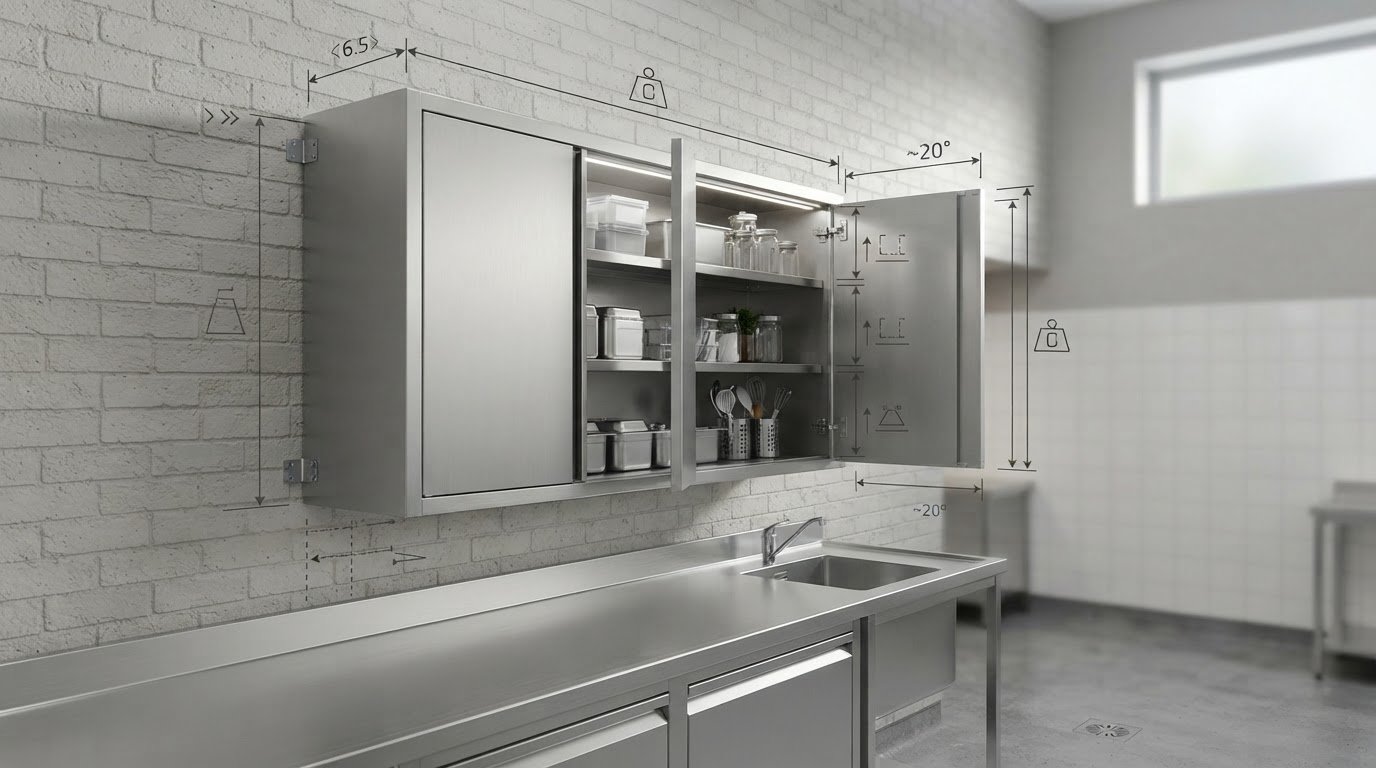
Could a cabinet that fits the drawing still be unsuitable for the wall? Wall mounted stainless steel cabinets need to be specified for their intended use, available space and fixing conditions, not by dimensions alone.
Start with the width, height, depth and storage arrangement, then check the wall construction, proposed fixings, cabinet contents and clearances. Confirm these details before installation, rather than leaving them to be resolved on site.
This guide explains how to compare standard and made-to-measure cabinets, prepare a practical specification and identify what to confirm with a supplier. It covers dimensions, configuration, material grade, wall suitability and installation requirements.
GEC Anderson supplies standard and made-to-measure stainless steel cabinets and doors, with pre-production CAD drawings for client approval. Knowing what to include in your brief makes it easier to review a proposed design against the project’s needs.
Key Takeaways
- Define the cabinet’s purpose, location and storage needs before comparing options.
- Compare wall cabinets with shelving and floor-standing storage by considering access, visibility and use of space.
- Check product documentation for construction and material details, and confirm the grade and configuration with the supplier.
- Record site dimensions and constraints, then confirm wall suitability, fixings, load ratings and installation requirements.
- Consider standard or made-to-measure supply, and review pre-production CAD drawings against the brief before approving them.
What to assess before choosing wall mounted stainless steel cabinets
Begin with the job the cabinet needs to do. A wall mounted stainless steel cabinet is an enclosed storage unit fixed to a wall, intended to keep selected items organised and accessible without occupying floor space. Define its contents and how often they will be used. Frequently accessed items may need a different position and arrangement from items retrieved occasionally.
Wall cabinets, open shelving and floor-standing units serve different purposes. A cabinet conceals its contents behind doors; shelving keeps items visible and readily accessible; a floor-standing cabinet provides storage at ground level but uses floor area. The right option depends on access, available space and how the storage relates to work surfaces, sinks and other equipment. Check that an open door will not obstruct a working area or interfere with movement.
Which environments may call for stainless steel wall cabinets?
Potential applications include kitchens, washrooms, laboratories and other professional settings, as well as residential spaces. These examples do not mean that every cabinet suits every environment. Consider the activities carried out in the room, who will use the cabinet and what it needs to store. In a laboratory, for instance, assess the working routine and nearby equipment. In a washroom, consider what users need to reach and how much wall space is available.
Stainless steel is a corrosion-resistant steel alloy, but it is not immune to corrosion in every condition. This overview of the properties of stainless steel explains some of its general characteristics. For a cabinet project, assess the intended environment and confirm the grade specified for the product instead of assuming one grade suits every application.
What should the cabinet store and keep accessible?
Make a short inventory before choosing a configuration. List what the cabinet must hold, how often each item is needed and whether items should be grouped or separated. This helps you decide between enclosed storage and open shelving: choose a cabinet if contents should be kept behind doors, or consider shelving if visibility and immediate access matter more.
Record the usable wall dimensions and nearby constraints in the brief. Note the position of equipment and work areas, as well as anything that could affect access or installation. Do not estimate a cabinet’s capacity from its appearance. Ask the supplier to confirm any applicable load ratings and fixing requirements for the specific unit and site.
How cabinet construction and stainless steel affect the specification
Cabinets with similar dimensions may differ in construction, finish and suitability for a particular setting. Compare documented details rather than judging performance by appearance or the word “stainless”. Stainless steel is corrosion-resistant, but its resistance depends on the material and conditions of use.
General information about stainless steel describes the material, not the performance of a particular cabinet. Check product-specific claims against its technical documentation. For laboratory metal casework, the Scientific Equipment and Furniture Association’s SEFA 8M Metal Casework Standards is a relevant reference. Ask whether the cabinet documentation addresses applicable performance criteria; a material description alone does not demonstrate suitability.
Which stainless steel grade is specified for the cabinet?
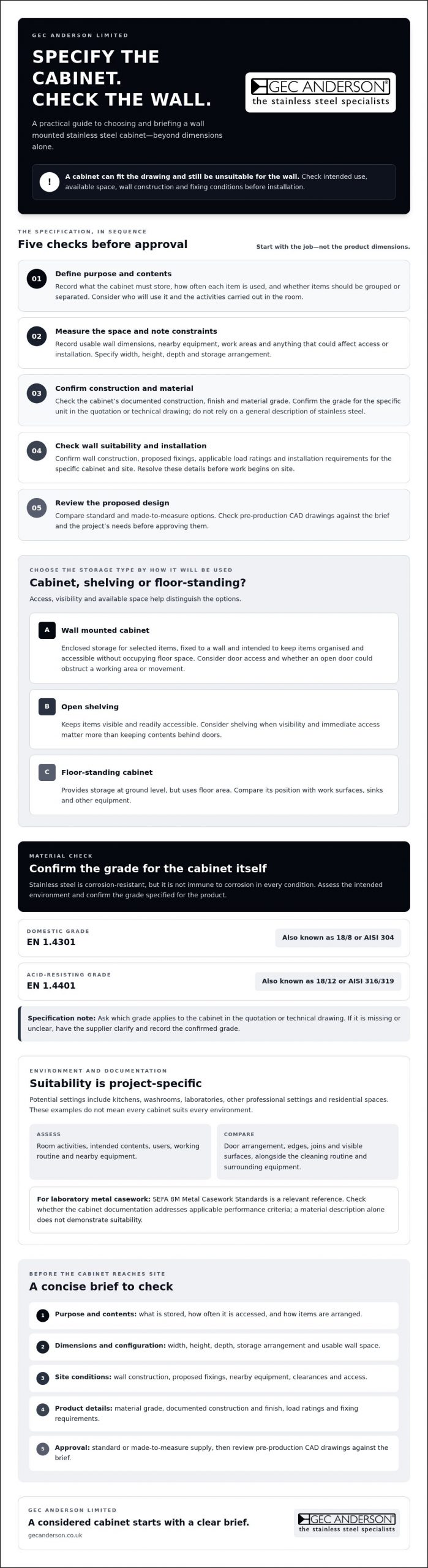
Check the grade stated for the cabinet itself, not just a general description of the supplier’s materials. GEC Anderson uses domestic grade EN 1.4301, also known as 18/8 or AISI 304, and acid-resisting grade EN 1.4401, also known as 18/12 or AISI 316/319. Confirm which grade applies to the cabinet in your quotation or technical drawing. If it is missing or unclear, ask the supplier to clarify and record the confirmed grade in the project specification.
How do fabrication and finish influence the finished cabinet?
Look beyond the material grade. Confirm the door arrangement, edges, joins and visible surfaces, since these affect the finished appearance and the areas that need to be cleaned. Ask how accessible edges and joins are finished, and whether the documented construction suits the cleaning routine and surrounding equipment. Do not assume every cabinet has the same detailing or finish.
Review the proposed construction and finish alongside the cabinet’s location and intended use. If appearance matters, identify which surfaces will be visible after installation. If cleaning access is important, note the edges and joins that need particular attention. Confirm these details with the supplier rather than inferring them from a photograph or a general stainless steel description.
GEC Anderson supplies standard and made-to-measure stainless steel cabinets and doors. Discuss the required dimensions and details, and confirm which options apply to the cabinet in question. For made-to-measure projects, pre-production CAD drawings are issued for client approval, giving you an opportunity to check the proposed design against the brief. Explore stainless steel cabinet options as a starting point for that discussion.
Wall mounted stainless steel cabinets compared with other storage options
Choose between enclosed wall storage, open shelving and floor-standing cabinets by considering the room, the items to be stored and the project requirements. Wall mounted stainless steel cabinets keep selected items off the floor and behind doors. Shelving leaves contents visible, while floor-standing units use space at ground level. Each option has trade-offs, so compare them against the actual layout.
| Storage type | Access and visibility | Space used | Installation considerations |
|---|---|---|---|
| Wall cabinet | Contents are enclosed and a door must be opened to retrieve them. | Uses wall area rather than floor space. | Consider wall construction, fixings, cabinet position and nearby equipment. |
| Open shelving | Contents are visible and readily accessible. | Uses wall area without cabinet doors. | Check wall support, positioning and access to stored items. |
| Floor-standing cabinet | Contents are enclosed, with access from ground level. | Occupies floor area and may affect movement around the room. | Consider available floor space, position and relationship to other units. |
When is enclosed wall storage preferable to open shelving?
A wall cabinet may suit items that need to be kept behind doors or a room where visible contents are not wanted. Open shelving may be more practical when users need to identify and reach items quickly. In either case, consider how people work around the storage and what the cleaning routine requires. Do not assume one format is inherently more hygienic. Check the project requirements and the details of the proposed unit.
When might a floor-standing or modular cabinet suit better?
A floor-standing cabinet may be worth considering if floor space is available and the storage works better at ground level. Limited wall space or nearby equipment may make a wall unit impractical. GEC Anderson’s DECIMETRIC® is a modular kitchen furniture system, not a wall-mounted cabinet. Confirm whether it is relevant to the project rather than assuming it is compatible with the proposed layout.
Compare the options against the room plan, stored items and installation conditions before choosing a format. For a broader view of storage planning, consult the stainless steel storage systems specification guide. Use it to frame the discussion, then make the final decision based on the project’s requirements.
How to prepare a wall cabinet specification and installation brief
A clear brief helps the supplier assess the proposed cabinet and gives the project team a basis for checking dimensions, site conditions and installation arrangements. For wall mounted stainless steel cabinets, describe both what the unit needs to do and where it will be installed.
- Define purpose and storage. List the items to be stored, how often they will be accessed and whether they need to be concealed or arranged in a particular way.
- Record the location. Identify the room, intended wall position and relationship to work areas, sinks and nearby equipment. Note anything that could restrict access or door movement.
- Measure the available space. Record usable width, height and depth, plus nearby features that could affect the cabinet’s position. Ask the supplier which measurements are needed before treating them as final.
- Describe the required cabinet. For a standard-stock enquiry, provide the product reference and quantity where applicable. For a made-to-order enquiry, explain the project-specific requirements and provide confirmed dimensions.
- Identify site and installation constraints. Record known wall construction and access limitations. Have a competent project professional assess wall suitability, fixings and installation requirements for the specific cabinet and site.
- Confirm information and responsibilities. Ask which drawings, templates or measurements the supplier needs. Clarify who will verify site conditions and carry out the installation.
What information should be ready before requesting a quotation?
Alongside the product reference or custom brief, provide the intended use, quantity, location and available dimensions. Note nearby equipment and any site constraints that could affect the arrangement. Do not assume a sketch or measurement is sufficient. Ask the supplier what information is needed to prepare and assess the specification.
How does drawing approval fit into a made-to-measure order?
GEC Anderson issues a pre-production CAD drawing for client approval. Check it against the brief, including the proposed dimensions and arrangement, and raise discrepancies before approving it. If installation is required, a site visit may be arranged to take dimensions or templates. Production follows client approval, so resolve uncertainties before that stage.
For a laboratory project, keep the brief focused on the cabinet and its site conditions. For a kitchen project that also includes worktops, the bespoke stainless steel kitchen worktop guide may be relevant. To discuss a cabinet brief, contact GEC Anderson about stainless steel cabinets.
How GEC Anderson supports a considered stainless steel cabinet project
GEC Anderson supplies standard and made-to-measure stainless steel cabinets and doors for professional and residential environments. A standard cabinet may suit a project if its available size and configuration meet the brief. Made-to-measure supply may be worth discussing when the room layout or required dimensions call for a different fit. Confirm the options available for the specific cabinet before finalising the specification.
For a cabinet project, begin by clarifying requirements and reviewing the proposed design. GEC Anderson issues pre-production CAD drawings for client approval, and technical support can help inform the specification. The project team should still confirm site conditions, fixing details and installation responsibilities.
When should a project consider made-to-measure cabinetry?
Discuss made-to-measure supply if a standard cabinet’s dimensions do not suit the available wall space, or if the position needs to work around equipment or other fixed features. Share the constraints and required storage arrangement, then ask which options apply to the cabinet. Confirm the available configuration and custom details with GEC Anderson before including them in the project specification.
What happens after the cabinet requirements are agreed?
GEC Anderson issues a pre-production CAD drawing for client approval. Review it against the agreed brief and raise any discrepancies before approval. Production follows client approval. If installation is required, a site visit may be arranged to take dimensions or templates. The project team should also establish who will check wall suitability, fixings and installation arrangements for the site.
To prepare an enquiry, bring together:
- The intended use, location and required storage.
- Available project dimensions and relevant layout constraints.
- The required quantity, and a product reference if enquiring about a standard option.
- Any custom requirements, with dimensions marked as confirmed or still to be checked.
- Questions about the drawings, templates, measurements and site information needed.
This information gives the supplier a clear starting point and helps the project team assess the proposed cabinet before approval. For a discussion about your requirements, Discuss a stainless steel cabinet project.
Move from cabinet brief to confident specification
Choosing wall mounted stainless steel cabinets starts with a clear purpose. A sound specification also accounts for available space, nearby equipment and conditions at the fixing point. Compare enclosed cabinets with other storage formats, then confirm dimensions, construction and installation requirements for the project.
A standard option may meet the brief, while project-specific dimensions or layout constraints may prompt a discussion about made-to-measure supply. Before proceeding, make sure the proposed details are documented and reviewed. Pre-production CAD drawings give you the opportunity to check the design against your requirements before approval.
Prepare the intended use, location, storage needs and confirmed measurements, then Discuss your stainless steel cabinet requirements. A clear brief is a practical first step towards a cabinet specification that fits the space and serves its purpose.
Frequently Asked Questions
What are wall mounted stainless steel cabinets used for?
Wall mounted stainless steel cabinets provide enclosed storage above floor level, keeping selected items organised and accessible. In a laboratory, they may be considered for supplies or equipment, depending on the room’s activities, users and project requirements. Decide what needs to be stored, how often it is used and whether it should be concealed. Confirm that the proposed cabinet’s dimensions, construction and material grade suit its intended environment.
Are stainless steel wall cabinets suitable for commercial kitchens?
They may be suitable for a commercial kitchen if the cabinet’s material, construction, position and installation meet the project requirements. Consider what it will store, how staff will access it and how it fits alongside work areas and equipment. Stainless steel is corrosion-resistant, but it is not immune to corrosion in every condition. Ask the supplier to confirm the grade and product details for the specific cabinet and intended use.
How do I choose the right size wall mounted stainless steel cabinet?
Measure the usable wall area and note the cabinet’s position in relation to work surfaces, doors and nearby equipment. Consider what needs to fit inside and how readily users need to reach it. Check the proposed width, height and depth against the project drawings, then confirm the measurements with the supplier. Establish wall suitability and fixing requirements before selecting a cabinet, rather than judging size by storage capacity alone.
Can a wall mounted stainless steel cabinet be made to measure?
Yes. GEC Anderson supplies made-to-measure stainless steel cabinets and doors. Confirm the requirements and available options for the specific cabinet. Made-to-measure supply may help where project dimensions or the room layout do not suit a standard option. Provide the intended use, location and confirmed measurements, and ask which configurations can be considered. Pre-production CAD drawings are issued for client approval, allowing you to review the proposed design before production.
How are wall mounted stainless steel cabinets fixed safely?
Safe fixing depends on the wall construction, the cabinet and its intended contents. Have a competent project professional assess whether the wall and proposed fixing arrangement are suitable for the installation. Confirm fixing details and any applicable load ratings with the supplier; do not infer them from the cabinet’s appearance. Agree who is responsible for checking site conditions and carrying out the installation before work begins.
What should I provide when requesting a quote for a stainless steel wall cabinet?
Provide the intended use, location, quantity and available dimensions. For a standard enquiry, include the product reference where applicable. For a made-to-measure request, describe the project requirements and identify which measurements are confirmed. Note nearby equipment and other site constraints, then ask the supplier what drawings, templates or additional measurements are needed. This gives the supplier a clear basis for discussing the cabinet specification.
Are wall mounted cabinets better than stainless steel shelving?
Neither is automatically better. Choose according to how the space will be used. A cabinet encloses contents behind doors, which may suit items that need to be concealed. Stainless steel shelving keeps items visible and readily accessible. Consider the room layout, user needs, cleaning expectations and installation conditions, then confirm project requirements before choosing a format. If the project involves demanding environments, the guidance on industrial stainless steel cabinets may help frame the specification around conditions, grade and configuration before approaching a supplier.