
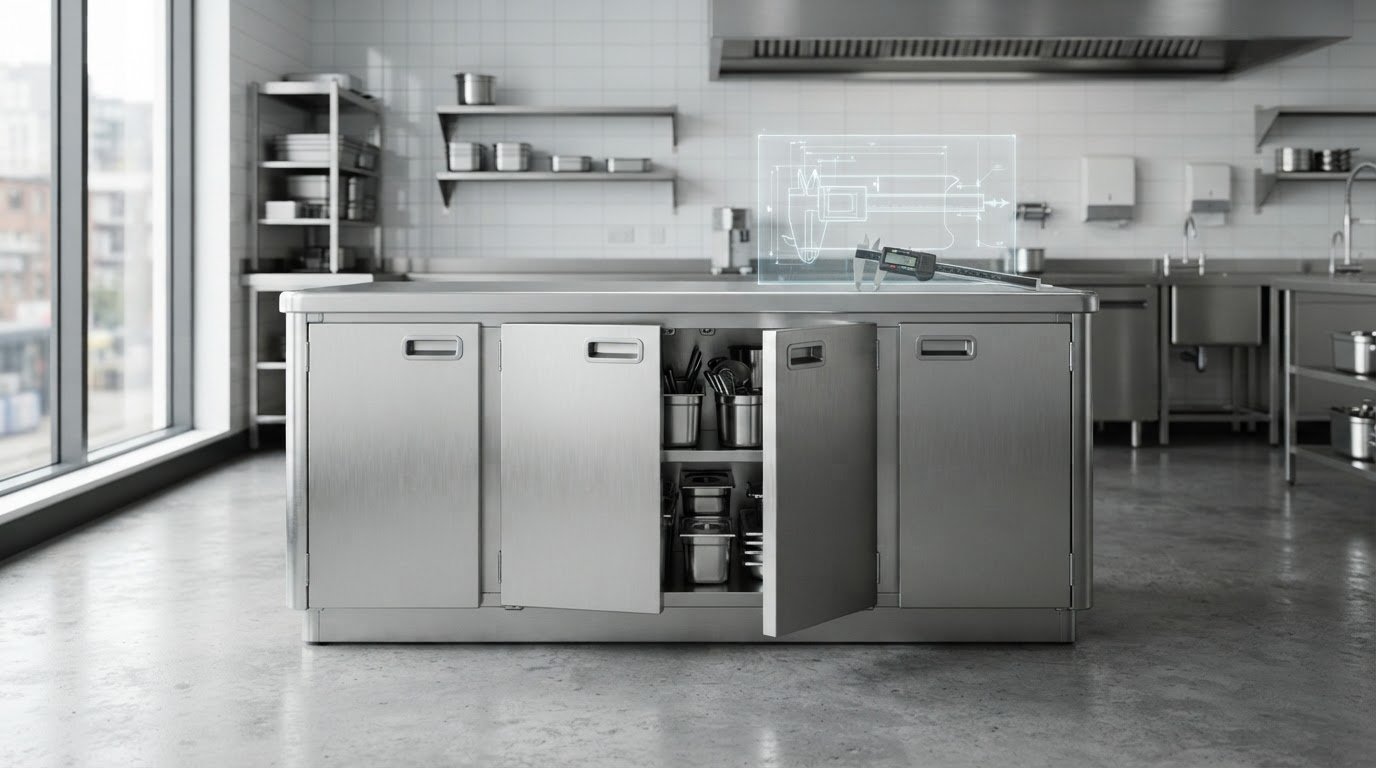
A cabinet can use the right stainless steel and still be wrong for the job. Industrial stainless steel cabinets should be specified around the conditions they’ll face, the items they’ll store and the way people will use them. Material grade matters, but it’s only one part of the decision.
Comparing options isn’t always straightforward. Product descriptions may not tell you whether EN 1.4301 or EN 1.4401 is appropriate for your environment, or whether a modular layout or made-to-measure cabinet better suits the space.
This guide sets out the main choices to help you prepare a clear brief for a supplier. It covers environment, grade, configuration and fabrication, including when GEC Anderson’s DECIMETRIC® system or a made-to-measure approach may be worth considering. You’ll also find the details to confirm, such as dimensions, capacity and finish, and how pre-production CAD drawings can support your review before manufacture.
Key Takeaways
- Start with the cabinet’s intended use and site conditions, then identify the access, layout and cleaning requirements that follow.
- Specify industrial stainless steel cabinets by considering grade and fabrication together. Ask the supplier to confirm suitability for the project environment.
- Compare standard, modular and made-to-measure options by how well they meet your space, repeatability and project-specific requirements.
- Prepare a brief covering contents, access, cleaning regime, environmental exposure and verified dimensions before requesting a supplier review.
- Use CAD drawings to check the proposed configuration before approval and order confirmation.
What Are Industrial Stainless Steel Cabinets Designed to Do?
Industrial stainless steel cabinets are enclosed storage units specified for the working conditions, contents and access needs of a particular project. Their layout and material should reflect the intended setting, rather than being assumed to suit every workplace.
Industrial stainless steel cabinets are purpose-specified enclosures for storing equipment, materials or supplies in a defined working environment. The choice of stainless steel is only part of the specification. A useful design must also account for how often staff need access, what the cabinet will hold, how it will be cleaned and what conditions it may encounter.
Which environments may require stainless steel storage?
Healthcare, education, laboratories, transport, industrial operations and commercial settings may all have reasons to consider stainless steel storage. Their requirements can differ substantially. A laboratory may need an arrangement suited to its stored items and cleaning regime, while a transport setting may have different access patterns and space constraints. In education, the intended users and frequency of access can also shape the brief.
Moisture, cleaning practices and other site conditions should be described to the supplier, rather than treated as standard across sectors. A cabinet appropriate for one room or process may not suit another. Confirm its suitability for the project environment and operational requirements before settling on a specification.
What distinguishes a cabinet from other stainless steel storage?
A cabinet provides enclosed storage, which keeps items within a defined space and gives the specifier a way to manage access. The required arrangement depends on what is stored and who needs to reach it. Don’t assume a particular door, lock or internal configuration without confirming the project requirements.
Open shelving, by contrast, keeps stored items visible and directly accessible. That may suit frequently handled items, while enclosed storage may better fit a brief that calls for items to be kept inside a cabinet. Neither format is automatically right for every workplace. Consider access, contents and cleaning alongside the available space.
Stainless steel covers a family of materials with different properties and types. A foundational overview of stainless steel can help clarify the material context, but it doesn’t determine which cabinet is suitable. For a wider view of how cabinets and open storage can form a coordinated arrangement, see the stainless steel storage systems guide.
How Stainless Steel Grade and Fabrication Shape Cabinet Specification
Start material selection with the conditions the cabinet will face, not with a grade chosen in isolation. Consider the substances or moisture it may encounter, how frequently it will be cleaned and how it will be used. Give these details to the supplier and ask them to confirm the proposed stainless steel is appropriate. Check the grade against the actual project exposure before specifying industrial stainless steel cabinets.
How do EN 1.4301 and EN 1.4401 differ?
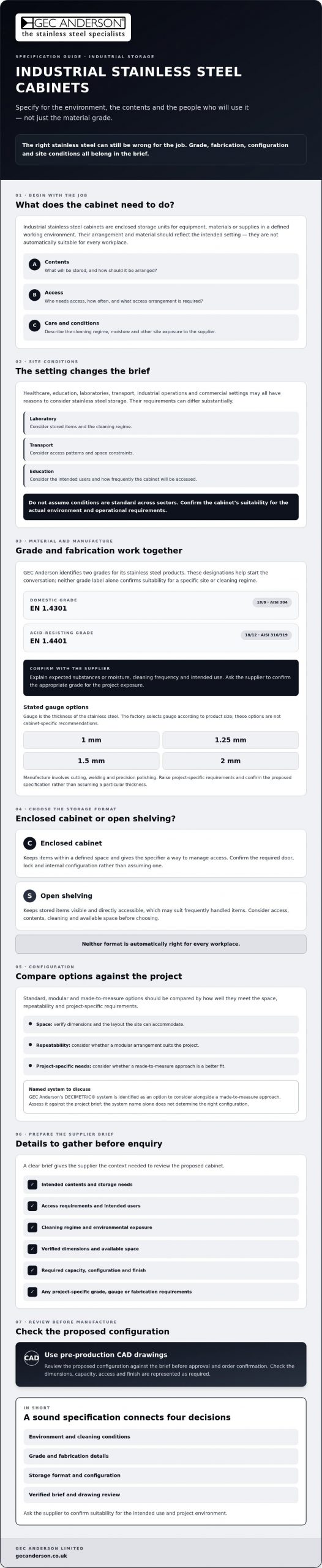
GEC Anderson identifies two grades for its stainless steel products: domestic grade EN 1.4301, also described as 18/8 and AISI 304; and acid-resisting grade EN 1.4401, also described as 18/12 and AISI 316/319. These designations provide a starting point for discussion, but they don’t replace an assessment of the conditions in which a cabinet will be used.
EN 1.4301 is the documented domestic grade, while EN 1.4401 is the documented acid-resisting grade. Neither label alone confirms suitability for a particular site or cleaning regime. Describe the expected exposure to the supplier and ask them to confirm the appropriate grade for the cabinet and its intended use.
Why do gauge and fabrication details matter?
Gauge refers to the thickness of the stainless steel. GEC Anderson’s stated options are:
- 1 mm
- 1.25 mm
- 1.5 mm
- 2 mm
The factory selects the gauge according to product size, so these options shouldn’t be read as cabinet-specific recommendations. If your project has defined requirements, raise them with the supplier and confirm the proposed specification rather than assuming a particular thickness.
Manufacture involves cutting, welding and precision polishing. These processes shape the finished component and its surfaces. Ask how the proposed fabrication relates to the cabinet’s intended arrangement and use, and have any project-specific requirements confirmed as part of the specification.
For a considered enquiry, provide the site conditions and cleaning regime alongside the cabinet requirements, then request confirmation of grade and gauge before approval. GEC Anderson’s stainless steel cabinets and doors are available in standard, modular and made-to-measure formats, with pre-production CAD drawings for client approval.
Modular or Made-to-Measure Industrial Stainless Steel Cabinets?
A suitable stainless steel grade doesn’t, on its own, make a cabinet right for a project. Fit, access, layout and the relationship with surrounding surfaces or equipment all matter. Compare the format as well as the material, and ask the supplier to confirm which dimensions, configurations and finishes are available for your requirements.
Keep the comparison practical by assessing each route against three questions: how closely it fits the space, whether the same arrangement needs to be repeated, and whether the project calls for a tailored solution.
- Standard: Consider this where an existing product may meet the brief. Confirm its dimensions and configuration with the supplier.
- Modular: Consider this where a repeatable system may help organise the layout. Check that the system and its published dimensions apply to the cabinet requirement.
- Made-to-measure: Explore this where the space, interfaces or project needs may not suit a standard format. Confirm the proposed details with the supplier.
This comparison helps avoid treating modular and made-to-measure as interchangeable. It also keeps the decision grounded in the project, rather than assuming one format suits every installation of industrial stainless steel cabinets.
When might a modular cabinet system suit a project?
Repeatable increments can provide a useful basis for planning a coordinated layout, although they don’t guarantee a particular fit or installation outcome. GEC Anderson’s DECIMETRIC® is a modular kitchen furniture system built on 100 mm increments. Its overall length is available up to 3000 mm, with widths up to 600 mm or 700 mm as indicated. These are system dimensions, not automatically a specification for an individual cabinet. Ask the supplier to confirm how the system relates to the cabinet and project in question.
When should a project explore made-to-measure cabinets?
Explore a made-to-measure cabinet where unusual dimensions, interfaces with adjacent elements or a project-specific layout need careful consideration. GEC Anderson supplies made-to-measure stainless steel cabinets and doors, but the required dimensions and configuration should be set out and confirmed for each project. A pre-production CAD drawing can help you review the proposed arrangement before approval.
If the brief specifically concerns a wall-mounted format, consult the wall mounted stainless steel cabinets guide as a related point of reference. Whichever route you consider, give the supplier clear project requirements and verify the proposed cabinet details before proceeding.
How to Prepare an Industrial Stainless Steel Cabinet Specification
A clear brief helps a supplier assess the cabinet against the actual site and task, rather than make assumptions about dimensions or use. For industrial stainless steel cabinets, document the requirements in sequence and flag anything that needs technical confirmation.
A useful cabinet brief records its intended use, users, contents, access, cleaning expectations, site conditions, verified dimensions and points for supplier review.
What information should a cabinet project brief include?
- Define the use case. Describe what the cabinet will store, who will use it and how often items need to be accessed.
- Record the location and site conditions. Identify where the cabinet will sit within the facility, and note relevant environmental exposure and cleaning expectations.
- Describe the layout. Explain the access requirements and how the cabinet will relate to adjacent equipment, worktops or surfaces. Discuss the configuration with the supplier rather than assuming it in advance.
- Provide verified measurements. Share site dimensions and any constraints that affect fit. Confirm cabinet dimensions, capacity and configuration for the specific product and project instead of inferring them from a general description.
- Flag material and finish considerations. State any project requirements for technical review. Don’t prescribe a grade or finish without evidence that it suits the environment. Ask the supplier to assess the details provided.
- Review the proposal. Check the proposed cabinet against the brief, resolve open questions and confirm the specification before approval.
Include sketches, plans or reference material where they clarify the space or interfaces. If a measurement is provisional, label it clearly rather than presenting it as verified.
How does drawing approval support made-to-measure work?
For made-to-measure projects, GEC Anderson provides pre-production CAD drawings for client approval. Compare the proposed arrangement with the brief, check dimensions and identify discrepancies before approving the drawing. Confirm cabinet-specific details rather than assuming they are settled by the drawing alone.
Where dimensions or templates are needed for an installation, a site visit may be arranged. Raise this requirement with the supplier as part of the enquiry. For wider project-planning considerations, consult the broader storage systems specification guide alongside your cabinet brief.
Ready to develop your requirements? Discuss your cabinet specification with GEC Anderson, providing the relevant measurements, site conditions and project references for review.
From Cabinet Requirements to a Considered Supplier Enquiry
A useful enquiry brings together the cabinet’s intended use, site conditions, preferred format and verified dimensions. These details help a supplier understand what the project needs and which points still require confirmation. For industrial stainless steel cabinets, a concise, well-organised brief is more useful than relying on a broad product description.
What happens after a buyer submits requirements?
Make clear whether you’re enquiring about a standard product or a project-specific requirement. For a standard-stock enquiry, provide the product reference and quantity. For a custom requirement, include the intended use, site measurements, layout constraints and any references or drawings that explain the brief.
GEC Anderson can provide technical design guidance, and pre-production CAD drawings are available for client approval. Review the drawing against your requirements and resolve outstanding details before approving it. The process is to provide references or requirements, review and approve the CAD drawing, then place the order. Written order confirmation includes a delivery date, which you should check with the supplier rather than assume availability or timing.
If dimensions or templates are needed for an installation, a site visit may be arranged. Raise this with the supplier as part of the enquiry so measurement support can be discussed.
How can cabinet specification fit a wider storage plan?
Consider how enclosed cabinets will work alongside open shelving and other specified stainless steel elements. Decide which items need enclosed storage and which should remain readily accessible on shelving. The overall brief should explain how each element relates to the space, access patterns and day-to-day use, without assuming every component has the same requirements.
For related planning considerations, refer to the broader storage systems guide. GEC Anderson supplies stainless steel cabinets and doors, as well as stainless steel shelving. Discuss how these products may relate to your requirements with the supplier.
Once your use case, environmental conditions, format and measurements are assembled, you’ll have a sound basis for a focused supplier discussion. Discuss your cabinet project brief with GEC Anderson to review the requirements and next steps.
Turn Your Cabinet Brief into a Clear Next Step
Good specification brings the whole project into view: the cabinet’s purpose, its environment, the right format and verified site dimensions. Stainless steel grade matters, but so do layout, fabrication and how the cabinet will be used. Considering these requirements together helps you assess whether standard, modular or made-to-measure industrial stainless steel cabinets may suit the brief.
GEC Anderson was founded in 1962, and its manufacturing is ISO 9001-certified. Pre-production CAD drawings and technical design guidance can help you review a proposed arrangement against your requirements before approval. Confirm project-specific dimensions, configurations and environmental suitability with the supplier.
Prepare your measurements and key requirements, then discuss your stainless steel cabinet requirements with GEC Anderson. A considered brief is a strong starting point for moving your project forward.
Frequently Asked Questions
What are industrial stainless steel cabinets used for?
Industrial stainless steel cabinets provide enclosed storage for equipment, materials or supplies in a defined working environment. Their layout should reflect what needs storing, who requires access and how the cabinet will be cleaned. They may be considered for settings such as healthcare, education, laboratories, transport, industry and commerce, but suitability depends on each project’s requirements and conditions. Confirm the cabinet’s dimensions and configuration with the supplier.
Which stainless steel grade is suitable for industrial cabinets?
The appropriate grade depends on the cabinet’s environment and expected exposure, so ask the supplier to confirm suitability for the project. GEC Anderson identifies EN 1.4301, also described as 18/8 and AISI 304, as domestic grade, and EN 1.4401, also described as 18/12 and AISI 316/319, as acid-resisting grade. Describe the site conditions and cleaning regime rather than selecting a grade based on its designation alone.
Are modular or made-to-measure stainless steel cabinets better?
Neither option is automatically better. The right route depends on the space, layout and project requirements. A standard cabinet may suit a brief that matches an available product. Modular furniture can support planning around repeatable increments, while made-to-measure cabinets can be considered for project-specific dimensions or interfaces. GEC Anderson’s DECIMETRIC® is a modular kitchen furniture system built on 100 mm increments, not a universal cabinet specification. Confirm product details with the supplier.
Can stainless steel cabinets be specified for healthcare or laboratory environments?
They can be considered for healthcare and laboratory projects, but the specification must reflect the particular room, process and operational requirements. Assess access, contents, cleaning regime and environmental exposure, then ask the supplier to confirm whether the proposed material and cabinet details are suitable. Don’t assume a cabinet intended for one healthcare or laboratory setting will meet the needs of another, or that material choice alone establishes compliance with project requirements.
What information should I provide when requesting a stainless steel cabinet?
Provide the intended use, users, contents, access needs, location, cleaning expectations and relevant environmental exposure. Include verified site measurements, along with notes or drawings showing adjacent equipment and surfaces. If you have a preferred format, such as standard, modular or made-to-measure, identify it as a requirement for discussion. Flag grade or finish preferences for technical review, and ask the supplier to confirm dimensions, capacity and configuration for the specific cabinet.
How are made-to-measure stainless steel cabinets approved before production?
For made-to-measure work, GEC Anderson provides pre-production CAD drawings for client approval. Compare the drawing with your brief, including site dimensions, layout and interfaces, and raise any changes or questions before approving it. A site visit may be arranged where dimensions or templates are needed for an installation. Following approval, the order proceeds into production. Written order confirmation includes a delivery date, which should be checked as part of the order process.