
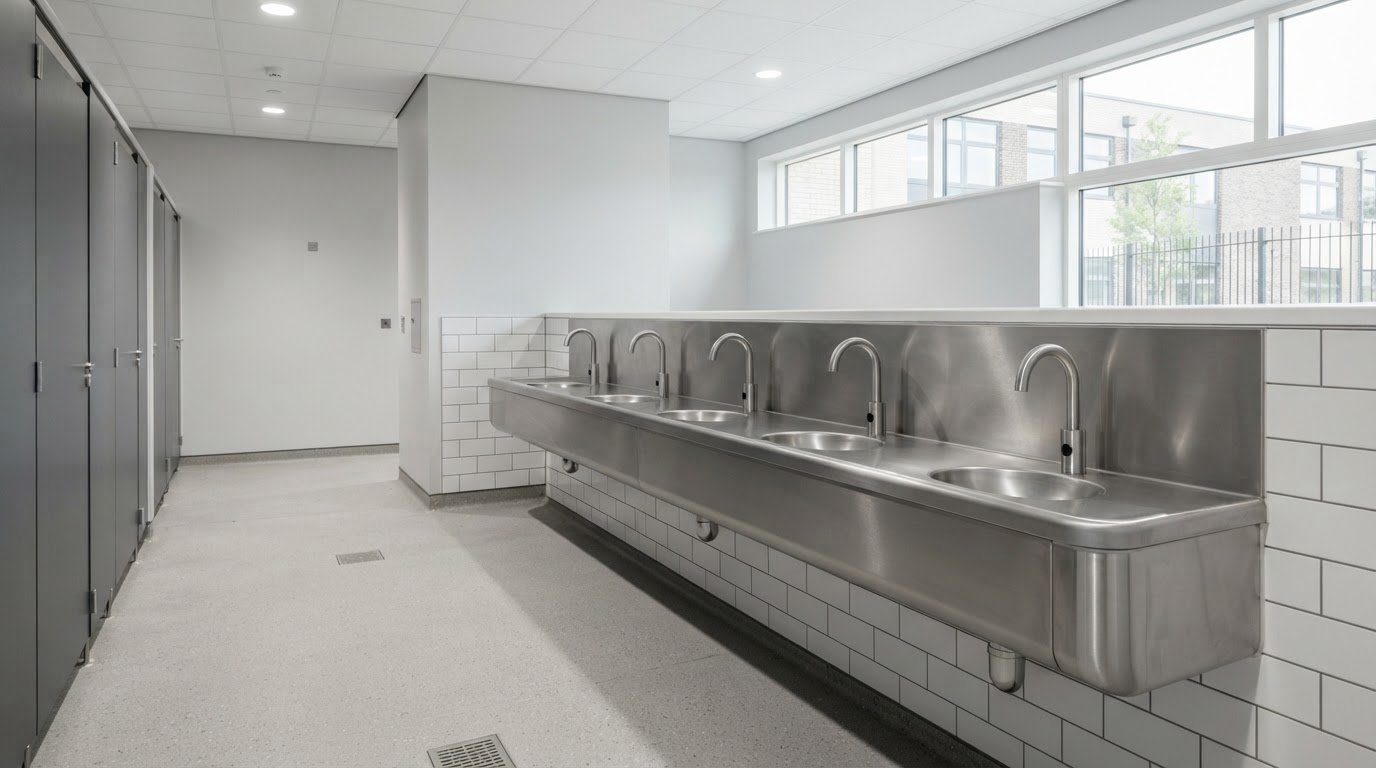
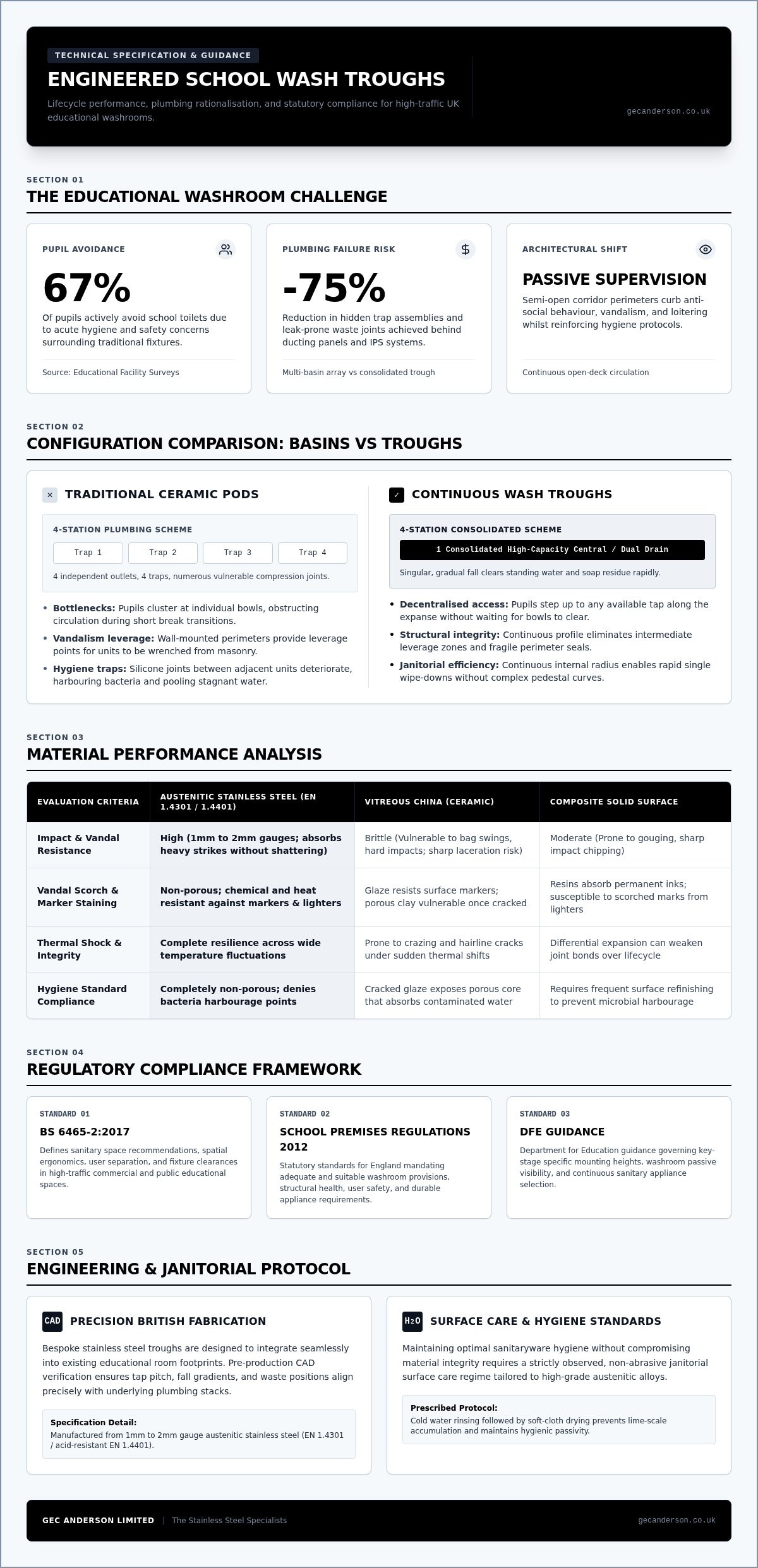
With 67% of pupils reporting that they actively avoid school toilets due to hygiene and safety concerns, traditional ceramic sanitaryware has become an unsustainable liability. Specifiers and estates teams understand the relentless cycle: cracked basins, persistent vandalism, bottleneck congestion during short breaks, and dozens of leak-prone waste joints beneath vanity units. Specifying engineered school toilet troughs UK education facilities can depend on solves these operational failures at the source, transforming high-traffic handwashing areas into durable, orderly environments.
It’s entirely possible to eradicate these recurring maintenance headaches while enhancing pupil dignity. This technical guide outlines how to evaluate, specify, and procure robust wash troughs tailored for intensive daily use. We examine practical Department for Education guidance, sanitary space recommendations under BS 6465-2:2017, and precision manufacturing methods, ensuring your project achieves full compliance, simplified servicing, and decades of reliable performance.
Key Takeaways
- Understand how specifying continuous school toilet troughs UK education facilities require resolves break-time congestion, prevents basin vandalism, and drastically reduces plumbing connection points.
- Evaluate the lifecycle performance and structural resilience of austenitic stainless steel compared to vitreous china and composite solid surfaces in high-traffic settings.
- Establish compliant mounting heights, user spacing, and sensor tap configurations aligned with Department for Education guidance and British Standards across all key stages.
- Implement strict surface care protocols, including cold water rinsing and soft-cloth drying, to maintain optimal sanitaryware hygiene without compromising material integrity.
- Explore how bespoke British fabrication and pre-production CAD verification deliver tailored architectural solutions that integrate seamlessly into existing room footprints.
Why School Toilet Troughs Are Replacing Individual Basins in UK Schools
The modern school wash trough serves as a continuous, multi-station handwashing system engineered specifically for heavy institutional footfall. Rather than relying on separate ceramic pods that isolate users and fragment plumbing, a single profiled trough provides an unbroken wash deck. This continuous design directly confronts the physical demands of educational washrooms. In contemporary UK school toilet troughs, the elimination of vulnerable silicone seams between adjacent units removes dirt traps, stops stagnant water pooling, and denies vandals the leverage points required to wrench fixtures from masonry walls.
Traffic Flow and Congestion Management in Educational Washrooms
Traditional rows of individual washbasins generate acute friction during short transition bells. Pupils cluster around individual bowls, creating physical bottlenecks that spill into cubicle pathways and block entrances. A continuous wash trough decentralises the washing station; pupils can step up to any available tap along the expanse without waiting for an individual basin deck to clear.
This layout aligns with the widespread architectural shift towards semi-open washroom designs. By siting continuous troughs along open perimeters visible from main circulation corridors, schools maintain passive supervision without intruding on cubicle privacy. Increased visibility sharply curbs anti-social behaviour, bullying, and loitering, while actively reinforcing established hand hygiene protocols amongst students.
Plumbing Simplification and Maintenance Reduction
From an estates management perspective, traditional basin arrays represent a continuous operational liability. Installing four individual basins demands four independent waste outlets, four bottle traps, and numerous compression joints. Each joint constitutes an eventual point of failure behind commercial Integrated Plumbing System (IPS) panels. In contrast, an engineered trough consolidates drainage into a single or dual, high-capacity waste outlet.
- Reduced leak exposure: Cutting the number of trap assemblies beneath ducting panels eliminates up to 75% of hidden joint failures.
- Rapid clearance: A singular, gradual fall across the trough base prevents standing water and directs soap residues swiftly to the drain.
- Accelerated cleaning: Janitorial teams wipe down a single, continuous radius rather than scrubbing around multiple complex ceramic pedestal curves.
Specifying these systems forms the baseline for resilient high traffic washroom solutions, mitigating concealed flooding risks and keeping operational budgets focused on teaching rather than emergency plumbing callouts.
Material Selection: Stainless Steel vs Solid Surface and Vitreous China
Specifying materials for educational washrooms demands an uncompromising balance of structural rigidity, impact resistance, and hygienic performance. While aesthetic preference often tempts specifiers towards composite polymers or traditional ceramics, high-traffic school environments quickly expose physical vulnerabilities. Meeting the legal expectations outlined in the School Premises (England) Regulations 2012 requires sanitary appliances that endure unrelenting daily use without cracking, crazing, or harbouring pathogens.
Impact Resistance, Vandalism, and Thermal Shock
Ceramic vitreous china remains brittle. Heavy school bags swung carelessly or deliberate impacts from hard objects inevitably cause hairline fractures or catastrophic shattering. Beyond presenting severe laceration hazards to pupils, cracked glazing exposes porous clay substrates that readily absorb contaminated water. Composite solid surfaces, while visually seamless, present different liabilities. Highly filled resin blends are vulnerable to stubborn permanent marker staining, gouging from sharp instruments, and scorched marks from lighters, requiring frequent resurfacing to maintain hygiene.
Specifying austenitic stainless steel eliminates these failure modes completely. Fabricated from 1mm to 2mm gauges of EN 1.4301 (or acid-resistant EN 1.4401) grade material, stainless steel provides exceptional tensile yield strength. It absorbs blunt force without fracturing, easily resists thermal shock from boiling wash-down procedures, and features a non-porous microstructure that denies bacteria a foothold. Deliberate ink vandalism washes away cleanly without chemical degradation.
Lifecycle Value and Environmental Sustainability
When evaluating whole-life operational expenditure across school estates, capital procurement costs tell only part of the story. Solid surface troughs typically require surface polishing, joint resealing, or total replacement every seven to ten years in secondary education settings. Premium stainless steel, by contrast, delivers an expected 50-year lifecycle. Its passive chromium oxide layer actively self-heals in the presence of atmospheric oxygen, safeguarding the underlying metal against progressive corrosion decade after decade.
- Long-term structural integrity: Resists cracking, chipping, and joint delamination under heavy school usage.
- Circular economy alignment: Fully 100% recyclable at building decommissioning, supporting institutional sustainability goals.
- Fire and chemical inertness: Class A1 non-combustible material that remains unaffected by strong janitorial cleaning agents.
For educational specifiers sourcing commercial stainless steel sanitaryware, investing in heavy-duty school toilet troughs UK facilities can rely on ensures long-term asset security; explore the full scope of precision options at gecanderson.co.uk to match your architectural requirements.
Technical Specification Checklist: Dimensions, Heights, and Tap Configurations
Precision detailing separates an average washroom installation from an enduring one. Specifying compliant school toilet troughs UK estates require involves matching physical dimensions to user ergonomics and plumbing mechanics. Following official government guidance ensures that installations not only satisfy statutory premises standards, but also provide effortless usability across all age profiles.
Age-Specific Mounting Heights and Ergonomics
Mounting heights must reflect the anthropometric data of the target year group to prevent water pooling on sleeves or floor splashing. For Early Years Foundation Stage (EYFS) and infant pupils, set the finished rim height between 500mm and 600mm from finished floor level (FFL). Junior schools require a height of 650mm to 700mm, encouraging proper posture and reach. For secondary schools, sixth forms, and staff washrooms, standardise rim heights at 750mm to 850mm. When designing accessible areas under Building Regulations Part M, ensure wheelchair users have clear knee clearance underneath the trough apron with an upper rim set around 750mm to 800mm.
Tap Centres, Spouts, and Water Controls
Proper tap spacing prevents physical crowding during break times. British Standard BS 6465-2:2017 outlines recommendations for sanitary appliance spacing, making a 500mm to 600mm centre-to-centre dimension between tap stations ideal for comfortable use.
- Centres and Spacing: Space outlets at least 500mm apart, with a minimum of 300mm clearance from the edge of any flanking end-wall.
- Water Control Types: Replace standard twist valves with non-concussive mechanical push taps or infrared touchless sensors to curb water wastage.
- Thermal Safety: Pair supplies with accredited TMV3 thermostatic mixing valves, strictly regulating discharge temperatures to avoid scald incidents.
- Mounting Interface: Specify integrated stainless steel rear splashbacks rather than tap deck piercings, protecting backing walls from moisture penetration.
Waste Outlets and Drainage Fall Engineering
Water stagnation creates bio-film hazards and unpleasant odours. A quality school trough incorporates a continuous laser-formed internal gradient, typically a 1:50 or 1:60 fall directing discharge briskly towards the waste point. In secondary education settings, avoid standard slotted pop-up plugs. Instead, specify unslotted, flush grated waste connections that prevent pupils from inserting rubbish, pens, or paper towels to induce deliberate flooding. Similar precision drainage detailing is utilised in hospital scrub up troughs UK healthcare facilities rely upon, demonstrating how clinical water management principles safeguard educational estates.
Hygiene Protocol and Maintenance Standards for School Wash Troughs
Sustaining the hygienic performance of school washrooms requires daily maintenance that respects the metallurgy of stainless steel. Whilst EN 1.4301 material is naturally resilient, careless housekeeping or abrasive tools can compromise surface passivity. Establishing correct janitorial routines ensures that school toilet troughs UK educational facilities invest in retain their clean satin finish, preventing bacterial adhesion and limescale build-up over decades of operation.
Routine Cleaning and Surface Preservation Rules
Daily cleaning requires simple, non-abrasive methods to avoid scratching the mill finish. Facilities teams should apply a standard cream cleaner using a soft, damp cloth. Always clean by rubbing along the grain of the stainless steel; circular motions across the grain can disrupt the directional polish and dull the metal over time.
- Cold water rinsing: Rinse the entire trough thoroughly with clean, cold water only. Never rinse surfaces with warm or hot water during maintenance, as elevated temperatures can accelerate mineral deposition and set chemical residues.
- Immediate drying: Dry the washed metal thoroughly with a soft cloth. Never allow wet surfaces to air dry; standing droplets evaporate to leave unsightly chalky watermarks and mineral rings.
- Prohibited equipment: Bar all wire wool, carbon steel scouring pads, and harsh bleach solutions from the cleaning caddy, as they introduce ferrous contamination and pitting risks.
Removing Limescale, Rust Discolouration, and Mineral Deposits
In hard water areas across the UK, calcium carbonate deposits can accumulate around waste outlets and tap junctions. Estates teams should treat stubborn limescale by applying a solution of vinegar or 10% acetic acid with a soft cloth, allowing the mild acid to dissolve the scale before completing a cold water rinse and soft-cloth dry. For heavy industrial calcification, a diluted nitric acid wash (one part HNO3 to four parts water) safely restores the surface without degrading base metal passivity.
Occasionally, what appears to be rust on stainless steel is actually external iron particles left by maintenance tools or plumbing swarf. Address light superficial iron discolouration by buffing gently along the grain with a dry cleaning powder. For persistent rust deposits, scrub lightly with a dry nylon fibre brush or apply diluted nitric acid. Follow immediately with a complete cold water rinse and a soft cloth dry to restore the protective chromium oxide film. To obtain full chemical compatibility data sheets or technical product guides, contact GEC Anderson for technical maintenance support.
Specifying Bespoke Stainless Steel Wash Troughs with GEC Anderson
Standard off-the-shelf catalogue units frequently force architectural compromises, creating awkward gaps, ungainly filler panels, and inaccessible dead spaces that trap dirt. Procuring bespoke school toilet troughs UK education projects require demands a manufacturing partner capable of tailoring fixtures to exact room geometry. Founded in 1962, GEC Anderson brings over six decades of British manufacturing heritage to educational washrooms, fabricating continuous stainless steel troughs in lengths up to 5 metres. Laser cutting and precision weld finishing eliminate dirt-collecting mechanical joints, producing seamless, hygienic profiles engineered for heavy daily footfall.
Architectural Precision and Made-to-Measure Flexibility
School washrooms, particularly within refurbishment projects, rarely feature perfectly uniform alcoves. Made-to-measure fabrication allows troughs to fit precisely wall-to-wall, maximising pupil washing capacity while removing the troublesome peripheral recesses where grime accumulates. Specifiers can customise every physical attribute:
- Continuous upstands: Integrate seamless rear splashbacks folded directly from the deck to protect background wall structures from damp.
- Tailored tap centres: Specify bespoke tap hole drillings and spacings to align perfectly with plumbing feeds or sensor controls.
- Engineered gauges: Select heavy-duty sheet thicknesses from 1.25mm to 2mm, providing optimal rigidity against structural deflection and vandalism.
- Material grades: Choose between standard austenitic EN 1.4301 for general washrooms or acid-resistant EN 1.4401 for laboratory and art block environments.
End-to-End Specification and Technical Support
Specifying custom sanitaryware should never introduce dimensional uncertainty or installation delays on site. GEC Anderson provides an advisory, consultative approach from early layout concepts through to final delivery. Every bespoke order undergoes a comprehensive pre-production CAD drawing approval process, giving architects, estates directors, and mechanical contractors complete certainty that tap centres, falls, and overall dimensions align perfectly with site services before metal is cut.
Backed by ISO 9001 certified manufacturing, every unit is built to deliver an expected 50-year lifecycle using 100% recyclable material, ensuring lasting value across the UK educational sector. To submit layout drawings or discuss technical requirements with an experienced specialist, request a bespoke specification quotation.
Delivering Enduring Value in Educational Washroom Specification
Replacing fragile ceramic basins with continuous stainless steel wash decks fundamentally transforms the operational resilience of educational estates. By resolving break-time congestion, consolidating vulnerable plumbing traps, and eliminating the risk of shattered sanitaryware, specifiers safeguard pupil wellbeing and capital budgets simultaneously. Choosing the right school toilet troughs UK projects demand ensures compliance with rigorous premises standards whilst radically reducing ongoing maintenance overheads.
With ISO 9001 certified British manufacture since 1962, GEC Anderson provides the engineering precision needed to execute demanding school layouts without compromise. From seamless continuous lengths up to 5 metres to meticulous pre-production CAD drawing approval, every bespoke installation is purpose-built to deliver an expected 50-year lifecycle using heavy-duty EN 1.4301 stainless steel.
Equip your next educational development with sanitary solutions engineered for decades of heavy use. Explore bespoke stainless steel wash troughs and request a technical quotation to discover how precision British manufacturing supports modern school design.
Frequently Asked Questions
Are wash troughs more hygienic than individual washbasins in UK schools?
Yes, continuous wash troughs offer superior hygiene over separate basins. The Department for Education now recommends troughs because seamless fabrication eliminates perimeter silicone joints and dirt traps where bacteria harbour. Paired with touchless sensor taps and continuous splashbacks, modern school toilet troughs UK facilities install minimise physical touchpoints, eradicate stagnant water pooling, and significantly streamline daily sanitation regimes for estates teams.
What is the recommended mounting height for a primary school wash trough?
Recommended rim mounting heights vary depending on the specific primary age group. For early years foundation stage and infant children, set the finished rim between 500mm and 600mm from finished floor level. For junior pupils aged 7 to 11, mount troughs between 650mm and 700mm. This ergonomic positioning ensures comfortable reach, prevents sleeve wetting, and reduces water splashing across floor surfaces.
How many taps should be specified per metre of school wash trough?
Specifiers should plan for approximately two tap outlets per linear metre. In accordance with BS 6465-2:2017 recommendations for sanitary appliance spacing, maintain tap centres between 500mm and 600mm apart. Ensure at least 300mm clearance between the outer taps and any adjacent side walls to provide adequate elbow room and avoid user bottlenecks during peak break periods.
Can school toilet troughs be custom fabricated to fit exact wall dimensions?
Yes, bespoke fabrication allows wash troughs to fit precise alcove or wall-to-wall dimensions up to 5 metres in a continuous length. Made-to-measure manufacturing removes the need for clumsy infill trims or dirt-harbouring peripheral gaps. Pre-production CAD approvals ensure that overall lengths, integrated splashbacks, waste positions, and tap hole centres align precisely with on-site mechanical services before production begins.
Which stainless steel grade is recommended for educational sanitaryware?
Austenitic EN 1.4301 (AISI 304) grade stainless steel is the standard specification for high-traffic educational washrooms. It provides exceptional impact resilience, non-porous hygiene, and an expected 50-year lifecycle. For demanding specialist spaces such as science laboratories, design technology blocks, or art classrooms exposed to harsher chemical solvents, acid-resistant EN 1.4401 (AISI 316) grade is strongly recommended.
How do school wash troughs prevent drainage blockages and vandalism?
Continuous troughs resist vandalism through heavy-gauge sheet construction (1mm to 2mm) that absorbs heavy impacts without cracking or crazing. Drainage vulnerability is eliminated by specifying unslotted, flush-grated waste outlets rather than standard plugs. This design prevents pupils from inserting rubbish, pens, or paper towels into the outlet, eliminating intentional classroom flooding incidents.
What is the proper method for cleaning and removing limescale from troughs?
Clean surfaces using a general cream cleaner applied with a damp cloth, always rubbing gently along the grain of the metal. Rinse thoroughly with clean, cold water only, and dry immediately with a soft cloth; never use warm water or allow surfaces to air dry. Remove calcium deposits using vinegar, 10% acetic acid, or diluted nitric acid (one part HNO3 to four parts water), followed by a cold water rinse.