
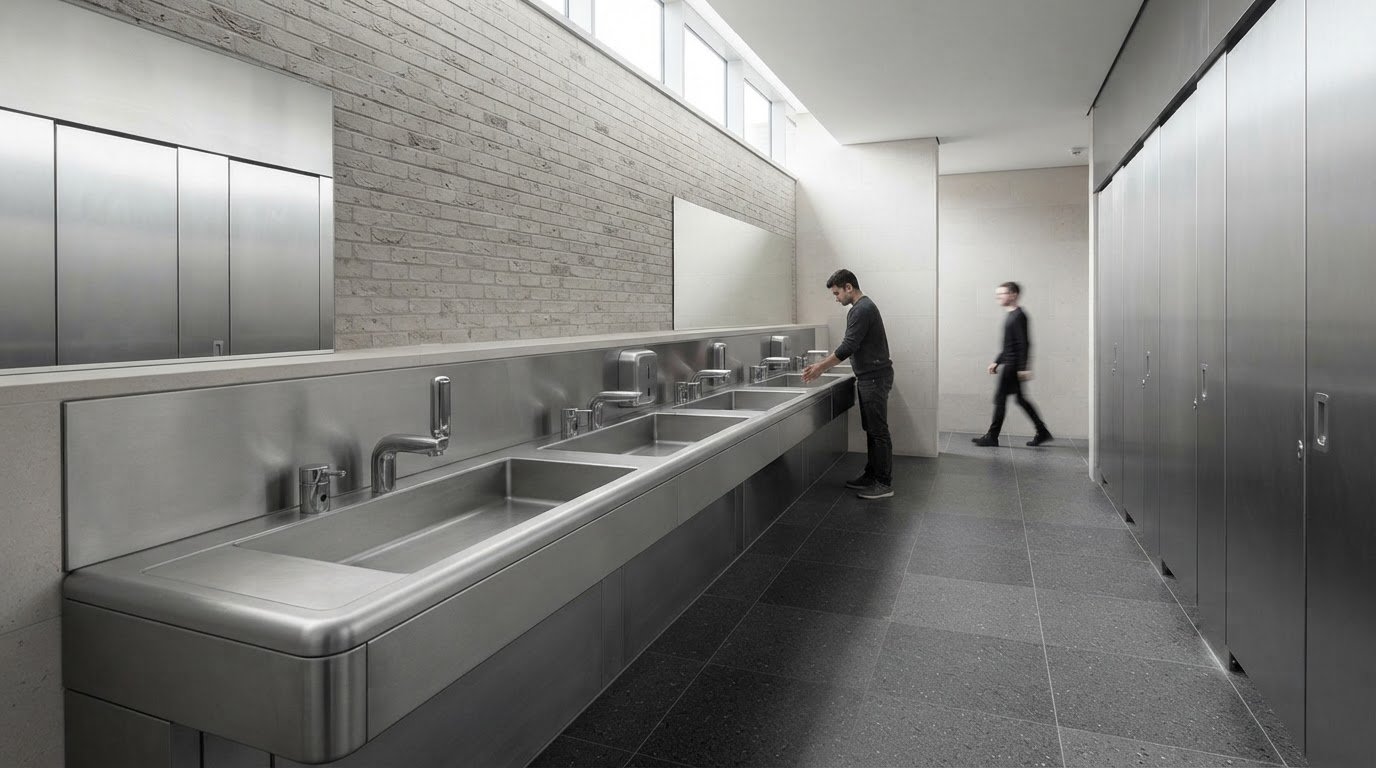
Why do so many commercial washrooms require extensive refurbishment only a few years after installation? For architects, facilities managers, and specifiers, the persistent cycle of cracked ceramic basins, vandalised fittings, and unscheduled downtime represents an unsustainable drain on operational budgets. Traditional vitreous china often fails under relentless public footfall, leaving facilities compromised and difficult to sanitise. Specifying genuine high traffic washroom solutions requires looking beyond short-term fixtures and focusing on robust materials engineered to withstand rigorous, non-stop use.
Every estates team recognises that maintaining pristine hygiene and uninterrupted service in busy public environments can feel like an unending battle. This resource demonstrates how to specify heavy-duty washroom spaces that prioritise total hygiene, structural resilience, and an authentic 50-year lifecycle. From navigating mandatory compliance under Approved Document T and Approved Document M to integrating seamless, bespoke stainless steel surfaces, the guidance below outlines how to design enduring public amenities that drastically reduce maintenance demands.
Key Takeaways
- Understand the functional distinctions between EN 1.4301 and acid-resisting EN 1.4401 stainless steel to achieve an authentic 50-year lifecycle in demanding public environments.
- Discover how specifying robust high traffic washroom solutions eliminates the recurring breakage, maintenance downtime, and bacterial traps inherent to porous ceramic installations.
- Evaluate the practical specification advantages of modular planning using the DECIMETRIC® system versus bespoke, continuous worktops fabricated up to 5 metres in length.
- Master the critical maintenance procedures required to safeguard surface longevity, including why post-clean rinsing must strictly use cold water followed by soft-cloth drying.
The Challenges of Specifying High Traffic Washroom Solutions
Specifying high traffic washroom solutions requires balancing extreme structural durability with uncompromising clinical cleanliness. Public transport interchanges, secondary schools, universities, and acute healthcare facilities endure footfall volumes that quickly degrade standard commercial fixtures. In these demanding environments, traditional vitreous china frequently proves inadequate. Ceramic glazes can chip upon blunt impact, exposing porous earthenware underneath that absorbs moisture, harbours pathogens, and eventually fractures under cyclic physical stress.
Relying on lightweight domestic-style fixtures rather than industrial engineering drastically inflates the total cost of ownership. Beyond the initial purchase invoice, repeated repairs, emergency closures, and cosmetic degradation represent an ongoing operational liability. Thoughtful specification directly influences user behaviour; established research into public toilet design and infrastructure demonstrates that pristine, robustly built amenities actively deter vandalism and casual misuse, establishing an unspoken standard of public respect.
Understanding the Intensity of Public Use
Calculating footfall and fixture fatigue is essential when planning high-capacity facilities. Repeated mechanical loads inevitably loosen standard ceramic basin brackets, while caulked perimeter seals erode to create moisture ingress points. Durable high traffic washroom solutions overcome these common failure points through heavy-gauge fabrication and concealed fixings, giving facilities management teams swift, uncomplicated access to rear plumbing runs without taking whole suites offline.
Hygiene and Infection Control in High-Volume Areas
Infection control in high-volume environments depends upon surfaces that refuse to retain bacteria. Vitreous cracks and porous jointing materials trap moisture, forming resilient biofilms that resist standard chemical sanitisation. In the context of EN 1.4301 grade steel, aseptic surfaces are completely non-porous, chemically inert metal planes that actively inhibit microbial colonisation and allow comprehensive sanitisation without degrading the material matrix. Specifying continuous, welded metal surfaces eliminates dirt traps entirely, safeguarding public health over decades of heavy service. Secondary schools and universities face particularly acute challenges in this regard; estates teams specifying school toilet troughs UK education facilities depend upon must address persistent vandalism, bottleneck congestion during short breaks, and the hygiene failures inherent to traditional ceramic installations. Healthcare environments face particularly stringent demands in this regard; hospital scrub up troughs UK clinical teams depend upon must achieve absolute compliance with HBN 00-10 Part C to suppress biofilm and prevent bacterial aerosol dispersal across surgical scrub rooms.
Material Selection: Why Stainless Steel is the Gold Standard
While many commercial specifications prioritise initial appearance through solid surface composites or compact laminates, these materials often degrade when subjected to chemical cleaners and unyielding footfall. Specifying true high traffic washroom solutions demands a material that combines mechanical strength with chemical inertness. Stainless steel stands as the definitive choice. It resists thermal shock, resists impact without chipping, and withstands rigorous cleaning regimes that would compromise resin-based alternatives.
Material selection centres on two principal austenitic grades:
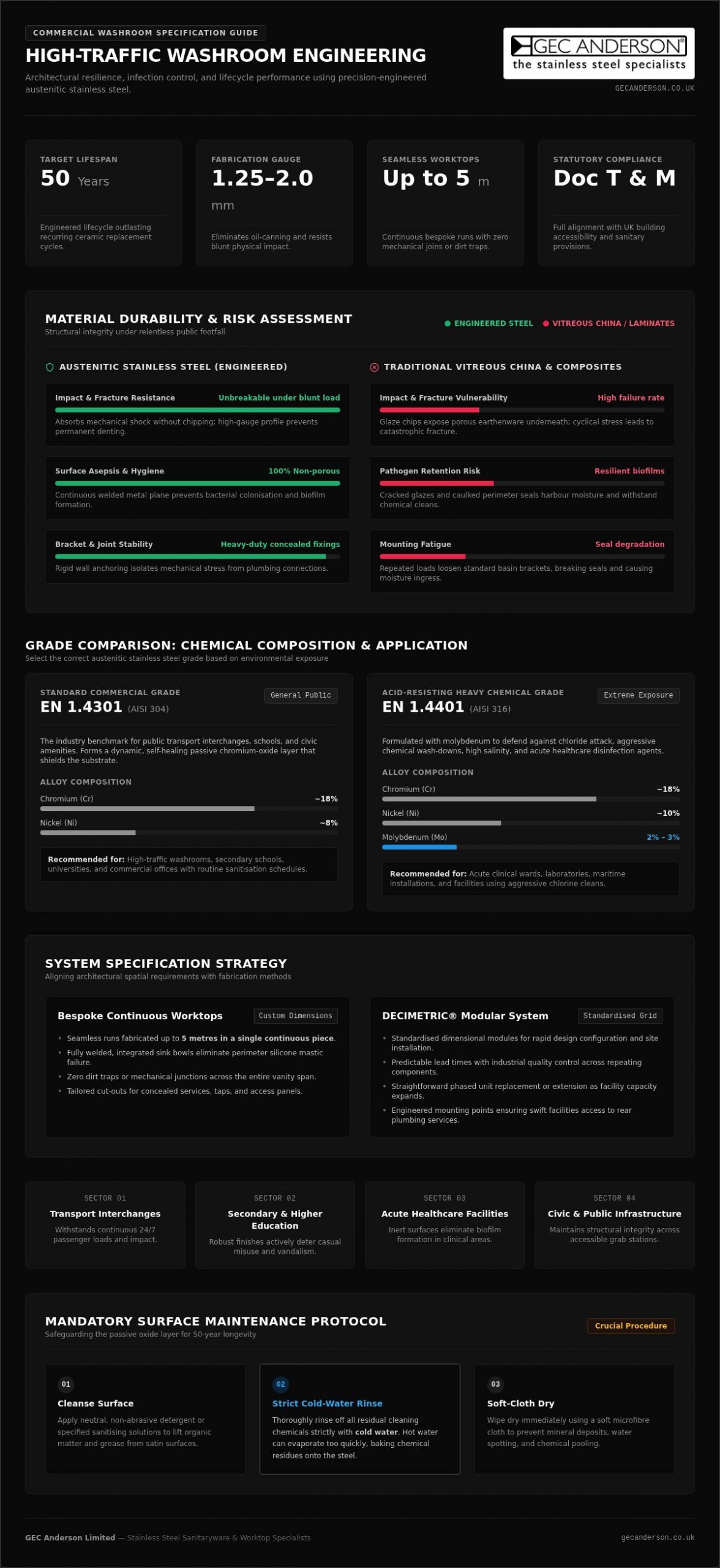
- EN 1.4301 (AISI 304): The standard specification for commercial public environments, containing roughly 18% chromium and 8% nickel for dependable corrosion resistance.
- EN 1.4401 (AISI 316): Formulated with 2% to 3% molybdenum, this acid-resisting alloy suits aggressive environments subjected to stringent chemical wash-downs or high salinity.
Beyond structural resilience, stainless steel delivers an elevated architectural aesthetic. Far from clinical utility, precision satin finishes create a refined, contemporary atmosphere while actively diffusing the visual impact of minor surface marks in heavy-use washrooms. Specifiers designing accessible commercial facilities to strict international criteria, such as ADA toilet room standards, consistently rely on this metal to maintain structural integrity across mandatory grab-points and wash stations.
The Technical Superiority of EN 1.4301 Grade Steel
The balanced chrome-nickel matrix of EN 1.4301 forms a self-healing passive chromium-oxide layer, preventing oxidisation and pitting under constant moisture. In heavy public facilities, material gauge is paramount. Fabricating washroom components from 1.25 mm to 2.0 mm sheet steel guarantees absolute rigidity, eliminating oil-canning and structural deformation when subjected to heavy loads or deliberate impact.
Sustainability and the Circular Economy
Specifying high-grade stainless steel directly advances circular construction goals. Unlike polymer-based panels that end their short operational cycles in landfill, stainless steel sanitaryware offers an authentic 50-year product lifecycle. When an installation eventually reaches decommissioning, the material is 100% recyclable, retaining its full metallurgical properties without downcycling. Specifiers seeking guidance on high-performance fabrications can explore bespoke stainless steel kitchen worktops to understand how identical engineering principles translate across demanding commercial sectors. To review technical drawings or discuss bespoke project parameters, explore the capabilities available at GEC Anderson.
Essential Components for High-Traffic Sanitaryware
Specifying high traffic washroom solutions requires an unyielding focus on structural reinforcement and mechanical simplicity. High-density transport interchanges, sports stadiums, and custodial facilities present distinct challenges: accidental misuse, blunt force, and intentional tampering. While vitreous china fixtures shatter upon sharp impact, creating hazardous sharp edges and instant facility closures, heavy-gauge stainless steel deforms rather than fractures. This mechanical resilience ensures water containment remains intact even under severe duress.
A comprehensive sanitary specification coordinates all room elements into an impenetrable barrier against vandalism and hygiene failure. Specifying integrated accessories, such as wall-recessed waste bins, frameless stainless steel safety mirrors, and robust drinking fountains, eliminates pry points and tampering opportunities. Adhering to strict workplace sanitation and maintenance requirements means handwashing stations must remain permanently operational, hygienic, and free of pooled water or surface degradation.
Heavy-Duty WCs and Urinal Troughs
In high-volume public conveniences, floor-standing or securely back-to-wall WCs fabricated from 1.5 mm to 2.0 mm steel withstand immense vertical and lateral forces. Concealed through-wall fixing bolts and fully enclosed pipework prevent unauthorised access to valves and traps. For male washrooms facing intense peak-hour rushes, continuous urinal troughs offer distinct advantages over individual wall-hung bowls. A continuous trough eliminates joint lines, accelerates throughput, and simplifies targeted chemical cleaning. Specifiers can evaluate comprehensive options within our guide to commercial stainless steel sanitaryware.
Seamless Basins and Wash Stations
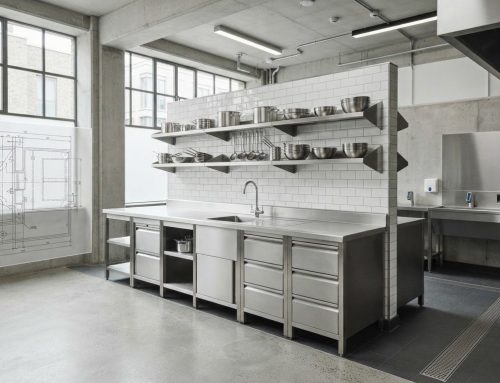
Traditional multi-basin installations rely on perimeter silicone seals that harbour black mould and degrade within months. Fabricating continuous, seamless stainless steel wash stations resolves this persistent issue. Integrating precision-welded Series A sink bowls into tailored stainless steel worktops creates an impervious, monocoque wash surface devoid of grime traps. These bespoke worktops can be engineered to match exacting architectural dimensions, accommodating specific fall requirements, rear splashbacks, and integrated sensor tap cut-outs to deliver complete infection control. Education estates teams managing high-turnover facilities during short break periods will find that the same engineering principles underpinning seamless public wash stations are directly applicable when specifying school toilet troughs UK projects must comply with under BS 6465-2:2017 and Department for Education guidance. The same fabrication principles that govern seamless public wash stations also underpin the hospital scrub up troughs UK healthcare estates teams specify to meet HTM 04-01 water trajectory protocols and prevent splash contamination in surgical environments.
Maintenance Protocols for Maximum Longevity
Even the most robust high traffic washroom solutions rely on rigorous housekeeping regimes to maintain their aesthetic lustre and material integrity over decades. Daily janitorial care requires nothing more complex than a standard cream cleaner applied with a damp cloth or sponge. Cleaners must always work in parallel with the grain of the steel to safeguard the brushed finish. Avoid harsh abrasive pads or wire wool, as these scuff the polished profile and embed carbon particles that trigger subsequent surface oxidisation.
Mineral scale and hard water run-off represent the primary visual nuisance in heavy-use public washrooms. Specifiers and cleaning contractors must follow exacting chemistry protocols when removing stubborn limescale deposits:
- Routine Descaling: Treat localized limescale with standard domestic vinegar or a 10% acetic acid solution, allowing it to dissolve mineral crusts before agitation.
- Industrial Descaling: For severe, established scale accumulations, apply diluted nitric acid mixed precisely at a ratio of one part HNO₃ to four parts water, ensuring operators wear protective equipment in a well-ventilated space.
The Cold Water Rinse Imperative
Rinsing technique governs the long-term appearance of commercial steel. Facilities teams must strictly rinse surfaces with cold water only. Never rinse stainless steel with warm or hot water; elevated temperatures accelerate chemical reactions from residual cleaning agents and promote instant evaporative mineral spotting. Once rinsed, always dry the surface thoroughly with a soft cloth. Never leave fixtures to air dry, as standing water droplets inevitably leave unsightly calcium halos on satin surfaces.
Restorative Care for Heavy-Use Fixtures
Surface blemishes in high-turnover washrooms occasionally arise from environmental contaminants rather than degradation of the parent metal itself. If isolated surface rust spots appear from contact with external iron filings, apply a dry cleaning powder lightly with a damp sponge, working parallel to the grain before completing a cold water rinse and soft-cloth dry. For persistent, deep-seated rust patches, scrub the area using a dry nylon fibre brush or apply diluted nitric acid at a ratio of one part HNO₃ to four parts water. For comprehensive technical advice on long-term estate care, contact GEC Anderson for detailed maintenance guidance.
Specifying Bespoke vs. Modular Washroom Solutions
Determining whether a commercial scheme requires bespoke fabrication or modular planning dictates both installation speed and long-term facility performance. Generic modular systems frequently introduce perimeter joints that trap water and dirt, accelerating structural failure in demanding environments. Delivering successful high traffic washroom solutions hinges on balancing dimensional flexibility against the operational imperative for continuous, easy-clean planes.
Every commercial layout presents distinct structural challenges:
- Modular Coordination: Ideal for uniform floorplates and rapid procurement programmes where standard footprints minimise installation labour.
- Bespoke Fabrication: Essential for maximising irregular alcoves, historic building refurbishments, or high-volume transit hubs requiring wall-to-wall seamless integration.
Architects coordinating directly with experienced fabricators eliminate site discrepancies early. Providing complete pre-production CAD drawings ensures precise alignment with contractor services, tap centres, and structural wall studs before metal cutting begins. This meticulous British engineering process guarantees seamless coordination and timely site delivery.
When to Choose Made-to-Measure
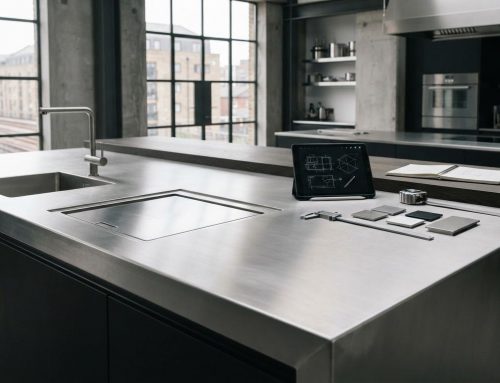
Made-to-measure fabrications resolve awkward architectural corners, out-of-square structural walls, and restricted service risers. Specifiers can achieve continuous stainless steel worktops up to 5 metres in length without a single joining seam. Eliminating mechanical joins ensures water cannot penetrate the cabinetry beneath, creating architectural installations that serve as both hygienic work stations and durable design statements. For complex configurations, consult our technical resource on made to measure stainless steel sinks.
The DECIMETRIC® Modular Advantage
When project schedules demand swift specification without compromising industrial build standards, the DECIMETRIC® system provides an exceptional modular framework. Designed around 100 mm dimensional increments, this system standardises lengths up to 3,000 mm alongside 600 mm or 700 mm standard widths. It allows specifiers to configure robust stainless steel worktops, integrated sinks, base cabinets, and shelving units with predictable precision, achieving durable high traffic washroom solutions across demanding institutional estates.
Specifying Washrooms Built for the Next Fifty Years
Achieving true longevity in public facilities requires matching design ambition with industrial reality. By moving away from fragile ceramics in favour of heavy-gauge stainless steel, specifiers eliminate the persistent cycle of mechanical failure and surface contamination. Whether deploying modular 100 mm systems for rapid estate programmes or engineering continuous five-metre seamless worktops, purposeful high traffic washroom solutions protect operational budgets while maintaining flawless hygiene over a 50-year lifecycle.
Established in 1962 with over 60 years of British engineering expertise, GEC Anderson combines precision craftsmanship with ISO 9001-certified manufacturing. Trusted across demanding sectors by clients including the NHS, London Underground, and the BBC, our technical team supports your design process from initial CAD layouts to final on-site coordination. When you are ready to eliminate downtime and elevate facility durability, explore our range of high-traffic washroom solutions and specify with absolute confidence.
Frequently Asked Questions
What is the best material for high-traffic public washrooms?
Heavy-gauge austenitic stainless steel is widely recognised as the superior material for demanding public conveniences. Unlike vitreous china or acrylic composites, steel withstands severe impact without cracking, chipping, or fracturing. Its impermeable, non-porous structure resists bacteria, harsh sanitising chemicals, and thermal shock. For facilities teams managing relentless footfall, robust high traffic washroom solutions manufactured from stainless steel provide unparalleled longevity and minimal operational disruption.
How long does a stainless steel washroom fixture typically last?
A quality stainless steel washroom fixture typically achieves an operational lifespan of approximately 50 years. Vitreous china installations often require replacement within 10 to 15 years due to structural chips, failing seals, or hairline fractures. Heavy-duty steel components maintain their mechanical integrity over half a century. This long design life drastically reduces lifecycle costs and eliminates the disruption of frequent fixture replacements in commercial buildings.
Can stainless steel sanitaryware be customised to fit specific room sizes?
Yes, stainless steel fabrications can be tailored to exact architectural dimensions, including seamless worktops up to 5 metres in length. Bespoke manufacturing resolves out-of-square walls, unusual alcoves, and awkward corner layouts where standard modular products leave unhygienic gaps. Pre-production CAD drawings verify all tap positions, bowl configurations, and waste runs prior to precision laser cutting and welding, guaranteeing an accurate fit on site.
Is stainless steel more hygienic than ceramic for commercial use?
Yes, stainless steel provides superior hygiene compared to commercial ceramic fixtures. Ceramic glazes can chip under daily wear, exposing porous earthenware that absorbs fluids and harbours microbial colonies. Stainless steel is completely non-porous and aseptic, preventing pathogens from penetrating the surface matrix. When fabricated as seamless units, it eliminates grime-trapping joint lines and perimeter caulking, facilitating rapid, uncompromising chemical sanitisation.
How do you prevent vandalism in high-traffic washrooms?
Preventing vandalism requires specifying heavy-gauge 1.25 mm to 2.0 mm welded stainless steel with fully concealed through-wall fixings. Eliminating exposed pipework, delicate handles, and weak bracket points prevents intentional tampering. Monolithic fixtures cannot be shattered into hazardous fragments or set alight. Integrating robust high traffic washroom solutions, such as recessed accessories and continuous wash troughs, creates an environment that naturally discourages antisocial behaviour and abuse.
What is the correct way to clean and maintain stainless steel sinks?
Clean the surface using a general cream cleaner applied with a damp cloth, always rubbing in line with the grain of the steel. You must only rinse with cold water; never use warm or hot water, as heat promotes mineral staining. Finish by drying the surface thoroughly with a soft cloth, and never allow it to air dry. For calcium deposits, apply domestic vinegar or 10% acetic acid.
Is stainless steel sanitaryware recyclable at the end of its life?
Yes, stainless steel sanitaryware is 100% recyclable at the end of its operational life. The alloy retains its entire metallurgical value and structural characteristics during the remelting process, avoiding downcycling into lower-grade materials. This circular capability, combined with a 50-year service lifecycle, makes stainless steel an environmentally sound specification for sustainable commercial building projects seeking high circularity standards.
What is the difference between 304 and 316 grade stainless steel?
The primary difference lies in chemical composition and corrosion resistance. Standard EN 1.4301 (AISI 304) contains roughly 18% chromium and 8% nickel, providing exceptional durability for typical commercial washrooms. Acid-resisting EN 1.4401 (AISI 316) incorporates 2% to 3% molybdenum, which delivers higher resistance against aggressive chlorides, industrial sanitising acids, and coastal exposure where pitting corrosion poses a significant operational risk.