
The right stainless steel mirror for a washroom isn’t chosen by appearance alone. Its setting, dimensions, fixing requirements and expected cleaning routine all affect whether it will suit the project. Specify stainless steel mirrors for washrooms around the practical demands of the space, then confirm the product details with the supplier.
Before selecting a mirror, establish what the washroom needs and which product details are confirmed. A description such as “stainless steel mirror” does not, by itself, tell you which parts are stainless steel, how the mirror is constructed or what fixings it needs.
This guide explains how to assess a mirror for a residential or professional washroom, what to request when checking product specifications and which installation details to resolve before work begins. It also covers stainless steel care, including cleaning with the grain, rinsing with cold water and drying with a soft cloth. GEC Anderson lists mirrors within its sanitaryware range and provides technical guidance on stainless steel products, which can help you frame questions as you develop a specification.
Key Takeaways
- Set out the washroom’s users, cleaning routine, available space and design intent before assessing stainless steel mirrors for washrooms.
- Ask the supplier to confirm dimensions, material grade, surface finish, fixing details and product-specific care instructions.
- Separate confirmed specifications from details that are not stated or depend on the project. Don’t treat assumptions as standard features.
- Coordinate measurements, fixing information and installation responsibilities with the project team before work begins.
- For stainless steel surfaces, clean with the grain, rinse with cold water and dry with a soft cloth. Confirm separate care instructions for other mirror components.
Why choose stainless steel mirrors for washrooms? Start with the project requirements
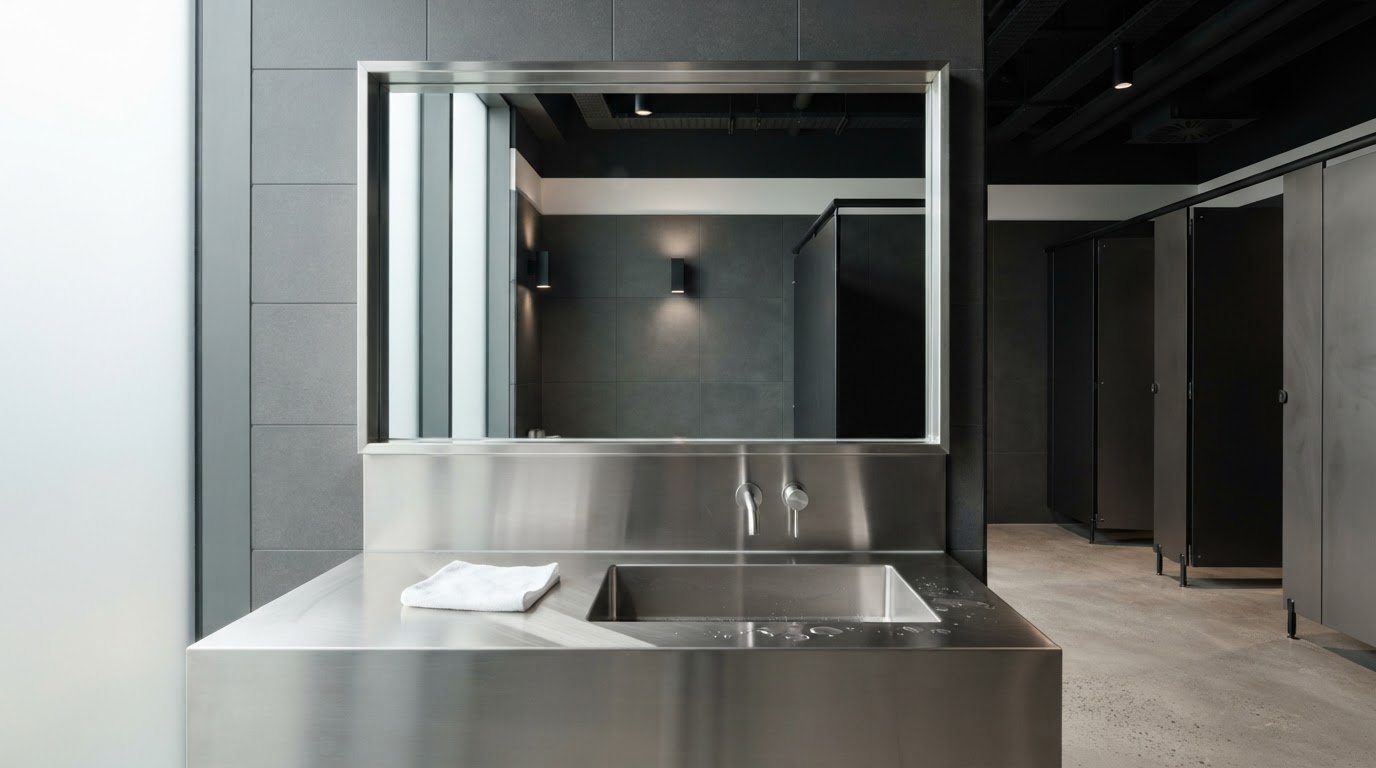
A stainless steel washroom mirror includes a stainless steel component, but that description alone doesn’t establish how the product is made. Stainless steel might form a frame, backing, surround or another part of the assembly. Ask the supplier to identify which components use stainless steel and explain how the reflective surface is produced and supported.
Start with the room and its users. A mirror in a private home may face different use and cleaning demands from one in a healthcare, education or workplace washroom. Consider who will use it, how often the room is occupied, how it will be cleaned, the space available and the intended appearance. These points help you define the brief, but they don’t confirm that a particular product is suitable. General information about what stainless steel is cannot establish the construction or performance of a specific mirror.
Which washroom requirements should you establish first?
Before requesting product details, record the project type and practical needs of the space. Note the expected use, user requirements, cleaning routine and design intent. Measure the proposed location, then check nearby fittings, circulation routes and sightlines. Share these details with the supplier and project team so they can assess the product against the actual setting.
For example, a basin, dispenser or other wall fitting may reduce the usable area or affect the mirror’s position. Circulation and sightlines also matter when deciding where it should sit. Treat these as checks against the site and design, not as reasons to assume a standard size or fixing method.
What does stainless steel contribute to a mirror specification?
The relevance of stainless steel’s material characteristics depends on the grade, finish and construction of the mirror being considered. Ask the supplier to identify the stainless steel component and provide product-specific information to support claims about hygiene, corrosion resistance, resistance to damage or service life. Don’t apply general material properties to a complete mirror without evidence about that product.
A useful starting brief is simple: Who will use the mirror, where will it go, how will it be cleaned, and what must the supplier confirm about its construction? Answering these questions separates essential requirements from preferences and gives the specification a practical foundation.
How to specify a stainless steel washroom mirror with confidence
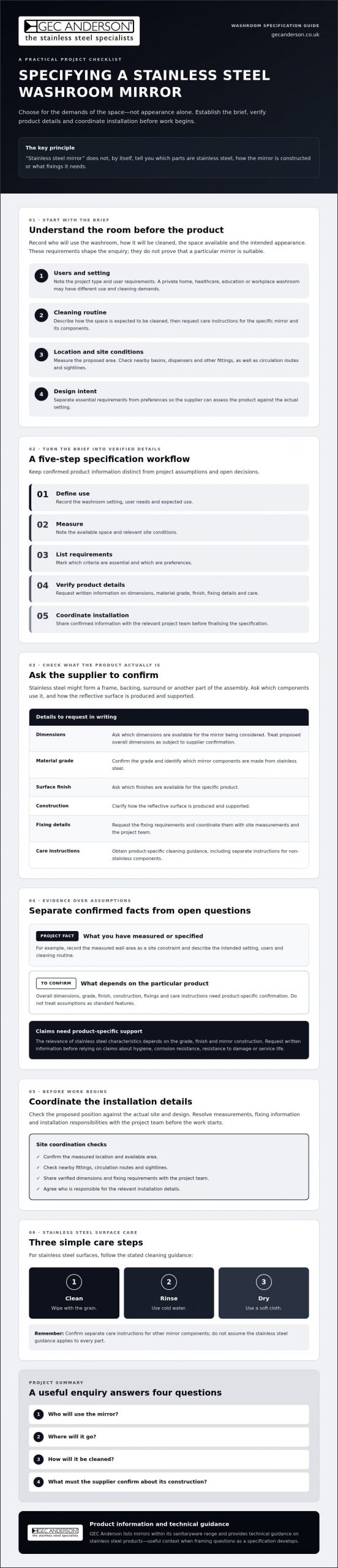
A reliable specification turns the project brief into details a supplier can verify. For stainless steel mirrors for washrooms, work through the requirements in order: define the use, measure the location, list essential criteria, check product information and coordinate installation. This keeps preferences separate from confirmed product attributes and helps prevent assumptions from carrying through into drawings or procurement.
- Define use: record the washroom setting, user needs and expected use.
- Measure: note the available space and relevant site conditions.
- List requirements: separate essential criteria from preferences.
- Verify product details: request written information on dimensions, material grade, finish, fixing details and care.
- Coordinate installation: share confirmed information with the relevant project team before finalising the specification.
What details should you include in a mirror enquiry?
Give the supplier the intended setting, user requirements, preferred location and measured space. Ask which configurations, dimensions, grades and finishes are available for the mirror being considered. Request written confirmation of fixing requirements and cleaning guidance, along with any project documentation needed by the design or facilities team.
Make it easy to identify what is fixed and what is still open. For instance, state the measured wall area as a site constraint, but mark the mirror’s proposed overall dimensions as subject to supplier confirmation. This avoids confusing a design preference with a product specification.
How should architects and facilities teams verify material claims?
Check the proposed grade and finish against written information for the specific product. GEC Anderson literature refers to stainless steel grades EN 1.4301 and EN 1.4401, but this does not confirm that either grade applies to its mirrors. Ask the supplier to verify the mirror’s material details and provide relevant technical information or drawings for review before finalising the specification.
A project requirement describes what the washroom needs; a verified product specification confirms what the supplier can provide. Keep those records distinct. If a detail is not stated, mark it for confirmation instead of filling the gap with an assumption. This is particularly useful when coordinating the mirror with surrounding fittings or agreeing who is responsible for installation.
GEC Anderson provides technical guidance on stainless steel products and lists mirrors within its sanitaryware range. Its stainless steel washroom guidance can provide broader context for preparing a brief. Confirm mirror-specific information directly before including it in project documents.
Stainless steel washroom mirrors: compare requirements, not unsupported claims
Products described as stainless steel mirrors may differ in construction, dimensions, finish and fixing requirements. The material name alone doesn’t establish how a mirror will perform in a particular washroom. Compare each option with the project brief and written supplier information rather than relying on generic rankings or broad claims about durability, hygiene or resistance to damage.
Use a comparison schedule to separate verified details from open questions. “Not stated” means the information hasn’t been confirmed in the product details you have, not that the feature is unavailable. Mark requirements as “project-dependent” when the right answer depends on the site or design.
Which mirror specification fields are meaningful to compare?
Record the supplier’s exact wording and where each detail comes from, such as a product document, drawing or written response. Keep visible characteristics separate from installation requirements. A stated finish describes appearance, while fixing information helps the project team plan installation.
| Specification field | What to compare | Status to record |
|---|---|---|
| Dimensions | Confirmed overall size and any relevant drawing | Confirmed, not stated or project-dependent |
| Material | Which component is stainless steel and any stated grade | Confirmed only with product-specific evidence |
| Finish | The finish identified for the mirror component | Not stated until verified |
| Fixing | Supplier’s fixing details and installation requirements | Record separately from appearance |
| Documentation | Drawings and relevant technical information supplied | List what has been received or remains outstanding |
| Maintenance | Product-specific cleaning and care instructions | Confirm before setting the cleaning routine |
How do you assess a mirror for a demanding washroom?
Describe the actual conditions to the supplier: who will use the room, how often it will be used, what cleaning routine is planned and which project requirements matter most. Then request evidence for any product-specific claims about durability, hygiene or resistance to damage. A general description of stainless steel isn’t evidence that every mirror construction is suitable for every environment.
When comparing stainless steel mirrors for washrooms, check each response against the brief and resolve gaps before approval. If a dimension, grade, finish, fixing method or care instruction is unconfirmed, keep it visible as an open item. This makes differences between options easier to assess without turning assumptions into specifications.
How to plan installation and maintain a stainless steel washroom mirror
Plan installation around approved product information, not an assumed fixing method. Before work begins, check that the confirmed dimensions suit the site and that the fixing details correspond with the wall and surrounding conditions. Agree who is responsible for measuring, supplying fixings and completing the installation. Check the proposed position against access, adjacent fittings and the design intent.
Follow the supplier’s instructions for the specific mirror. Construction can vary, so a method suitable for one product should not be treated as universal. Resolve missing information with the supplier and project team before installation, especially if the mirror includes components that need different handling or care.
How should you clean stainless steel mirror surfaces?
For the stainless steel component, apply a general-purpose cleaning material such as cream cleaner to a damp cloth or sponge. Rub gently, following the grain of the stainless steel. Follow the supplier’s product-specific instructions, particularly if the mirror includes other materials or a reflective face that needs separate care.
Rinse the cleaned stainless steel thoroughly with cold water, then dry it carefully with a soft cloth. Never rinse with warm or hot water, and don’t leave the surface to air-dry. If discolouration remains, repeat the cleaning process, then rinse with cold water and dry with a soft cloth.
Calcium deposits can be removed with vinegar, 10% acetic acid or diluted nitric acid at one part HNO₃ to four parts water. Apply the solution following the grain. If using diluted nitric acid, ensure good ventilation and follow the usual rules for handling strong acids. After treatment, rinse thoroughly with cold water and dry with a soft cloth. Check the supplier’s care guidance before applying any cleaner to the mirror assembly.
Rust stains call for a different method from routine cleaning. For a stain that has not persisted long, apply dry cleaning powder lightly with a damp cloth or sponge, rinse with cold water and dry with a soft cloth. For rust that has persisted for an extended period, use a dry nylon fibre brush or diluted nitric acid at one part HNO₃ to four parts water. With nitric acid, ensure good ventilation and follow the usual rules for handling strong acids. Rinse with cold water and dry with a soft cloth. See the stainless steel rust removal guide for these stated methods.
For project-specific stainless steel guidance, the GEC Anderson website provides a starting point. Confirm mirror-specific installation and care instructions with the supplier before work begins.
Where GEC Anderson fits into a stainless steel washroom mirror project
GEC Anderson lists mirrors within its SANITARYWARE range and provides technical guidance on stainless steel products for professional and residential environments. Mirror-specific dimensions, grades, finishes, fixing details and availability need to be confirmed, so treat them as questions rather than assumed features. A useful first step is to ask whether the company’s mirror offering suits the intended washroom and project brief.
For broader context on specifying washroom products, see the commercial stainless steel sanitaryware guide. It can help frame the wider specification, but details for a particular mirror still need to be confirmed directly.
What can you ask a stainless steel specialist?
Ask which mirror formats are available and request confirmation of the dimensions, material grade, finish and fixing information relevant to the application. You can also ask for applicable technical information, care guidance and drawings, where available. If manufacturing credentials are referenced, check whether they apply to the specific mirror rather than assuming they cover every item in a range.
Where pre-production CAD drawings are applicable, the documented process is to share the requirements, review the drawings and approve them before production. This gives the project team an opportunity to check that the proposed details reflect the agreed brief. Confirm which drawings will be provided and what information they contain for the mirror under consideration.
What information should accompany your enquiry?
A concise project summary helps make the discussion specific. Include the washroom setting, intended use, available dimensions and known installation constraints. List unanswered questions too, such as which material and finish are proposed, what fixing details apply, and whether care instructions or product documentation are available. This makes it easier to distinguish confirmed information from details that still need a response.
GEC Anderson Limited was founded in 1962 and offers technical support, including design guidance and cleaning and maintenance guidance. For stainless steel mirrors for washrooms, share the project brief and ask the company to confirm whether its mirror offering is suitable, along with any relevant specifications.
Discuss your washroom mirror requirements with GEC Anderson.
Make your mirror specification work for the project
A well-considered washroom mirror starts with the setting, users and cleaning routine. Define those needs, measure the intended location and compare options using details confirmed by the supplier, including construction, dimensions, finish and fixing requirements. Don’t treat a general description of stainless steel as proof of a particular mirror’s performance.
Installation should follow confirmed product information, with responsibilities agreed by the project team. For ongoing care, follow the supplier’s instructions for each component. Clean stainless steel in the direction of the grain, rinse with cold water and dry with a soft cloth. These steps give stainless steel mirrors for washrooms a clearer path from selection to maintenance.
GEC Anderson offers technical support, including design and cleaning guidance. Mirror-specific details still need to be confirmed for your project. With the brief and open questions ready, contact the company to discuss whether its mirror offering suits your requirements.
Frequently Asked Questions
Are stainless steel mirrors suitable for washrooms?
They can be suitable when the specific product’s construction and documented performance meet the needs of the room. Confirm whether stainless steel forms the frame, backing, surround or another component, and ask for product-specific information on dimensions, grade, finish and care. Consider the setting, use and cleaning routine. The material name alone doesn’t establish suitability for every washroom or prove claims about hygiene, corrosion resistance or durability.
How do you clean a stainless steel washroom mirror?
Clean the stainless steel component with a general-purpose cream cleaner applied using a damp cloth or sponge, rubbing gently in the direction of the grain. Rinse thoroughly with cold water and dry carefully with a soft cloth. Never rinse with warm or hot water or leave the surface to air-dry. If the mirror includes other materials or a separate reflective face, follow the supplier’s instructions for those surfaces.
Can stainless steel mirrors develop rust stains?
Yes. Rust stains commonly originate from foreign iron or carbon steel that has contacted the surface, or from water with a high iron content that leaves marks after evaporation. Chloride-containing materials, including salt, can also cause corrosion and should be removed immediately. A rust mark doesn’t necessarily mean the mirror itself is made from rusting steel, so check the product construction and use the appropriate care method.
What should I check before specifying a stainless steel washroom mirror?
Confirm the dimensions, the role and grade of the stainless steel, the finish, fixing requirements and care instructions with the supplier. Check these details against the intended location, users, cleaning routine and installation conditions. Request relevant written product information or drawings, and mark unconfirmed details as outstanding rather than assuming they are standard. Verify any claims about durability or resistance to damage for the specific mirror being considered.
Can vinegar remove calcium deposits from stainless steel?
Yes. Vinegar is one of the specified options for removing calcium deposits from stainless steel. The other listed options are 10% acetic acid or diluted nitric acid at one part HNO₃ to four parts water. Apply the cleaning material following the grain. After treatment, rinse thoroughly with cold water and dry carefully with a soft cloth. If using diluted nitric acid, ensure good ventilation and follow the usual rules for handling strong acids.
What should I do if a rust stain does not come off easily?
If the rust has persisted for an extended period, use only a dry nylon fibre brush or diluted nitric acid at one part HNO₃ to four parts water. If using nitric acid, ensure good ventilation and follow the usual rules for handling strong acids. Rinse thoroughly with cold water and dry with a soft cloth. For a recent stain, use the separate dry cleaning powder method: apply it lightly with a damp cloth or sponge, then rinse with cold water and dry with a soft cloth. Don’t substitute other chemicals or tools.