
A whole-fit-out estimate can look precise whilst revealing very little about the stainless steel within it. To understand commercial kitchen fabrication costs UK, separate worktops, sinks, cabinets, shelving and splashbacks from appliances, ventilation and wider building work. The specification, not simply the kitchen’s size, shapes the fabrication scope.
Suppliers’ quotes may describe different dimensions, materials, integrated features or levels of customisation. A made-to-measure worktop with an integrated sink is not the same specification as a modular unit, even if both appear to serve the same purpose.
This guide explains the main factors that shape fabrication costs without relying on unsupported headline prices. It also shows how to compare bespoke and modular stainless steel on a like-for-like basis, and what information to prepare for a useful quotation. GEC Anderson supplies stainless steel products rather than complete kitchen fit-outs. Pre-production CAD drawings can help clarify proposed dimensions and configurations before manufacture.
Key Takeaways
- Separate stainless steel products from appliances, extraction and other project costs to define what a fabrication quotation covers.
- Understand how dimensions, quantities and integrated features shape commercial kitchen fabrication costs UK, and why a clear scope matters.
- Compare quotations against matching product details, including material grade, gauge, finish and dimensions.
- Prepare quantities, product references and project drawings so suppliers can assess the brief and clarify assumptions.
- Assess whether a modular system or a made-to-measure specification better suits your layout and requirements.
Commercial kitchen fabrication costs UK: what the budget covers
A fit-out budget covers the wider project; a fabrication quotation covers the specified manufactured fixtures and only the additional work explicitly included in that quote. Keep these figures separate to understand what you’re comparing and where other project costs sit.
Commercial kitchens serve different parts of the food service industry, from catering operations to institutional settings. Their layouts and requirements vary, so a useful fabrication estimate starts with a defined scope rather than a generic kitchen size. The product list, dimensions, quantities and drawings all affect what a supplier is being asked to manufacture.
What is included in commercial kitchen fabrication?
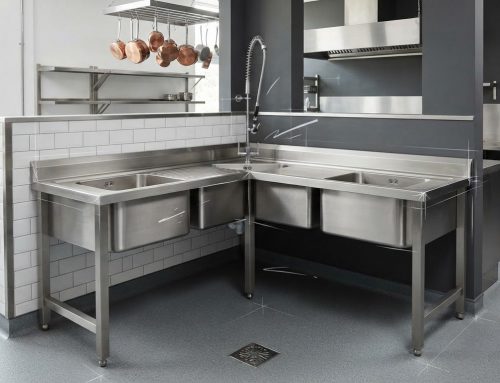
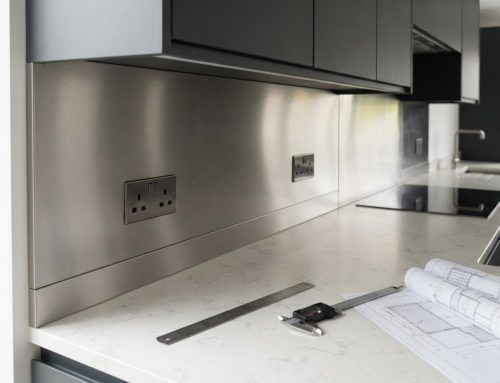
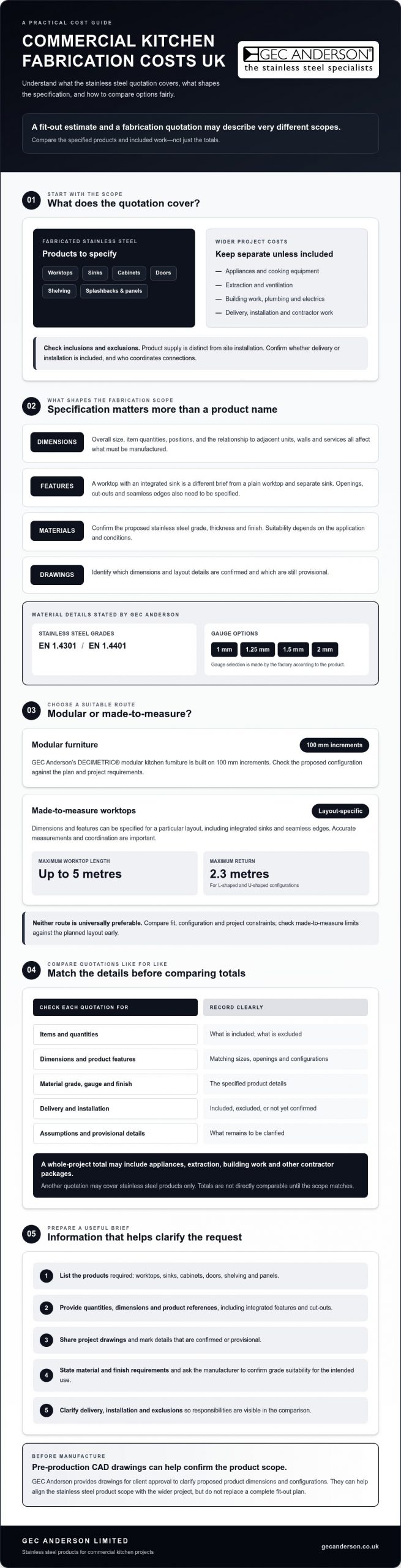
Fabricated stainless steel products can include worktops, sinks, cabinets, doors, shelving and panels such as splashbacks. The quotation should identify each item and give its required dimensions and features. For example, a worktop with an integrated sink is a different brief from a plain, separate worktop and sink.
Product supply is distinct from site installation and other contractor packages. Confirm whether a quotation covers delivery, installation or neither, and establish who is responsible for coordinating connections. GEC Anderson manufactures stainless steel products, but doesn’t supply kitchen appliances or provide general plumbing services.
Why whole-project budgets are not like-for-like
A whole-project estimate may combine fabricated fixtures with cooking equipment, extraction, building work, plumbing, electrics and installation. Another supplier’s figure might cover only the stainless steel products. Totals can look comparable whilst describing substantially different scopes, so don’t assess them on price alone.
For a like-for-like review, record the items included in each estimate and list exclusions and assumptions alongside them. Check that quantities, dimensions and product features match, then note any work assigned to another contractor. If project drawings are still developing, make clear which details are confirmed and which remain provisional.
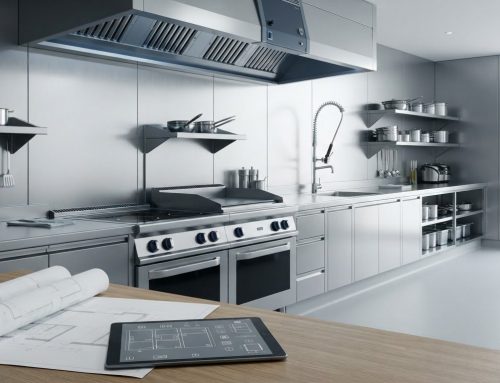
Clear documentation makes the next comparison more useful. GEC Anderson provides pre-production CAD drawings for client approval, helping confirm proposed product layouts and dimensions before manufacture. These drawings don’t replace a complete fit-out plan, but they can help align the stainless steel product scope with the wider project.
Which specification choices shape commercial kitchen fabrication costs?
The specification determines how much material and manufacturing work is required. Overall dimensions, the number of items, their positions and the details of each component all contribute to the fabrication scope. A run of standard worktops, for example, is a different brief from one with several sink openings, cut-outs and bespoke dimensions to suit fixed site constraints.
These choices are why commercial kitchen fabrication costs UK can’t be assessed from a product name alone. A useful brief describes what each item must do and how it fits with adjacent units, walls and services. Guidance from the Nationwide Caterers Association (NCASS) can also help caterers consider the practical needs of operating a food business as they develop their requirements.
Made-to-measure or modular stainless steel?
Standard products may suit a project where available dimensions and configurations fit the layout. Modular furniture offers a defined system of repeatable units. GEC Anderson’s DECIMETRIC® modular kitchen furniture is built on 100 mm increments, so check the proposed configuration against the plan and project requirements.
Made-to-measure worktops and sinks allow dimensions and features to be specified for a particular layout, including integrated sinks and seamless edges. A worktop can be made up to 5 metres long, with a maximum return of 2.3 metres for L-shaped and U-shaped configurations. Check these limits against the planned layout early in the design process. Bespoke dimensions can address site-specific requirements, but need accurate measurements and coordination. Neither route is universally preferable: compare fit, configuration and project constraints.
Material, gauge and fabrication detail
Stainless steel grade and thickness are specification decisions, not universal defaults. GEC Anderson uses EN 1.4301 and EN 1.4401 grades; the appropriate choice depends on the application and conditions. Ask the manufacturer to confirm the proposed grade and its suitability for the intended use.
Gauge options are 1 mm, 1.25 mm, 1.5 mm and 2 mm, with selection made by the factory according to the product. Rather than assuming a particular thickness, ask which gauge is specified for each item and confirm it on the quotation. Also identify the finish and any integrated sink, seamless edge or bespoke cut-out. Confirm the relevant specification and finish directly, as availability can depend on the product.
To compare proposals, record dimensions, quantities, grade, gauge and fabrication details in the same schedule for each supplier. Clarify assumptions about site measurements or interfaces with other work before approving drawings. If you’re specifying a work surface, you can review stainless steel worktops as one of the product categories to consider.
How to compare commercial kitchen fabrication quotations
Once the product brief is defined, use the same schedule to request and review each quotation. A lower total isn’t meaningful if it covers fewer items, different dimensions or a narrower service scope. For a sound comparison of commercial kitchen fabrication costs UK, obtain current, project-specific quotations and check what each supplier has actually allowed for.
Build a like-for-like fabrication comparison
List every product and quantity, then compare each quotation against the same details. A simple table makes gaps visible before you assess the quoted totals:
- Product and quantity: number and type of worktops, sinks, cabinets, doors, shelves and panels.
- Dimensions and layout: agreed measurements, positions and interfaces with walls or adjoining units.
- Material and finish: specified stainless steel grade, gauge and finish.
- Features: integrated sinks, cut-outs, edges or other bespoke details.
- Scope: product supply, site measurement, installation, delivery and any work assigned to other trades.
Ask each supplier to state inclusions, exclusions and assumptions in writing. If a detail is undecided, record it as provisional rather than treating different assumptions as equivalent. Keep fabrication separate from installation and other contractor packages so the comparison reflects the same work on each side.
Check drawings, manufacturing and service scope
The price is only one part of the offer. Check what technical information and coordination are included, and how responsibilities are divided. In particular, ask whether pre-production CAD drawings are provided for client approval and what information the supplier needs to prepare them.
Clarify how site dimensions will be established if the project requires them. Ask whether you must provide confirmed measurements or templates, and who checks that the agreed dimensions suit the site. Don’t assume these activities are included unless the quotation says so.
Before proceeding, confirm how the final specification is recorded in the written order and how delivery is coordinated with the project. Check that the approved drawings, quotation and order describe the same products and features. GEC Anderson provides pre-production CAD drawings for client approval and coordinated delivery; confirm the arrangements for your project directly.
With scope, specification and responsibilities aligned, you can judge whether differences between current quotations reflect the products and service offered, rather than missing details or mismatched assumptions.
How to prepare a commercial kitchen fabrication brief
A well-prepared brief gives suppliers a clearer basis for defining the work and helps make quotations more useful. For commercial kitchen fabrication costs UK, the detail matters: product types, quantities, dimensions and integrated features should be clear enough to review against the project layout.
Information to gather before requesting a quotation
Start with the products required, such as worktops, sinks, cabinets, shelving or splashbacks. Note product references for standard items and describe custom requirements in practical terms. Include available plans and dimensions, showing locations and relationships between items, walls and other fixed elements.
Record features that affect the design, such as sink integration, cut-outs or edge details. Also describe the intended working environment and any material grade or finish requirements already established by the project team. If a detail is undecided, mark it clearly rather than leaving suppliers to make different assumptions.
For a worktop brief, the made-to-measure worktops specification guide can help identify the information to consider. For sink-specific planning, refer to the bespoke stainless steel sinks reference. Confirm product details and finish availability for the particular project.
From CAD approval to production
Use a defined sequence to take the brief from enquiry to manufacture:
- Submit the requirements: provide the product list, quantities, references, dimensions and available project drawings.
- Review the proposal: check the pre-production CAD drawings against the intended layout, measurements and specified features.
- Resolve and approve: raise discrepancies or amendments, then approve the drawings once they accurately reflect the agreed scope.
- Confirm the order: check the written order confirmation, including the delivery date, before production proceeds.
Production follows client approval and written order confirmation. Treat drawing review as a practical check, not a formality: confirm dimensions, orientations, openings and interfaces with adjoining elements before approval.
Where installation is required, site visits for dimensions or templates may be arranged. Establish this during the enquiry, including what measurements or access information the supplier needs and how responsibilities are divided. GEC Anderson provides pre-production CAD drawings for client approval and coordinated delivery; confirm the specific arrangements for the project.
For a product brief based on your project requirements, review GEC Anderson’s stainless steel specification options.
Choose the right stainless steel fabrication route for your project
The right approach depends on how closely defined product dimensions and configurations fit the project layout. A modular system can suit a plan that works with repeatable units, whilst made-to-measure products may be more appropriate where fixed site dimensions or integrated features require a tailored specification. Neither route is automatically preferable; let the brief determine the choice.
For shelving or storage, include the required locations, quantities and dimensions in the product schedule. This makes it easier to assess whether standard or modular units meet the layout, or whether a made-to-measure solution needs to be considered.
Match the fabrication approach to the project
GEC Anderson’s DECIMETRIC® modular kitchen furniture is built on 100 mm increments. Assess the proposed configuration against the available space and project drawings, and confirm that the specific requirements can be met. A defined system can help organise a layout around repeatable units; it may be less suitable if the dimensions or features fall outside that configuration.
Made-to-measure worktops and sinks can be specified for particular dimensions and may include integrated sinks or seamless edges. These details can address a site-specific design, provided measurements and interfaces are clearly established. If storage is in scope, consult the stainless steel storage systems guide as part of planning the product schedule.
What GEC Anderson can support
GEC Anderson is an independent specialist manufacturer of standard, modular and made-to-measure stainless steel products, including worktops, sinks, cabinets, shelving and splashbacks. It supplies products for professional environments, not complete kitchen fit-outs, appliances or general plumbing services. Keep those other packages distinct in the project plan.
For a defined product brief, the company provides technical guidance and pre-production CAD drawings for client approval. Measurement requirements and any site visit for dimensions or templates should be discussed where relevant to the project. Coordinated delivery is also part of its service; confirm the specific arrangements and product details for your requirements.
Clear dimensions, quantities, product references and drawings give both parties a sound basis for discussing the specification. This is more useful than seeking an indicative figure without an agreed scope, and helps ensure a quotation reflects the intended products rather than the entire fit-out.
Discuss your stainless steel fabrication brief with GEC Anderson and request a quotation based on your project requirements.
Turn a clear specification into your next step
A useful understanding of commercial kitchen fabrication costs UK starts with separating stainless steel products from the wider fit-out, then comparing quotations against the same dimensions, materials, quantities and features. A defined brief helps reveal what each supplier has included and gives you a sounder basis for choosing between modular and made-to-measure options.
GEC Anderson is an independent specialist manufacturer, founded in 1962, supplying standard, modular and made-to-measure stainless steel products. Its technical specification support and pre-production CAD drawings help clarify the proposed products before manufacture. The company supplies stainless steel products, not a complete kitchen fit-out.
Prepare your product list, drawings and requirements, then discuss your stainless steel fabrication brief with GEC Anderson and request a quotation for the specified products.
Frequently Asked Questions
What affects commercial kitchen fabrication costs in the UK?
Dimensions, quantities, material grade and gauge, finish, integrated features and bespoke requirements all shape the product specification. A worktop with an integrated sink and cut-outs, for example, requires a different brief from a plain surface. Drawing preparation or measurement needs may also affect the scope. These factors are separate from installation, appliances, building work and other trades. Actual commercial kitchen fabrication costs UK require a current, project-specific quotation based on an agreed scope.
Are commercial kitchen fabrication costs the same as full kitchen fit-out costs?
No. A fabrication quotation covers specified manufactured stainless steel products, whilst a complete fit-out may also include appliances, extraction, building work, plumbing and installation. Suppliers may include different items or responsibilities in their quotations, so check inclusions and exclusions before comparing totals. GEC Anderson manufactures and supplies stainless steel products rather than undertaking complete kitchen fit-outs. Treat its product quotation as one part of the wider project budget, not the whole project cost.
Is made-to-measure stainless steel more expensive than modular kitchen furniture?
There’s no reliable general price comparison because the answer depends on dimensions, configuration, integrated features and project scope. Made-to-measure products allow a specification to respond to particular layout requirements, whilst DECIMETRIC® modular furniture is based on defined 100 mm increments. To compare options, give suppliers the same product list, quantities and requirements, then review current, project-specific quotations. This shows how each route addresses the brief without relying on a blanket price claim.
Which stainless steel grade should I specify for a commercial kitchen?
GEC Anderson uses EN 1.4301 and EN 1.4401 grades, but the appropriate choice depends on the application and project requirements. There isn’t one grade that can be recommended for every product or working environment. Describe the intended use and conditions to a suitable manufacturer or specifier, and ask them to confirm the proposed grade in the product specification. Check that the quotation and approved drawings refer to the same agreed material.
What information do I need to get a commercial kitchen fabrication quotation?
Provide product references and quantities for standard items, or describe custom requirements for made-to-measure work. Include available project drawings, dimensions, layout details, material and finish preferences, and integrated features such as sink openings. Clarify measurement or installation needs and who is responsible for them. Pre-production CAD drawings are issued for client approval before an order enters production, so review them against the brief and resolve discrepancies before approving.
Does GEC Anderson provide a complete commercial kitchen fit-out?
No. GEC Anderson manufactures and supplies stainless steel products, including worktops, sinks, cabinets, shelving and panels. It doesn’t supply kitchen appliances or provide general plumbing services, and shouldn’t be treated as a complete fit-out contractor. Appliances, building work, extraction, plumbing and installation may need to be arranged separately. For a defined stainless steel product brief, clarify which items need to be quoted.
Why are CAD drawings useful before stainless steel fabrication begins?
Pre-production CAD drawings allow you to review proposed product dimensions and arrangements before approval. This gives you an opportunity to check the drawings against the brief and raise questions before manufacture. At GEC Anderson, production follows client approval, and written order confirmation includes a delivery date. Review the drawings carefully and confirm that they reflect the agreed specification. The process doesn’t imply an unconfirmed production or delivery timescale.