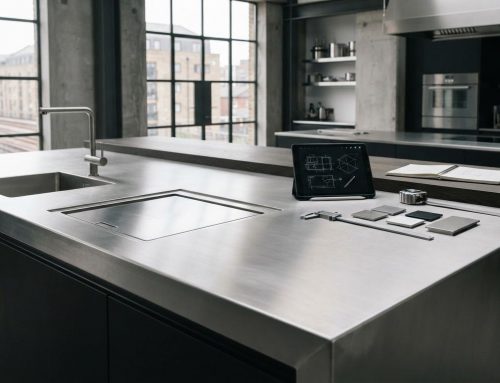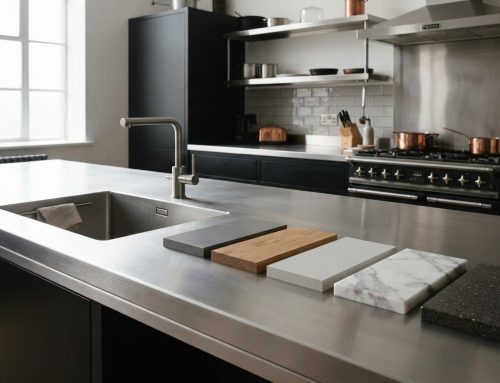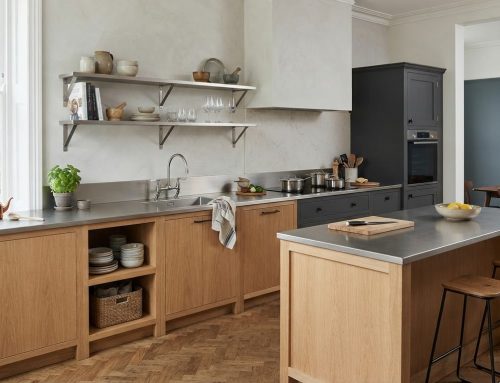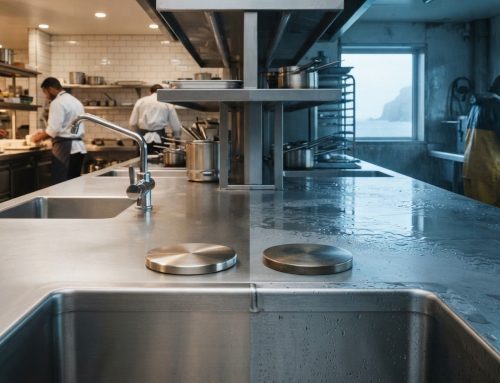

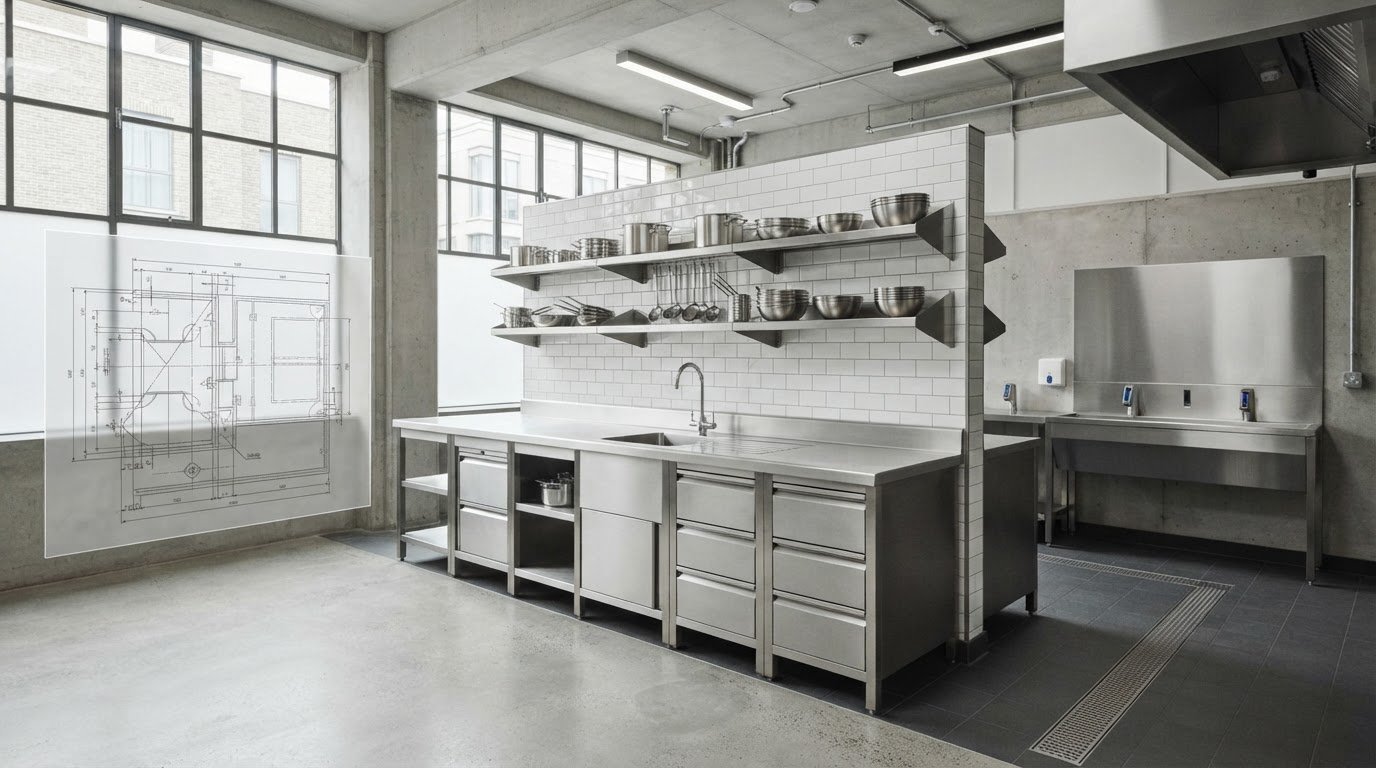
How do you turn a design idea into stainless steel furniture that fits the space, works as intended and can be installed with confidence? Specifying bespoke stainless steel furniture UK projects need involves more than choosing a finish. Dimensions, material grade and practical details all shape the finished result.
Made-to-measure worktops, sinks, cabinets and shelving can be designed around a project’s requirements. The DECIMETRIC® modular system offers another option, using 100 mm increments to create repeatable layouts. The right approach depends on the space, the intended use and how closely the brief fits an established configuration.
This guide explains the scope of bespoke stainless steel furniture and how to choose between made-to-measure and modular solutions. It also covers EN 1.4301 and acid-resisting EN 1.4401, plus the dimensions, functional details and approvals that help clarify a specification. Pre-production CAD drawings support design review before manufacture, helping align the intended layout with the components and their installation. A clear brief and considered decisions help translate project requirements into a precise, coordinated design.
Key Takeaways
- Define the dimensions, functions and surroundings your furniture must accommodate before deciding how it should be made.
- Choose a stainless steel grade according to the project environment and requirements, not appearance alone.
- Compare standard, modular and bespoke stainless steel furniture UK options to balance design freedom, flexibility and repeatability.
- Prepare clear project details and review pre-production drawings before approving the design for manufacture.
- Explore GEC Anderson’s stainless steel range and manufacturing expertise when developing your specification.
What counts as bespoke stainless steel furniture in the UK?
Bespoke stainless steel furniture is designed or adapted to suit the dimensions, functions and surroundings of a particular space. A project might need a worktop that follows an unusual room layout, a sink coordinated with an adjoining surface, or cabinets and shelving arranged around a specific workflow. The defining feature is not simply the material: the design responds to requirements that a standard configuration may not meet.
The scope can include worktops, sinks, cabinets, doors, panels and shelving, as well as sanitaryware within a wider interior scheme. Consider each element in context: how it will be used, what it needs to coordinate with and how its dimensions relate to the room and other fittings. Understanding the properties and grades of stainless steel can also help inform material decisions, which are covered later in this guide.
How does bespoke differ from made-to-measure and modular furniture?
These terms describe different ways of responding to a project brief. A standard product follows an established configuration. Made-to-measure furniture keeps the general form and purpose of a product category, while tailoring dimensions or specifications to the project. Bespoke design goes further, addressing requirements that call for a configuration beyond a standard product arrangement.
For example, adjusting a worktop to fit a particular run is made-to-measure. A coordinated arrangement of work surfaces, storage and other components designed around a specific layout may call for a bespoke approach. DECIMETRIC® offers a modular alternative, organised around 100 mm increments. It can suit a project where repeatable modules provide the required flexibility without developing every dimension from scratch.
Where can bespoke stainless steel furniture be used?
Applications range from residential kitchens to healthcare, education, science and transport environments. The setting helps define the priorities. A home kitchen may need a worktop and sink to fit an individual layout, while a laboratory or healthcare space may prioritise hygiene, robust use and coordination with surrounding fixtures. Educational facilities may need furniture arranged for particular activities, while transport projects can involve tight spatial constraints.
- Residential: worktops, sinks and storage planned around the room and how it will be used.
- Healthcare and education: coordinated surfaces and storage specified for the intended environment.
- Science and laboratories: furniture arranged to support defined tasks and fit the available space.
- Transport: project-specific dimensions and coordination within a constrained interior.
These examples are starting points, not universal specifications. Product choice, material and construction details need to suit the particular environment and intended use. Establishing those demands gives the design process a practical foundation, whether the project needs tailored dimensions, a modular layout or a more fully bespoke arrangement.
Which stainless steel grades and construction details shape performance?
A sound specification covers more than the visible surface. Steel grade, material thickness, finish and fabrication all affect how a component suits its intended use. For bespoke stainless steel furniture UK projects, record these choices alongside dimensions and functional requirements so that the design intent and manufacture stay aligned.
When should a project consider EN 1.4301 or EN 1.4401?
EN 1.4301, also identified as 18/8 and AISI 304, is the domestic stainless steel option. Acid-resisting EN 1.4401 is identified as 18/12 and AISI 316/319 in the product literature. Grade selection should reflect the environment and project requirements, rather than being based on appearance alone.
Set out the intended application and relevant environmental conditions in the brief. This gives the material choice a clear basis and helps establish whether the domestic grade or acid-resisting option is appropriate to consider. Neither designation should be treated as a universal answer: relate the grade to the actual use of the worktop, sink, cabinet or other component.
How do finish, gauge and fabrication affect the specification?
Material gauge refers to sheet thickness. The available options include 1 mm, 1.25 mm, 1.5 mm and 2 mm, but these are not interchangeable for every item. The factory selects the gauge according to product size. Include dimensions and intended function in the project information rather than assuming one thickness will suit every component.
Finish is another design and specification decision. Textured finishes have a maximum size of 2.4 × 1.15 metres, so account for this limit when planning panels or larger visible surfaces. Identify where a textured finish is required and how it will relate to adjacent components early in the design process.
Fabrication brings the specified material and dimensions together. Manufacturing processes include automated laser and punch cutting, automated and manual welding, and precision polishing. A clearly dimensioned drawing helps show how separate elements meet and where the intended finish will be visible.
For a useful specification, record the grade, finish, dimensions and intended application together. This gives the design and manufacturing teams a coherent basis for review, rather than leaving key decisions to be inferred from appearance. Explore GEC Anderson’s stainless steel furniture range alongside these specification considerations.
Bespoke, standard or modular: which furniture approach fits the project?
The right approach depends on how closely the space and intended use match an established configuration. Standard products suit requirements that align with existing specifications. Modular furniture combines repeatable components within defined increments, while made-to-measure or bespoke work can address dimensions and arrangements that need a more specific response. The comparison below helps clarify the trade-offs before developing the design.
| Approach | Design freedom | Dimensional flexibility | Repeatability | Coordination |
|---|---|---|---|---|
| Standard | Follows an established product configuration | Uses set dimensions | Consistent across repeat orders | Works best where the layout accommodates the product |
| Modular | Arranges defined units in different combinations | Flexible within the system’s increments and size limits | Supports repeatable layouts | Requires planning around the module sizes |
| Made-to-measure or bespoke | Responds to project-specific requirements | Made-to-measure dimensions can be tailored; bespoke design can address requirements beyond a standard arrangement | Can be specified for coordinated project components | Needs clear dimensions and design review |
When is a made-to-measure solution the better fit?
Choose made-to-measure when a standard dimension would leave an awkward gap, conflict with the room geometry or fail to meet an integrated requirement. It can be useful for a worktop that must follow a particular wall line or meet adjoining furniture precisely. GEC Anderson worktops can be made up to five metres long, with returns up to 2.3 metres. These limits help inform early layout planning; show the required dimensions clearly in the project drawings. For more detail, consult the bespoke stainless steel worktops specification guide.
When can modular furniture simplify a project?
DECIMETRIC® is organised in 100 mm increments, with an overall length of up to 3000 mm and widths of up to 600 mm or 700 mm, as indicated in the product literature. This defined framework helps teams plan repeatable layouts and coordinate units across a project. Its flexibility comes from combining standard modules, rather than shaping each component around unique geometry. If the space has unusual dimensions or integrated requirements that fall outside the modular arrangement, made-to-measure furniture may be a closer fit. The stainless steel storage systems guide offers related context for storage planning.
To choose an approach, compare the site dimensions with the selected product or system, then consider how its components must align with the wider layout. Standard products prioritise established configurations, modular furniture provides structured repeatability, and bespoke stainless steel furniture UK projects can respond to more specific spatial or functional demands. Matching the route to the brief keeps design development and coordination focused.
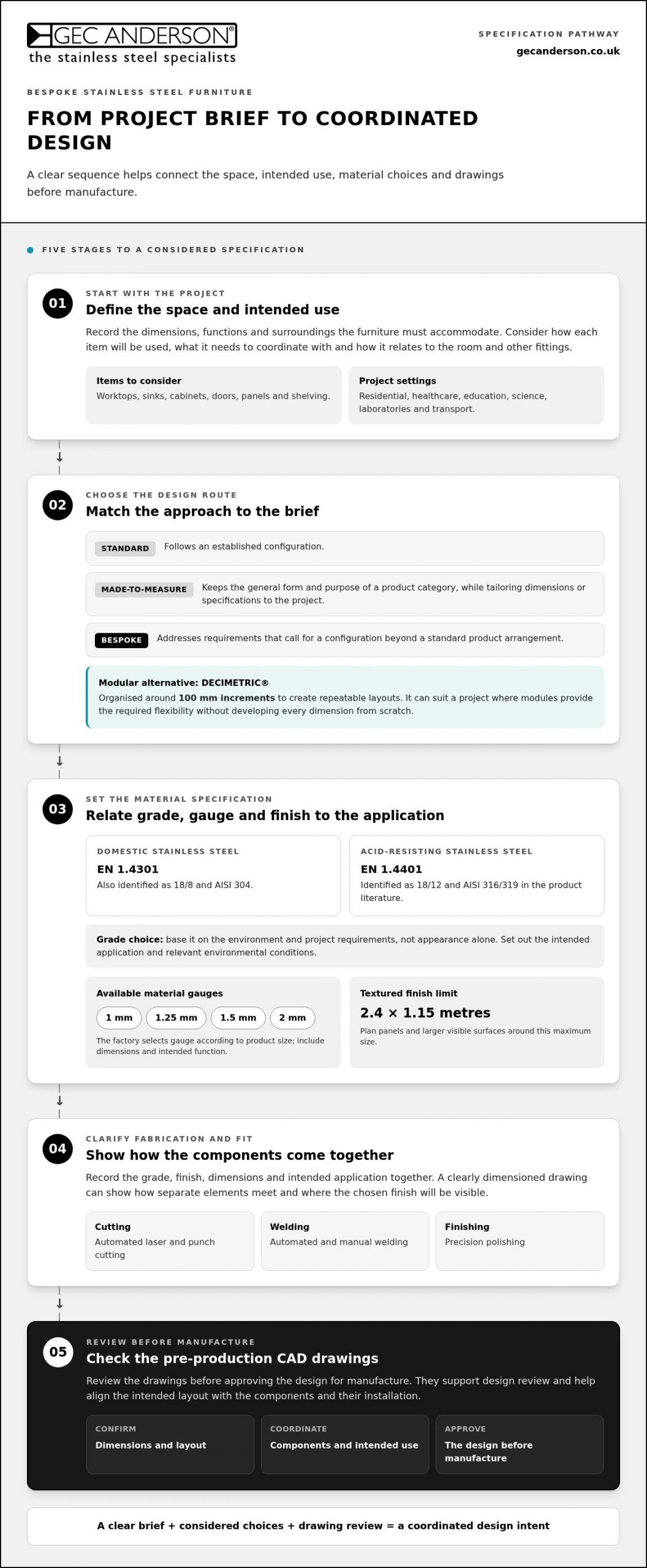
How does a bespoke stainless steel furniture project move from brief to production?
A clear process turns design intent into information that can be reviewed before manufacture begins. For bespoke stainless steel furniture UK projects, the key stages are defining requirements, providing project details, reviewing pre-production drawings, approving the design and placing the order. Keeping decisions and open questions visible helps everyone work from the same specification.
- Define the requirements. Identify the product type, intended use, quantities and key dimensions. Note site conditions or spatial constraints that affect the design.
- Submit the project details. For standard stock, provide the product reference and quantity. For a custom requirement, outline the desired dimensions, function and design intent. Drawings and reference information are useful where available.
- Review the proposed design. GEC Anderson issues pre-production CAD drawings for client review and approval.
- Approve and place the order. Production follows client approval and order placement. Written order confirmation includes a delivery date.
- Coordinate site requirements. Where installation is required, a site visit for dimensions or templates may be arranged.
What project information helps develop a precise specification?
A useful brief separates decisions already made from details still under development. This lets the design review focus on unresolved points instead of treating assumptions as confirmed requirements. Include:
- Intended use and product type, such as a worktop, sink, cabinet or shelving.
- Dimensions and quantities, with units stated clearly and any relevant tolerances identified in the project information.
- Site constraints, including surrounding features or interfaces that affect the furniture’s position and fit.
- Reference material, such as drawings, marked-up plans or images, if available.
For example, if a dimension is fixed but the arrangement of components is still open, label that distinction. It gives the review a clearer basis and makes it easier to identify which decisions need approval.
Why are CAD drawings and approval important?
Pre-production CAD drawings set out a proposal to assess before manufacture. Review them against the brief: check the dimensions, layout and relationships between components, and identify any discrepancies or required changes before approval. This is particularly useful when several items need to coordinate in one space, because the proposed design can be considered as a whole rather than as isolated parts.
Approval is a project control, not a formality. Confirm that the drawing reflects the intended requirements before placing the order. Production follows those steps, and written order confirmation records the delivery date. If installation is required, a site visit for dimensions or templates may be arranged as part of the coordination. To discuss a project brief and its stainless steel furniture requirements, contact GEC Anderson about your project.
Why specify GEC Anderson for bespoke stainless steel furniture?
GEC Anderson is an independent stainless steel specialist established in 1962. Its focus on stainless steel products brings together product knowledge and manufacturing capability for projects that need more than a standard configuration. Architects, designers, contractors and end-users can consider how a component’s intended use, dimensions and finish relate to its place in the wider scheme.
The range includes made-to-measure stainless steel worktops, sinks, cabinets, panels, doors and shelving, alongside splashbacks, the Stortidy System and the DECIMETRIC® modular kitchen furniture system. This range allows related elements to be considered together, whether the brief centres on one fitted worktop or a coordinated group of stainless steel components.
What does GEC Anderson bring to a project?
Project support includes technical guidance and pre-production CAD drawings, giving clients a defined proposal to review before manufacture. Measurement support and installation guidance can also help address practical considerations around the space and the relationship between components. Manufacturing is ISO 9001-certified, providing a documented quality-management framework for production.
Stainless steel furniture is specified for enduring use. GEC Anderson states a typical product life-cycle of approximately 50 years. This is a general life-cycle context, not a guarantee for an individual product; actual service life depends on the product, its use and its care. For project teams, the key consideration is to treat the furniture as a long-term element of the interior rather than a temporary fit-out decision.
When a sink needs to integrate with a worktop or surrounding furniture, the made-to-measure stainless steel sinks technical guide can help inform the design discussion. Bring together the sink requirements, adjoining surfaces and relevant dimensions in the brief so that the intended relationship is clear.
What is the next step for a bespoke furniture brief?
Architects, designers, contractors and end-users can start by outlining the product requirements and project context. Include the intended application, approximate or confirmed dimensions, quantities and any site constraints that will influence the specification. If some decisions are still developing, distinguish them from confirmed requirements. Drawings or other reference information can help communicate design intent, while a clear written outline gives the project discussion a practical starting point.
GEC Anderson supports the brief with technical guidance and pre-production drawings for review. This provides a route from the initial requirement to an approved design and manufacture, with attention to how the stainless steel elements fit the project as a whole.
Discuss a bespoke stainless steel furniture requirement
Set your project brief in motion
Turn the design intent into a working brief that the project team can act on. Bring together the decisions already made, the details still under review and the people responsible for approving the final layout. This creates a shared reference as the design develops, keeping functional needs and spatial constraints in view alongside the desired appearance.
For bespoke stainless steel furniture UK projects, clarity at the outset makes it easier to shape a proposal around the space and its intended use. You do not need every detail resolved before beginning. A concise outline gives the discussion a practical starting point, and supporting drawings can help communicate the design where available.
Whether you are planning a single made-to-measure element or coordinating several components, a well-defined brief helps move the work forward. Start planning your stainless steel furniture brief with GEC Anderson.
Frequently Asked Questions
Can bespoke stainless steel furniture be made for residential and commercial projects?
Yes. GEC Anderson supplies bespoke stainless steel furniture for residential and professional environments. In private accommodation, a made-to-measure worktop may need to fit an existing room; healthcare, education, transport and laboratory projects can have different operational demands. Product type and specification depend on the brief, including intended use and surrounding conditions. A design developed for one setting should not be assumed to suit another.
What information should I provide when planning bespoke stainless steel furniture?
Share the product type, intended use, quantity, dimensions and relevant site constraints. For a standard-stock request, provide the product reference and quantity. For made-to-order work, describe the custom requirements, including what the furniture needs to accommodate or coordinate with. Drawings or reference images can help clarify the design if available. Separating confirmed details from open questions can also focus the project discussion.
Does GEC Anderson provide drawings before bespoke furniture is made?
Yes. GEC Anderson issues pre-production CAD drawings for client approval. Review the proposed arrangement and dimensions against the project brief, then approve the design before order placement and production. If installation is required, a site visit for dimensions or templates may be arranged to address site-specific measurement considerations.
Can bespoke stainless steel furniture include an integrated sink?
Yes. GEC Anderson supplies made-to-measure stainless steel sinks and worktops, including integrated sinks and seamless edges. Treat the sink position, surrounding worktop dimensions and relationship to adjacent components as one design requirement, rather than a late addition. Include these details in the brief and review the proposed arrangement in the pre-production drawing. For further integration considerations, see the made-to-measure stainless steel sinks technical guide.
How long can a made-to-measure stainless steel worktop be?
Made-to-measure stainless steel worktops can be up to five metres long. For L-shaped and U-shaped worktops, the maximum return is 2.3 metres. These are stated limits for worktops, not general dimensions for all stainless steel furniture. Consider the project layout and relationship with adjoining elements in the design. For more specification detail, consult the bespoke stainless steel worktops specification guide.
How should stainless steel furniture be cleaned without damaging the surface?
Apply a general-purpose cream cleaner gently with a damp cloth or sponge, following the grain of the stainless steel. Rinse thoroughly with cold water, then dry carefully with a soft cloth. Do not use warm or hot rinse water, and do not leave the surface to air-dry. If discolouration remains, repeat the same cleaning process. Following the grain and drying with a soft cloth helps maintain the surface finish.
What should I do if rust marks appear on stainless steel furniture?
Visible rust stains can come from foreign iron or carbon steel contacting the surface, or from iron-rich water. For recent stains, apply dry cleaning powder lightly with a damp cloth or sponge, rinse with cold water and dry with a soft cloth. For persistent rust, use a dry nylon fibre brush or diluted nitric acid at one part acid to four parts water. Ensure good ventilation and follow the usual precautions for handling strong acids; rinse with cold water and dry with a soft cloth.