
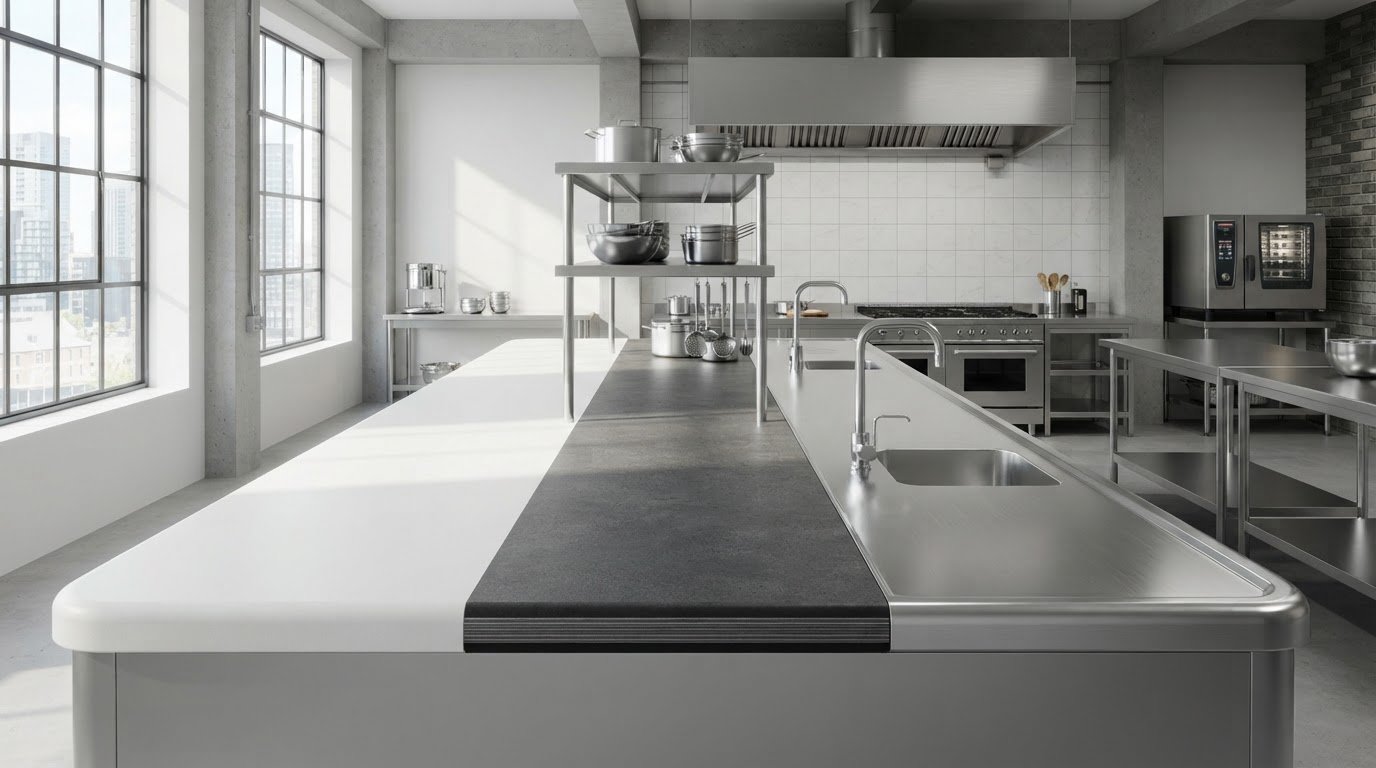
The most hygienic worktop is not simply the one that looks clean: smoothness, moisture resistance and the number of joints all matter. For a home kitchen, stainless steel is often the best material for hygienic surfaces because it is easy to clean. Solid surface can offer inconspicuous joints, while laminate edges may leave places where moisture and dirt collect.
It is reasonable to want a surface that wipes down easily and copes with everyday food preparation. Hygiene depends on both the material and the worktop’s design and maintenance, so there is no single answer for every kitchen.
This comparison explains how solid surface, laminate and stainless steel differ in smoothness, impermeability, joints and cleaning. It also outlines the food-safety criteria for food-contact surfaces in the UK, helping you weigh practical hygiene against your kitchen’s needs.
Key Takeaways
- Compare solid surface, laminate and stainless steel by how their finish, edges and joints affect routine cleaning.
- Look closely at seams and joins: fewer places for moisture and dirt to collect can make a surface easier to keep clean.
- For food preparation areas, prioritise surfaces that are smooth, washable, corrosion-resistant and non-toxic.
- Antimicrobial treatments may add a further property, but they don’t replace thorough cleaning and disinfection.
- Use the material’s porosity, cleanability and maintenance needs to decide which option best suits your kitchen.
Comparing solid surface, laminate and stainless steel
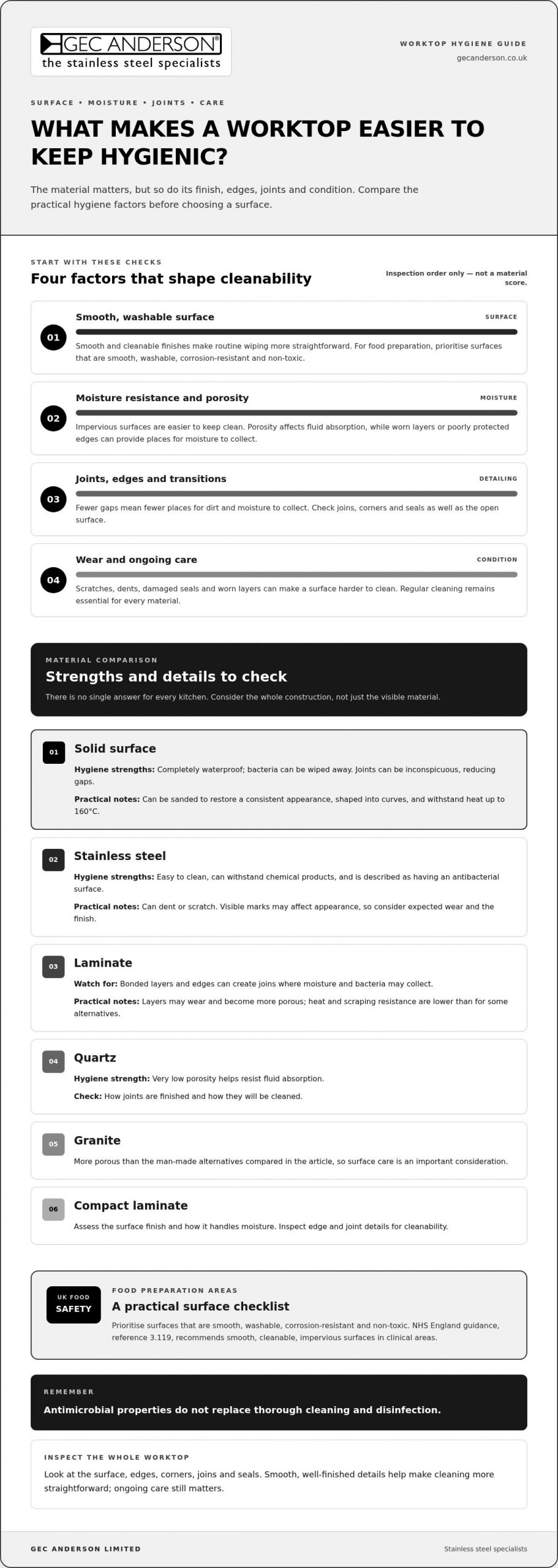
For kitchens and healthcare settings, choose a smooth, washable surface with few joints and good resistance to moisture. NHS England guidance, reference 3.119, recommends smooth, cleanable, impervious surfaces in clinical areas; for food preparation, the surface material and its edges also matter.
In daily use, stainless steel is easy to clean but can dent or scratch. Solid surface can withstand heat up to 160°C and be sanded, while quartz has very low porosity and resists fluid absorption. Laminate has lower resistance to heat and scraping, and its layers can wear over time. Compact laminate needs assessment of its own finish and edge details.
Solid surface is made from a single matrix, and sanding can restore its consistent appearance. It can also be shaped into curved worktops or washbasins, with inconspicuous joints that reduce gaps. Stainless steel offers a cleanable surface that can withstand chemical products, although visible scratches may affect its appearance. Laminate’s bonded layers and edges can create joins where moisture and bacteria may collect.
| Material | Surface and moisture | Joints and daily use |
|---|---|---|
| Solid surface | Completely waterproof; bacteria can be wiped away. | Can be joined inconspicuously; can be sanded. |
| Laminate | Layers may wear and become more porous. | Edges and joins may collect moisture; lower heat and scrape resistance. |
| Stainless steel | Easy to clean; withstands chemical products. | Can dent and scratch; worktops have an antibacterial surface. |
| Quartz | Very low porosity helps resist fluid absorption. | Consider how joints are finished in the installation. |
| Granite | More porous than the man-made alternatives compared here. | Porosity makes surface care an important consideration. |
| Compact laminate | Assess the finish and how it handles moisture. | Inspect edge and joint detailing for cleanability. |
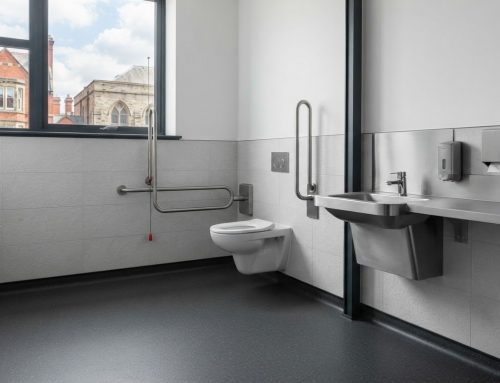
In a bathroom, humidity and intensive use make cleanable surfaces and well-finished joints important. Stainless steel is also used for bathroom fittings and accessories, including taps, shower fittings, shower-screen profiles and decorative elements. A surface’s suitability depends on its treatment as well as its base material.
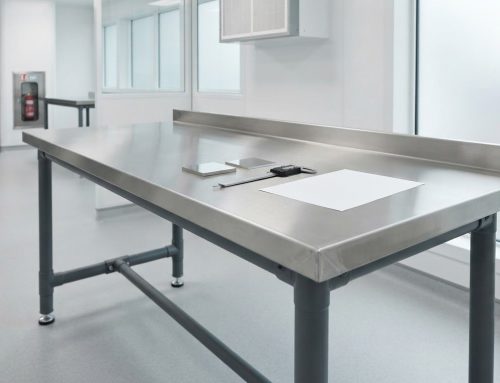
Stainless steel worktops are described as antibacterial, and their surfaces can be cleaned with an antibacterial wipe. This can suit kitchens where regular wiping is part of the routine. Scratches and dents remain practical considerations, particularly on a busy worktop. The finish and the way adjoining surfaces meet affect how easily the whole area can be cleaned.
Weigh cleanability, porosity, edge construction and expected wear together. Solid surface suits designs where inconspicuous joints and shaping matter; stainless steel suits a wipe-clean work area; laminate calls for careful attention to joins and wear. In every case, regular cleaning remains essential.
Seamless joints and infection control
Joints, scratches and damaged seals can trap dirt and moisture, making surfaces harder to clean and creating conditions that may support mould. In kitchens and healthcare settings, fewer gaps and a smooth finish make cleaning more straightforward, but regular cleaning is still essential.
Seamless joints
A seamless joint is a connection finished with little or no visible gap between adjoining surface sections. Solid-surface elements can be joined inconspicuously or designed as one piece, reducing places where moisture, dust and bacteria can collect. By contrast, tile grout creates a network of joins that can be harder to clean, particularly where food particles lodge.
This matters for infection control because cleaning must reach corners and connections, not just open areas. The Hygiene Council states that bacteria can survive on household surfaces for long periods. In healthcare settings, seamless joints reduce potential collection points, but they do not replace the cleaning routine required for the surface’s use.
Mould prevention
Seamless construction can limit gaps where moisture lingers, helping reduce conditions that encourage mould. A smooth, resistant surface is easier to wipe than a run of edges and recesses. However, a seamless appearance alone will not prevent mould if water remains around fittings, behind a surface or in an adjoining structure.
Inspect corners and transitions around a basin, worktop or shower enclosure. If a seal has split or lifted, water can pass behind the visible finish and remain there. Repairing damaged seals and drying wet areas helps address these moisture pathways.
Waterproofing and sealed joints are especially important where separate materials meet. Glass or stone can be used in bathrooms when surfaces are properly waterproofed and their joints well sealed. A carefully sealed junction helps prevent water ingress; an unsealed edge can let moisture collect beneath the finish, even if the main surface is smooth.
Compare the whole construction, not just the visible material. Check where a worktop meets a wall, whether a basin edge has a recess, and whether the shower corners have continuous seals. Tile grout can collect food particles and be difficult to clean, while inconspicuous solid-surface joints reduce these collection points. Quartz has very low porosity, but its installed joints still need attention during cleaning.
For a practical assessment, look for visible gaps, cracked sealant, rough edges and scratches that interrupt a smooth finish. These details identify places needing extra cleaning or maintenance. A surface described as antibacterial doesn’t make joint design irrelevant: soil and moisture can still accumulate at interfaces. Where a smooth, cleanable finish is central to the design, consider stainless steel surfaces as part of the material comparison.
HACCP requirements for food preparation areas
HACCP is a legal requirement in Europe under EC Regulation 852/2004. It provides a framework for identifying and controlling food-safety hazards, including contamination risks linked to food-contact surfaces. A suitable worktop supports hygienic handling, but material choice works alongside cleaning, maintenance and safe food-handling procedures.
For food-contact surfaces, the European Commission, EUR-Lex states that materials should be smooth, washable, corrosion-resistant and non-toxic, unless the competent authority accepts other materials. These properties help make a surface practical to clean and suitable for contact with food. They also provide useful criteria for comparing a worktop’s finish, joints and condition.
Assess the surface as installed, not just the material sample. A smooth central area may still be difficult to clean if joints, edges or fixings create recesses. Check where the worktop meets a wall, sink or splashback. Food debris and moisture can collect at poorly finished transitions, adding cleaning steps.
- Smoothness: Look for a finish that can be wiped without dirt catching in rough areas.
- Washability: Consider whether routine cleaning can reach the whole surface and its edges.
- Corrosion resistance: Assess how the material stands up to its intended cleaning and food-preparation environment.
- Non-toxicity: Ensure the food-contact surface meets this stated material criterion.
Damage changes the cleaning task. A scratch, chipped edge or worn laminate layer can interrupt an otherwise smooth finish. Inspect frequently used areas, especially beside chopping and washing zones. If damage leaves a rough or exposed section, cleanability may be reduced, making maintenance part of the hygiene plan.
Cladding also needs attention where it meets a work surface. A sealed, well-finished junction avoids an open gap that can collect water or food particles. For a food-preparation counter beside a wall, assess the worktop and adjoining edge together. The same principle applies around sink rims and other fitted components.
Match the surface’s properties to how the area is used and cleaned. Stainless steel is easy to clean and can withstand chemical products; solid surface can be formed with inconspicuous joints. Laminate needs particular attention at edges and bonded layers, where joins can collect moisture. These differences help assess practical suitability, but no material removes the need for regular cleaning.
Use a simple inspection routine: examine the finish, check joints and edges, identify damage, then confirm that cleaning reaches each area. In a healthcare or commercial food setting, record maintenance needs alongside the cleaning procedure. This keeps material condition visible as part of day-to-day hygiene management.
Antimicrobial technologies
Antimicrobial treatments add a functional property to a surface, rather than changing every aspect of its construction. Some ceramics are developed with antibacterial and fungicidal properties, and special treatments are intended to prevent pathogens from proliferating. This can be relevant in kitchens, where food residues, moisture and frequent handling make routine cleaning essential.
The treatment and the underlying material do different jobs. A treated ceramic may inhibit the proliferation of certain pathogens, while its smooth finish helps make it easy to clean. Solid surface, by comparison, relies on its material properties and can be joined inconspicuously. Neither treatment nor material removes the need to clean spills, food debris or stains.
Consider the whole surface, including edges and joints, before prioritising antimicrobial performance. A treated tile still has grout lines; a treated worktop may still have joins around a sink or wall. Moisture or residue left in these areas can undermine the practical benefit of a cleanable surface. Choose a design that allows easy access for wiping and routine disinfection.
- Identify the treatment: Distinguish an antibacterial claim from a fungicidal one.
- Consider the substrate: Compare the ceramic or other surface’s smoothness, porosity and joint detail.
- Plan cleaning: Include the worktop, edges and adjoining splash areas in the cleaning routine.
- Inspect condition: Look for wear, damage or residues that could affect cleaning.
For example, a ceramic surface beside a kitchen sink may be exposed to repeated splashes and cleaning. Its treatment is only one consideration: the finish, grout and condition also affect how easily the area can be maintained. A smooth, accessible junction is easier to wipe than a narrow recess where moisture and stains remain.
Antimicrobial technology should be assessed as one part of a hygiene strategy, not as a substitute for cleaning. Thorough cleaning and disinfection remain important for bathroom hygiene and other frequently used spaces. In food-preparation areas, regular cleaning of kitchen surfaces is also a recommended hygiene practice.
Before selecting a treated finish, match its stated purpose to the room and cleaning routine. For a home kitchen, consider how the surface will handle food preparation, water and everyday wiping. In a healthcare setting, prioritise cleanability and suitability for frequent cleaning alongside any antimicrobial treatment. Compare these practical properties with the treatment’s intended function, rather than relying on the label alone.
How surface smoothness and impermeability support hygiene
Smoothness affects how easily cleaning reaches a surface; porosity affects how moisture behaves. NHS England guidance, reference 3.119, recommends smooth, cleanable, impervious surfaces in clinical areas.
Surface smoothness
A smooth finish gives dirt fewer crevices to lodge in, making wiping more direct. Stainless steel is easy to clean, while ceramic is described as easy to clean and waterproof. Rough, damaged or heavily worn areas interrupt that cleanable surface. Assess the finish alongside edges and joints, since a smooth centre cannot compensate for hard-to-reach gaps.
Surface impermeability
An impermeable surface limits liquid absorption, so spills remain on the surface for removal rather than entering the material. Solid surface is described as completely waterproof, and ceramic is also waterproof. Quartz has very low porosity, which helps it resist fluid absorption. Granite is slightly more porous than the man-made alternatives discussed, so sealing and care form part of its durability.
Wood is highly porous and needs extensive treatment to improve its hygienic condition. Granite worktops should be sealed once or twice a year to help protect the material. These differences matter in busy environments: compare how the chosen finish will withstand moisture, cleaning and everyday use against the project’s hygiene standards.
Non-porous surfaces
Surface materials vary in how readily they absorb moisture, so check the specified properties of the material you choose. Stainless steel is also easy to clean. Smooth, cleanable surfaces are easier to disinfect because wiping reaches the exposed finish; joints and damaged areas still require attention. Non-porous surfaces are generally less susceptible to germs, but routine cleaning remains necessary.
In the UK, cost per square metre depends on the selected material, thickness, finish, fabrication and project details. Compare these factors together, since a shaped edge or integrated joint changes the specification as well as the surface area.
Cleaning products should suit the material and its finish. Stainless steel can withstand chemical products, but that does not make every cleaner appropriate for every surface. Use products compatible with the specified material and follow their directions. For example, an antibacterial wipe can be used on stainless steel worktops; abrasive action can affect the surface finish.
For a practical comparison, assess porosity, smoothness, joints and cleaning requirements together. This gives a clearer basis for selecting a surface that supports hygiene and durability in its intended environment. Explore stainless steel surface options when comparing cleanable finishes for a project.
GEC Anderson Limited: Stainless Steel Worktops
GEC Anderson Limited supplies stainless steel worktops for projects where a smooth, cleanable preparation surface is a priority. Stainless steel is easy to clean and can withstand chemical products, making these practical properties relevant to kitchens and washrooms. It can also be prone to dents and surface scratches, so consider appearance and use alongside hygiene requirements.
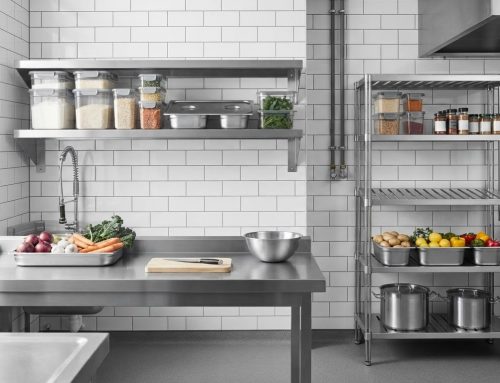
For a coordinated layout, GEC Anderson Limited also supplies stainless steel sinks, cabinets and doors, and shelving. Products are available as standard, modular or made-to-measure, supporting different project scales and layouts. The range is a natural consideration when specifying a worktop alongside other stainless steel elements.
To discuss stainless steel worktops for your project, contact GEC Anderson Limited.
Make your surface choice work for the whole space
Before settling on the best material for hygienic surfaces, define how the area will be used and maintained. Consider who prepares food, where water is likely to collect, and how the worktop connects with sinks and surrounding cabinetry. These practical details can guide a specification that supports daily routines rather than focusing on appearance alone.
GEC Anderson Limited supplies stainless steel worktops, sinks, cabinets and doors, allowing these elements to be considered together when planning a kitchen or washroom. The right choice depends on the project’s layout, cleaning routine and priorities. A material that suits one room may not be the most practical fit elsewhere.
If stainless steel is right for your project, contact GEC Anderson Limited to discuss the next step. A carefully considered specification can help create a space that feels purposeful, functional and ready for everyday use.
Frequently Asked Questions
What’s the best kitchen worktop for improved hygiene in the home?
The best material for hygienic surfaces in a home kitchen depends on how you use and clean the worktop. Stainless steel suits a kitchen where frequent wiping and resistance to cleaning chemicals matter. Solid surface may suit a layout that needs inconspicuous joints or shaped transitions. For either material, plan the sink edge and wall junction carefully, since awkward corners can make routine cleaning harder.
What are the most hygienic surfaces for healthcare design?
Smooth, cleanable and impervious finishes are appropriate priorities for healthcare environments. Stainless steel and solid surface can both support cleanable designs, but layout and detailing matter too. For example, a clinical handwashing area benefits from accessible edges and well-resolved connections around the basin. The specification should also suit the cleaning routine and the way staff use each space.
Is stainless steel more hygienic than quartz, laminate or ceramic tile?
Not in every installation: hygiene depends on the finish, condition, joints and cleaning routine as well as the material. Stainless steel is straightforward to wipe, while quartz’s low porosity helps resist fluid absorption. Tile grout and laminate edges can create harder-to-clean areas. Ceramic is waterproof and easy to clean, but tile joints still need attention. Compare the complete installed surface, not just a sample.
How do surface materials compare for bacteria and mould resistance?
Non-porous, smooth surfaces give moisture and residue fewer places to penetrate or remain, helping with routine cleaning. Solid surface is waterproof, and bacteria can be wiped from its surface. Stainless steel is easy to clean, while worn laminate layers may become more porous. Mould risk also relates to persistent dampness: inspect seals and corners around sinks, baths and showers, where water can collect.
What UK healthcare guidance covers hygienic wall and worktop surfaces?
NHS England guidance, reference 3.119, recommends smooth, cleanable, impervious surfaces in clinical areas. For food-contact surfaces, the Európai Bizottság, EUR-Lex identifies smooth, washable, corrosion-resistant and non-toxic properties, unless the competent authority accepts other materials. The Department of Health’s Health Building Note 00-09 states that carpet is not to be used in clinical areas; that point concerns flooring, rather than a worktop specification.
How should hygienic surfaces be installed to minimise seams and contamination?
Plan the layout before fabrication so the surface has fewer separate sections and awkward joins. Coordinate the worktop with the sink, wall finish and splashback, then detail their meeting points to avoid open gaps or recesses. A one-piece design can reduce joints where the layout allows; otherwise, ensure connections are sealed and accessible for cleaning. Inspect the finished installation for rough edges or gaps.