
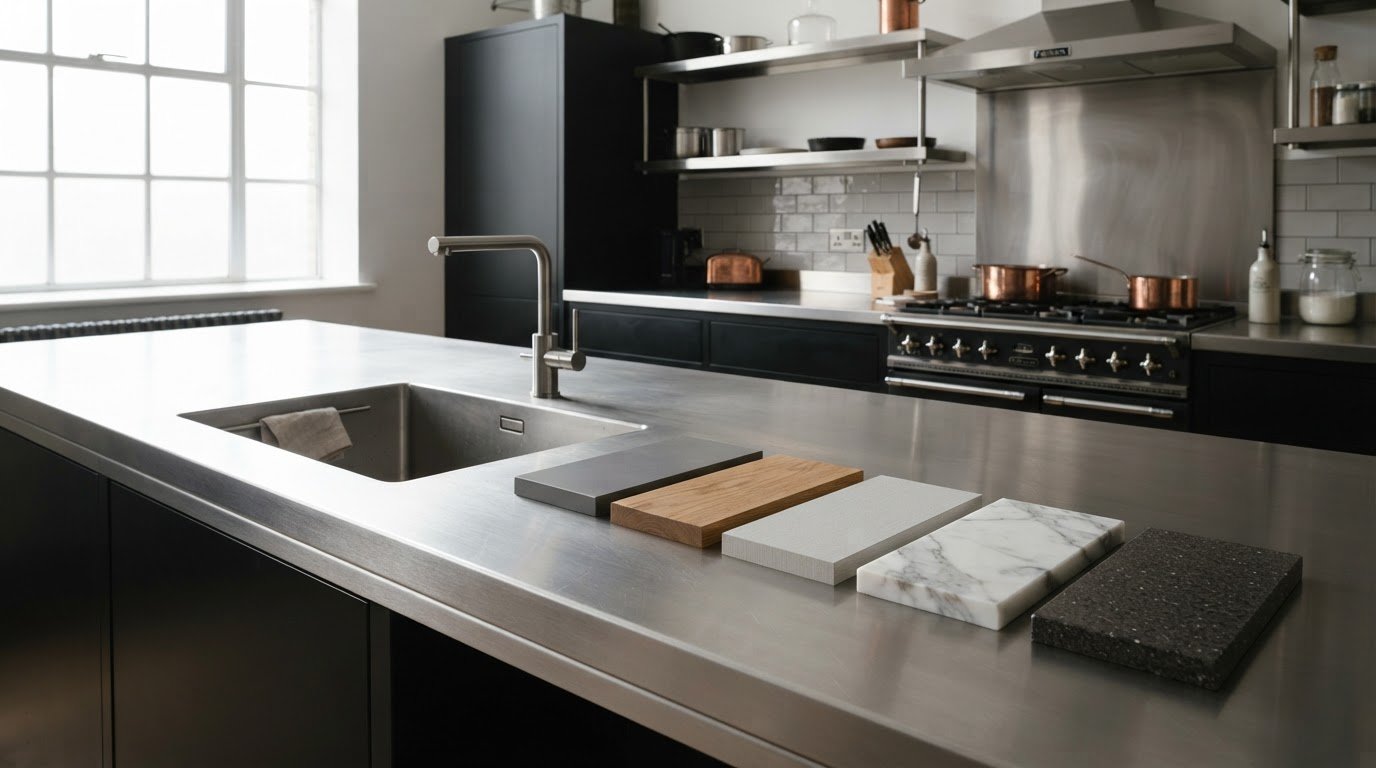
The best alternative to Corian may be a material that behaves very differently from it. If you’re asking what is better than Corian for worktops, the answer depends on what matters most for your project, not on a single winner.
Corian is valued for its smooth, seamless appearance and repairable solid-surface finish. Those qualities may suit a kitchen where a continuous look is the priority. But heat tolerance, resistance to cutting, maintenance, appearance and the shape of your worktop can all change the comparison. A material that performs well on one measure may involve a different look or different care in everyday use.
This guide compares Corian with laminate, wood, natural and engineered stone, and stainless steel. Use the practical comparisons to narrow your options, then check product-specific specifications and care guidance before deciding. Made-to-measure stainless steel is a distinct option for projects that prioritise hygiene, integrated sinks and seamless fabrication, rather than a like-for-like solid surface.
Key Takeaways
- What is better than Corian for worktops depends on your priorities, including appearance, everyday use, maintenance and fabrication needs.
- Compare solid surface, natural stone, engineered stone and stainless steel by material characteristics, then check the specification for the exact product.
- To narrow your options, consider how the worktop will be used, the look you want and the care it may need.
- Made-to-measure stainless steel may suit designs that call for integrated sinks, seamless edges or project-specific dimensions.
- Stainless steel has a distinct appearance, so weigh its practical strengths against the finish and feel you want from your worktop.
What Does Corian Offer, and Why Look for an Alternative?
Corian is a brand of solid-surface material used for worktops, but it helps to distinguish the brand from the wider material category. Solid surface is generally a manufactured blend of mineral material and resin, formed into sheets and fabricated for interior applications. Natural stone is quarried, while stainless steel is a metal. These differences affect both the material’s appearance and how a finished worktop is made.
Solid-surface materials are associated with inconspicuous joints and the ability to form shapes beyond a simple flat slab. Corian’s manufacturer describes its surfaces in terms of design flexibility and repairability, but exact properties and care guidance depend on the product and finish. A broader overview of solid surface materials can help distinguish the category from a particular brand. For a buying decision, check the specifications for the exact product you are considering.
What is a solid-surface worktop?
A solid-surface worktop is made from manufactured sheet material rather than a single slab of quarried stone or a sheet of metal. Sections can be joined, with joints finished to appear discreet. The material can also be used for shaped details, although the options depend on the product and fabrication method. If an unusual edge, curved section or integrated sink is important, establish how that detail will be made before choosing a surface.
Why might Corian not suit every project?
Corian may be a considered choice, but its qualities won’t match every brief. A project focused on natural texture, a metallic finish or another visual effect may point towards a different material category. The way a worktop is used, its exposure to heat and the owner’s expectations for cleaning and upkeep also matter. These are questions of fit, not evidence of a universal flaw.
Consider the worktop in its actual setting. Will it sit beside a hob or regularly receive hot cookware? Is it likely to be used directly for food preparation, or will chopping boards and trivets be part of the routine? Would a smooth, continuous surface support the design, or would the variation of stone or the character of metal feel more appropriate? Specific answers make material comparisons more useful than brand-led claims.
Maintenance expectations deserve the same attention. A surface that looks appealing in a sample may need a care routine that doesn’t suit the household or working environment. Read the relevant manufacturer’s cleaning instructions and guidance on use; don’t assume that all solid-surface products behave alike. Apply the same care when comparing a brand’s claims with general properties associated with an entire material category.
So, what is better than Corian for worktops? There isn’t one answer for every kitchen or project. The stronger choice is the material that meets the brief across appearance, use, fabrication and care. Compare the details that will affect your design, such as joint placement, sink arrangement and made-to-measure dimensions.
Which Worktop Materials Can Replace Corian?
Start by comparing material categories, then look at individual products. A brand name may suggest a familiar style or set of features, but it doesn’t tell you on its own how a particular surface will perform in your kitchen or fit the design. Broadly, compare other solid surfaces, natural stone, engineered stone, laminate, wood and stainless steel. Each brings different visual and fabrication possibilities, so the right shortlist depends on the project.
Solid-surface alternatives to Corian
Hanex, HI-MACS and Staron are examples of other solid-surface brands. Their products belong to a similar broad category, but specifications and advertised attributes vary by product, finish and intended application. Compare manufacturer documentation for the particular surface you’re considering, including care guidance and fabrication details. A brand-to-brand comparison alone can’t establish which option best suits your layout, appearance preferences or intended use.
Natural and engineered stone
Natural stone, such as granite or marble, is quarried, so its appearance can include variation in pattern and veining. Engineered stone is manufactured, with appearance and composition depending on the product. These categories offer a different visual character from solid surface, but there isn’t one performance profile that applies to every stone. The specific material, finish and manufacturer guidance matter. Consider the look you want and the care expectations for the product, rather than relying on a broad category label.
How stainless steel differs from solid surface
Stainless steel is metal, not another acrylic solid-surface product. Its visible finish gives a worktop a distinct character, and its fabrication can support integrated sinks and seamless edges. GEC Anderson makes bespoke worktops without joins or seams, designed around project-specific dimensions and layouts. This makes stainless steel worth considering where the sink arrangement and fabrication details are central to the design, rather than where a solid-surface appearance is essential.
For a project that calls for a continuous worktop and integrated sink, review the bespoke stainless-steel worktop specification guide to understand how dimensions and fabrication can be planned. GEC Anderson also supplies made-to-measure stainless-steel worktops for project-specific layouts.
So, what is better than Corian for worktops? The useful question is which category fits the brief. If you want to retain a solid-surface look, compare specific products within that category. If your priorities point towards the natural variation of stone or the metal finish and fabrication possibilities of stainless steel, assess those on their own terms. For everyday use, compare the actual products’ care instructions, joints and fabrication details, not just their brand names.
How Do Corian Alternatives Compare for Everyday Use?
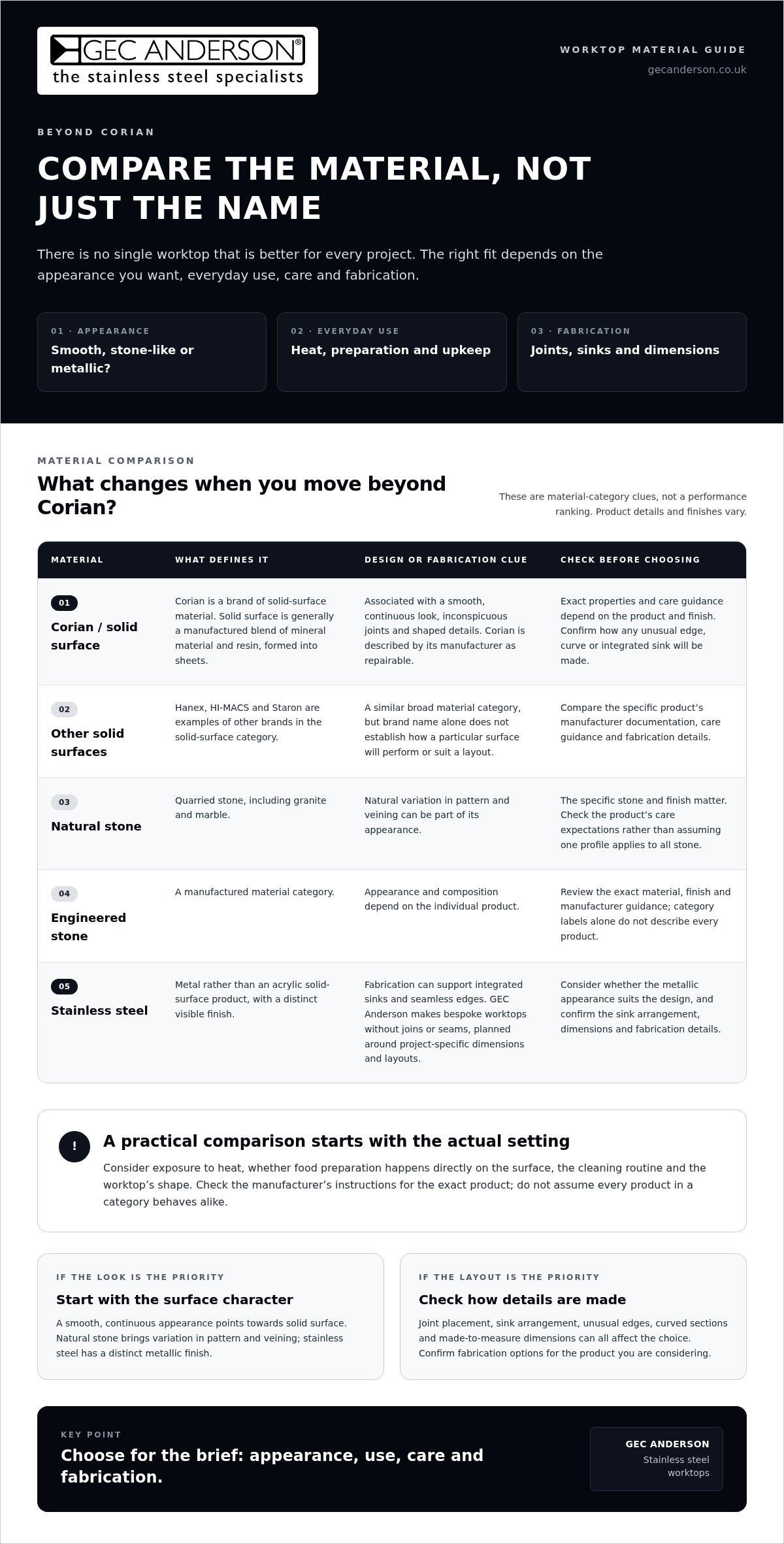
A useful comparison looks beyond broad claims such as “durable” or “easy to maintain”. The table sets out general design considerations, not a performance ranking. Product composition, finish, fabrication and manufacturer guidance can all affect the result, so check specifications for the exact surface being considered.
| Material | Appearance | Joints | Maintenance | Everyday use and project fit |
|---|---|---|---|---|
| Corian and other solid surfaces | Manufactured surface with design options that vary by product. | Fabrication can create discreet joints; details depend on the product and worktop design. | Follow the specific manufacturer’s care instructions. | Consider if a continuous solid-surface look and shaped details suit the brief. |
| Natural stone | Quarried material with natural variation in colour and pattern. | Joints depend on slab layout and fabrication. | Care requirements vary by stone and finish; use product-specific guidance. | May suit a design where the character of natural material is central. |
| Engineered stone | Manufactured appearance varies between products. | Joints depend on the worktop layout and fabrication. | Check the manufacturer’s cleaning and care instructions for the chosen product. | Compare the exact specification and appearance with the project requirements. |
| Stainless steel | Distinctive metal finish, with a different character from solid surface or stone. | Made-to-measure fabrication can provide seamless edges and integrated sinks. | Follow care guidance; the surface can show signs of use and isn’t scratch-proof. | Worth considering where hygiene, integrated sinks or a tailored layout are priorities. |
| Wood or laminate | Wood brings visible grain; laminate is available in varied decorative finishes. | Joints and edge details depend on the product and installation design. | Care differs by material and product; check the manufacturer’s recommendations. | Assess the intended look alongside the worktop’s expected use and care routine. |
Durability, heat and day-to-day demands
Performance claims need context. GEC Anderson describes its stainless-steel worktops as resistant to hot pans and cutting, but that doesn’t mean the surface can’t mark or show wear. Assess Corian and other alternatives against current, product-specific manufacturer guidance rather than assuming they share the same limits or care requirements. For a practical comparison, list the tasks the worktop will face and consider where hot cookware will be placed.
Appearance, joints and maintenance expectations
Solid surfaces can support shaped designs and discreet joints, while stainless steel makes a more overt material statement. A metallic finish needn’t dictate an industrial-looking room: the overall effect depends on how the worktop is combined with cabinetry, splashbacks, lighting and other finishes. Seamless edges and an integrated sink can create a continuous working area, particularly when the layout is tailored to the space.
There’s no reliable overall score for what is better than Corian for worktops. Compare the specific product, its care instructions and fabrication details against your priorities. This makes trade-offs clearer without treating one material as the universal winner.
How Can You Choose the Right Corian Alternative for Your Project?
Start with the job the worktop must do, then consider the appearance and fabrication details needed to achieve the design. This keeps the decision tied to the room rather than to a general ranking of materials. Use the following sequence to establish the brief:
- Define the use. Consider whether the worktop is for a domestic kitchen or a professional setting, and how it will be used day to day. Hygiene, heat exposure and the tasks taking place on the surface may carry different weight in each project.
- Set appearance priorities. Decide whether you want a manufactured, continuous surface, the natural variation of stone or the distinct character of metal. Consider how the worktop will sit alongside cabinetry, splashbacks and other finishes.
- Assess fabrication needs. Identify any unusual dimensions, returns, integrated sinks, seamless edges or junctions with adjoining surfaces. These details can determine which materials and fabrication approaches are suitable.
- Compare maintenance expectations. Review the care guidance for the specific products under consideration. Choose a routine that fits the way the space will be used, rather than assuming products in the same material category need identical care.
Match the material to the room and its use
Residential and professional kitchens can place different demands on a worktop, but no two projects are identical. Before comparing materials, record the tasks, expected heat exposure, hygiene priorities and desired visual character. For stainless-steel worktops, GEC Anderson uses grades including EN 1.4301 and EN 1.4401. The grade forms part of the product specification and should be considered alongside the project’s requirements.
Check fabrication and specification requirements
Take accurate dimensions before settling on a material. GEC Anderson’s made-to-measure stainless-steel worktops can be up to 5 metres long, with returns up to 2.3 metres. Plan the sink position, edge treatment and connections to adjacent surfaces as part of the same brief. These decisions shape the finished layout, particularly where a continuous worktop and integrated sink are central to the design.
GEC Anderson issues pre-production CAD drawings for client approval. Review the proposed dimensions and arrangement against the project brief before manufacture. Where sink configuration is a key specification, the made-to-measure stainless-steel sink technical guide can help inform the design.
The best choice balances use, appearance, care and fabrication requirements. If your project calls for tailored dimensions or an integrated stainless-steel sink, explore made-to-measure stainless-steel worktops as part of your specification.
When Is a GEC Anderson Stainless-Steel Worktop a Better Fit Than Corian?
A GEC Anderson stainless-steel worktop can suit a project where hygiene, an integrated sink and carefully planned fabrication take priority. It offers a different material and visual language from Corian, not a like-for-like solid-surface replacement. The decision depends on how well each surface fits the intended use and design. Stainless steel has a distinct metal finish, so consider how it will work with cabinetry, lighting and other materials in the room.
What makes a bespoke stainless-steel worktop distinctive?
Made-to-measure fabrication can bring the worktop, sink and edge details together as one coordinated design. GEC Anderson’s bespoke worktops can be made without joins or seams, with integrated sinks and seamless edges. Worktops can be up to 5 metres long. These options are useful where the layout needs a tailored fit or continuous working surface, while the finished appearance remains recognisably stainless steel.
GEC Anderson describes its stainless steel as hygienic and resistant to hot pans and cutting. That resistance doesn’t mean the surface is scratch-proof or that it won’t show signs of use. The company’s product information gives a typical product life-cycle of around 50 years; this is indicative, not a guarantee. Stainless steel is 100% recyclable, though that fact alone doesn’t establish its environmental impact across its full life-cycle.
How GEC Anderson supports worktop specification
GEC Anderson has specialised in stainless-steel products since 1962, and its manufacturing is ISO 9001-certified. Specification support includes pre-production CAD drawings for client approval. Reviewing the drawing gives the project team a chance to assess the proposed dimensions and arrangement before production, helping align the worktop design with the planned layout.
For architects, designers and homeowners, this process is especially relevant where an integrated sink, edge detail or unusual dimension needs to be reflected accurately in the design. It also helps clarify how the worktop relates to adjoining surfaces and cabinetry. The choice of stainless-steel worktop should still be guided by the project brief, rather than by a general claim that one material is best.
Stainless steel may be the better fit when its practical characteristics and distinctive appearance align with your brief. Explore GEC Anderson stainless-steel worktops for a made-to-measure option with integrated sinks and seamless fabrication.
Turn Your Worktop Priorities into a Clear Specification
The question of what is better than Corian for worktops becomes easier to answer when you turn preferences into a practical brief. Before committing, write down the finish you want, how the surface will be used and which fabrication details matter most. Then compare shortlisted materials against those points, rather than relying on a general “best” label.
Consider how the worktop will look alongside the room’s cabinetry and finishes, and whether the material’s character suits the atmosphere you want to create. A choice that performs well on paper should also feel right in the completed space. Keep the decision grounded in everyday needs, not only the appearance of a sample or a brand’s reputation.
If stainless steel fits your design direction, explore the available worktop options and consider how they could suit your layout. Explore GEC Anderson stainless-steel worktops and develop a specification that reflects your project.
Frequently Asked Questions
Is quartz better than Corian for worktops?
Quartz isn’t automatically better; it may suit a project with different priorities from those for Corian. The answer to what is better than Corian for worktops depends on the design, intended use and care expectations. Compare the specific products, including their appearance, manufacturer guidance and fabrication options. For example, a preference for a particular stone-like pattern may lead you towards one product, while a shaped design or discreet joints may favour another.
Can you put hot pans directly on Corian?
It’s safer not to place hot pans directly on Corian. Use a trivet or heat-resistant mat, particularly for cookware just removed from a hob or oven. Solid-surface materials can be affected by high heat, and precise care advice depends on the product. Follow the current manufacturer instructions for the specific surface, and don’t assume that a claim about heat resistance means direct contact with hot cookware is suitable.
What is the most durable alternative to Corian?
There’s no single most durable alternative for every kitchen, because durability depends on the type of use and the exact product. Stainless steel may be worth considering where resistance to hot pans and cutting is important; GEC Anderson describes its worktops as resistant to both. That doesn’t mean the surface can’t scratch or show wear. For any material, compare product-specific guidance with the tasks the worktop will actually face.
How much do Corian alternatives cost?
Costs vary by material and project, so there isn’t one useful price for all Corian alternatives. The total can depend on the worktop’s dimensions, finish, edge details, sink arrangement and fabrication requirements. A simple layout and a bespoke design with an integrated sink aren’t directly comparable. For a fair comparison, assess each specification on the same basis, including the fabrication and fitting work covered. Stainless-steel worktop pricing is project-specific.
Does Corian need to be sealed?
Corian is generally described as a non-porous solid-surface material, so routine sealing isn’t usually required. This differs from some natural stones, which may have product-specific sealing guidance. Check the care instructions for the exact Corian surface and finish you’re considering, rather than applying advice for another material. Sealing and everyday cleaning are separate issues: a surface that doesn’t need sealing still needs appropriate routine care.
Can you cut directly on a Corian worktop?
Use a chopping board rather than cutting directly on Corian. A knife can leave marks on the worktop, and a board provides a more suitable surface for food preparation. This is a practical habit regardless of the worktop material: it helps protect the finish and keeps knife use confined to a dedicated cutting surface. Check the product’s care guidance for instructions on addressing marks or surface damage.
Is stainless steel recyclable?
Yes. Stainless steel is 100% recyclable, according to GEC Anderson’s product information. Recyclability is one part of a material’s environmental profile, though; it doesn’t by itself establish the impact of manufacture, transport, use or end-of-life processing. If sustainability is central to your decision, consider the full project context and information available for each material, rather than treating recyclability alone as a complete comparison.