

The highest-numbered stainless steel grade isn’t automatically the right choice. If you’re looking for different grades of stainless steel explained clearly, start by matching the material to its working environment, rather than assuming that 316 is always better than 304.
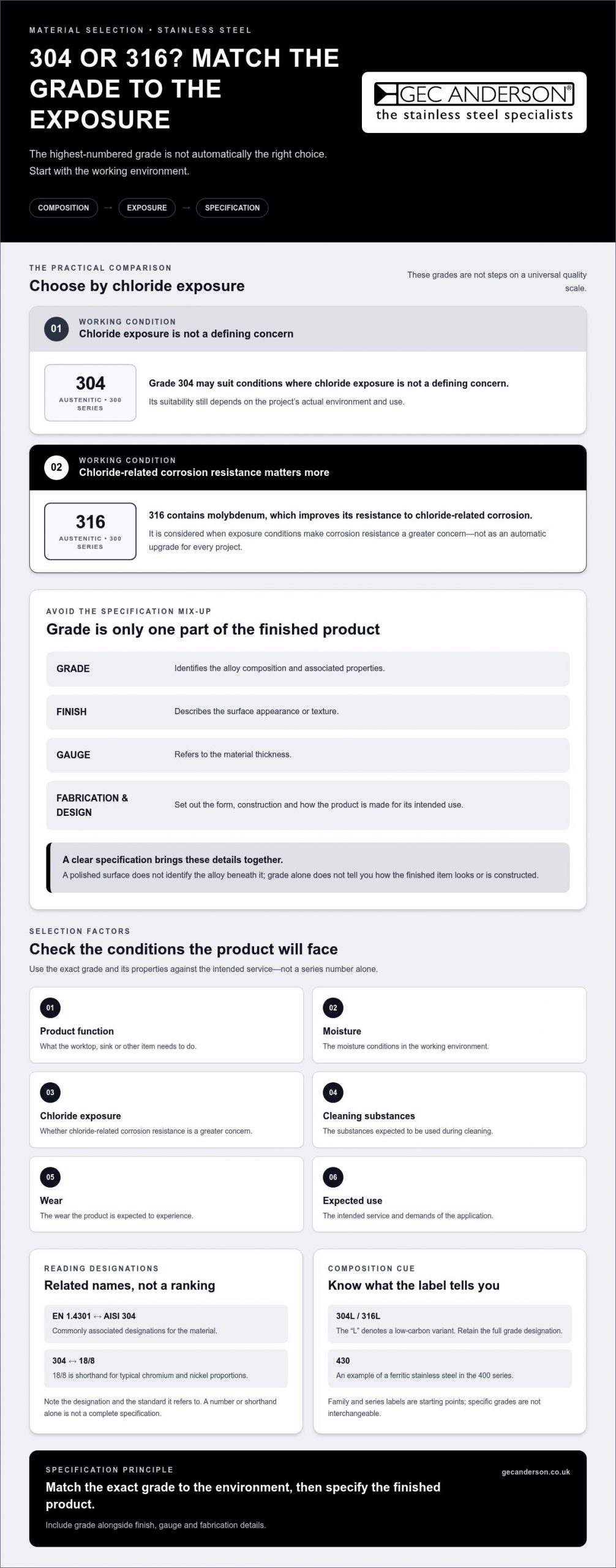
Grade numbers and standards can make a specification feel more complicated than it needs to be. A grade identifies the steel’s composition and associated properties; it doesn’t describe the finish, thickness or fabrication. The difference between 304 and 316 is specific: 316 contains molybdenum, which improves its resistance to chloride-related corrosion, while 304 may suit conditions where chloride exposure isn’t a defining concern.
This guide explains common grade designations, including how EN and AISI names relate, and compares 304 and 316 in practical terms. It also sets out the project conditions to consider when choosing a grade, and how grade fits alongside finish, gauge and fabrication. Use it to build a clearer specification for a worktop, sink or other stainless steel product.
Key Takeaways
- Read common designations without mistaking grade for finish, thickness or product design.
- Use alloy families as a starting point, then assess the exact grade against your project’s requirements.
- Compare 304 and 316 by their composition and expected exposure, rather than assuming one is always the better choice.
- Consider the product’s function, moisture, chloride exposure, cleaning substances, wear and expected use when specifying a grade.
- GEC Anderson identifies grades for its stainless steel products. Include grade alongside finish, gauge and fabrication in a complete specification.
What do different grades of stainless steel actually mean?
A stainless steel grade is a material designation that identifies an alloy’s composition and associated properties. It helps describe how the steel is expected to behave, including its corrosion resistance and response to fabrication. Stainless steel isn’t corrosion-proof: its performance depends on the grade and the conditions in which it is used.
Understanding different grades of stainless steel explained starts with separating the material from the finished item. A grade describes the alloy, not the visible surface, sheet thickness or shape of a sink or worktop. Those details matter, but they answer different specification questions. A polished surface, for example, doesn’t identify the alloy beneath it.
Grades are identified through standards and naming systems. In UK specifications, an EN number may appear alongside an AISI designation, particularly when product information uses both European and American terminology. These labels identify a material; they aren’t steps on a single quality scale. Choose a grade according to the application and its requirements.
How are stainless steel grades named?
Different standards can use different labels for related materials. EN 1.4301 is the European designation commonly associated with AISI 304. You may also see 304 described as 18/8, shorthand for its typical chromium and nickel proportions. These names help with comparison, but a number or shorthand alone isn’t a complete specification.
When reading a material description, note the designation and the standard it refers to. Don’t treat a higher number as proof of better quality. A grade’s composition and properties need to suit the intended environment. A different designation may indicate a different alloy, not a superior version.
Is grade the same as finish or thickness?
No. Grade identifies the material; finish describes the surface appearance or texture; gauge refers to material thickness. Product design is another consideration, covering the form and construction of the finished item. Keeping these details separate makes a specification clearer and helps prevent one being mistaken for another.
For example, a stainless steel worktop specification could state the grade, finish and gauge, as well as its dimensions and fabrication details. A sink description can likewise identify the alloy separately from its surface and form. The grade alone won’t tell you how the finished product looks or is constructed, just as a particular finish doesn’t establish the alloy’s composition.
Treat these as connected but separate decisions. Grade helps address material performance; finish informs appearance and surface character; gauge describes thickness; and design sets out how the product is made for its intended use. A complete specification brings these details together, so the grade is understood in context rather than used as a stand-alone quality label.
How stainless steel composition creates different grade families
Changes in alloy composition can affect how stainless steel resists corrosion and responds to fabrication. Chromium is central to stainless steel’s corrosion resistance, while additions such as nickel and molybdenum help distinguish particular grades and their performance. The overall composition matters, so no single element tells the whole story.
Grade families offer a useful starting point. Austenitic and ferritic describe broad structures within stainless steel, while series numbers group grades in another way. These categories can help narrow a comparison, but they don’t replace checking the exact grade and its properties for the intended service. This overview of stainless steel families provides further background, but a family label alone isn’t a complete specification.
What distinguishes the common 300-series grades?
Grades 304 and 316 are common austenitic stainless steels in the 300 series. Their compositions differ, which affects how they perform in particular environments. Grade 316 contains molybdenum and is generally considered when exposure conditions make corrosion resistance a greater concern. That doesn’t make it a universal upgrade: the appropriate choice still depends on actual exposure and use.
The suffix L, as in 304L or 316L, denotes a low-carbon variant of the corresponding grade. It identifies a compositional difference, not a separate series or a higher quality ranking. If a specification names an L grade, retain the full designation rather than shortening it to 304 or 316.
What are ferritic and other specialist grades?
Grade 430 is an example of a ferritic stainless steel in the 400 series. The series includes other types too, so “400-series” shouldn’t be read as a set of interchangeable properties. Ferritic grades differ in composition and behaviour from austenitic grades. Compare specific designations against the requirements of the application.
Duplex stainless steels combine characteristics associated with austenitic and ferritic structures and are used for particular engineering requirements. Other specialist grades are developed for defined combinations of performance and fabrication needs. This guide to different grades of stainless steel explained is an orientation, not a full catalogue or a substitute for grade-specific data.
For a practical specification, use the family as a starting point, identify the exact grade, then assess its properties against the working conditions. This keeps material selection focused on the project rather than a series number alone. For worktops and sinks, GEC Anderson’s stainless steel products provide a practical context for considering grade alongside the rest of the specification.
304 Vs 316 stainless steel: what is the practical difference?
The practical choice between 304 and 316 depends on the environment the material will face. Both are widely used austenitic stainless steels, but their compositions differ. Grade 316 contains molybdenum, which improves its resistance to corrosion in chloride-bearing conditions compared with 304. This can make it relevant in more demanding environments, such as outdoor pool surrounds where specialists like outlookfencing.com.au rely on corrosion-resistant fittings, though it isn’t the best choice for every project.
304 is a common general-purpose choice, while 316 is often considered where chloride exposure or other demanding corrosion conditions call for greater resistance. The British Stainless Steel Association provides further guidance on stainless steel grades and selection. Use the comparison below as a starting point, then assess the specific exposure and product requirements.
| Consideration | 304 | 316 |
|---|---|---|
| Composition | Often described as 18/8, referring to typical chromium and nickel proportions. | Often described as 18/12, with molybdenum as an additional alloying element. |
| Exposure | Commonly selected for general service where chloride exposure isn’t a defining concern. | Considered for more demanding corrosion conditions, particularly exposure to chlorides such as salt. |
| Common applications | Used in a range of general-purpose equipment and architectural or interior applications. | Used where the service environment places greater demands on corrosion resistance. |
| Selection caveat | Suitability depends on actual exposure and use; it isn’t corrosion-proof. | Greater corrosion resistance in relevant conditions doesn’t make it suitable for every environment. |
When is 304 stainless steel a suitable starting point?
304 is a common general-purpose grade and GEC Anderson identifies it as its domestic grade, EN 1.4301 (18/8, AISI 304). It can be a useful starting point when the expected working environment and product function align with its properties. Assess actual exposure rather than assuming that a domestic or commercial setting automatically makes 304 suitable.
When might 316 stainless steel be specified instead?
Consider 316 where chloride exposure, including salt-bearing conditions, or another demanding corrosion environment is relevant. GEC Anderson identifies EN 1.4401 (18/12, AISI 316/319) as its acid-resisting grade. That description isn’t a promise of resistance to every acid or chemical. The substance, concentration, contact conditions and full product specification all affect suitability.
For a worktop or sink, base the decision on its intended function and the substances or conditions it will encounter. Grade is one part of the specification, alongside finish, gauge and fabrication. Understanding different grades of stainless steel explained in this way helps avoid treating 316 as a simple quality upgrade. GEC Anderson’s stainless steel worktops and sinks provide a practical context for considering grade in relation to the finished product.
How to choose a stainless steel grade for its working environment
Start with the job the product must perform, then describe the environment it will face. A useful grade decision reflects actual exposure and expected use, not the designation that sounds most robust. Use this sequence to build a practical specification.
- Define the product’s function. Record whether you’re specifying a worktop, sink, splashback or another item, and what it must do in daily use. Note whether it will support equipment, contain water or encounter repeated handling.
- Describe the operating environment. Note whether the product is indoors or outdoors, dry or regularly wet, and whether it may be exposed to chlorides such as salt. Include the nature and frequency of contact rather than relying on a broad label such as “commercial”.
- Identify cleaning and process exposures. List the cleaning substances and other materials the surface may encounter, along with relevant contact conditions. Don’t assume a grade is suitable for every chemical simply because it is described as acid-resisting.
- Assess wear and expected use. Consider repeated contact, abrasion, impact and intensity of use. These conditions help define the performance required, although grade is only one part of the finished product’s specification.
- Complete the specification. State the grade separately from finish, gauge, dimensions and fabrication requirements. Include any hygiene or design requirements that affect the finished product, so the material choice is considered in context.
Which exposure conditions should a specification identify?
Be specific about moisture, chloride-bearing conditions, cleaning substances and operating demands. A sink in regular use, for example, has a different pattern of contact from a decorative panel in a dry interior. Similarly, when planning exterior metal installations, specialist fabricators such as Gate Tech Pros must account for weather exposure, moisture and mechanical wear to ensure lasting performance. Unusual, concentrated or otherwise aggressive exposures call for a carefully reviewed material specification; a general grade comparison may not resolve every application.
Before specifying a grade, assess the product’s function, indoor or outdoor setting, moisture, chloride exposure, cleaning substances, wear and expected use conditions.
What else belongs in the material specification?
Grade doesn’t define the complete product. Record the surface finish, material gauge, dimensions and fabrication requirements separately, then consider how the item’s form and intended use bring them together. GEC Anderson’s made-to-measure stainless steel worktops guide and stainless steel sink technical reference show how product-specific considerations inform specification.
This is the practical value of having different grades of stainless steel explained in relation to an application: you can assess the material without overlooking the details that shape the finished item. For a project requiring a tailored stainless steel worktop or sink, explore GEC Anderson’s made-to-measure options.
How GEC Anderson specifies stainless steel grades for its products
Grade selection is most useful when it’s tied to a product and its intended conditions. GEC Anderson identifies two stainless steel designations in its product information: domestic grade EN 1.4301 (18/8, AISI 304) and acid-resisting grade EN 1.4401 (18/12, AISI 316/319). These are the company’s stated descriptions, not a universal rule that one grade suits every domestic or acid-exposed application.
The designations identify the material, but they don’t describe the complete finished item. A made-to-measure specification also needs to cover what the product must do, its dimensions and how it will be fabricated. This connects material choice to practical requirements rather than treating grade as a stand-alone quality label.
Which GEC Anderson products use stainless steel grades?
GEC Anderson supplies made-to-measure stainless steel sinks and worktops, as well as cabinets, panels, doors and shelving. Its stated grade designations provide a practical example of how materials can be identified across a product range. The appropriate grade still depends on the product’s use and working environment.
For projects where sanitaryware is part of the specification, the commercial stainless steel sanitaryware guide provides related product context. As with a sink or worktop, consider the item’s function and working conditions when specifying its grade.
How does grade fit into a made-to-measure specification?
A made-to-measure specification brings material and product requirements together. The grade identifies the stainless steel designation; dimensions define size and configuration; fabrication details describe how the product is formed. Finish and gauge are separate choices. Considering them together helps clarify what is being specified without confusing material grade with surface appearance or thickness.
GEC Anderson’s ordering process includes pre-production CAD drawings for client approval. These drawings give the proposed design a defined point for review before production. Grade remains one element of the project brief, alongside dimensions and the details that determine how the finished product is intended to fit its setting.
Explaining different stainless steel grades through product specifications connects material terminology with the decisions that shape a finished sink, worktop or other item. The stated EN designations provide a material reference, while the working environment and complete project requirements guide their application.
For a considered starting point, explore GEC Anderson stainless steel products and their made-to-measure applications.
Turn your material choice into a clear project brief
A stainless steel specification is useful when it helps everyone involved make the same decisions. Before moving from research to a project brief, note the conditions the finished item will face and the details that will shape its form. This gives grade selection a practical purpose and keeps material, design and intended use aligned.
Understanding different grades of stainless steel explained is a strong starting point. Next, apply that understanding to your requirements: what the product needs to do, where it will be installed, and which dimensions or fabrication details matter to the wider design. A considered brief helps focus discussions around the project.
GEC Anderson has worked with stainless steel since its founding in 1962 and supplies made-to-measure products for considered interiors. If you’re developing a sink, worktop or another stainless steel element, explore GEC Anderson stainless steel products to start shaping a specification around your project.
Frequently Asked Questions
Is 304 stainless steel magnetic?
It can show some magnetic response, so a magnet isn’t a reliable way to identify grade 304. Austenitic stainless steels such as 304 are generally described as non-magnetic when fully annealed, but fabrication and the material’s condition can affect their behaviour. If the designation matters for a purchase or project, use material documentation or suitable testing rather than relying on a household magnet.
Can 304 stainless steel rust?
Yes. Stainless steel resists corrosion, but it isn’t immune to it. Chloride exposure, contamination or unsuitable service conditions can contribute to staining or corrosion. Salt left on a surface, for example, may cause localised corrosion, so remove chloride-containing material promptly. The grade should suit the product’s actual use and exposure; a 304 designation alone doesn’t guarantee that rust or staining can’t occur.
What does 18/8 stainless steel mean?
18/8 is shorthand for the approximate proportions of chromium and nickel associated with a commonly used stainless steel, often identified as grade 304: around 18% chromium and 8% nickel. It’s a useful informal description, but not a complete material specification. For procurement or design records, use the precise grade designation and relevant material documentation rather than relying on the shorthand alone.
Is 316 stainless steel always better than 304?
No. Grade 316 may be more appropriate where its composition offers an advantage for the expected exposure, but that doesn’t make it the right choice for every application. Different grades of stainless steel explained by their working conditions don’t form a simple quality ladder. Consider the product’s function, environment and full specification rather than ranking grades by number.
What is the difference between 304 and 304L stainless steel?
The “L” in 304L identifies a low-carbon variant of grade 304. That distinction can matter in certain fabrication and service contexts, particularly where welding is involved. It doesn’t mean 304L is automatically a higher-quality choice for every product. If a specification calls for 304L, retain the full designation in project documents and assess it against the relevant fabrication requirements.
Are stainless steel grade and finish the same thing?
No. Grade identifies the alloy, while finish describes the surface appearance or treatment. For instance, a specification might identify grade 304 and separately describe a satin finish. Thickness, dimensions and fabrication are also distinct details. Listing these separately helps prevent a surface description being mistaken for a material designation and gives the project team a clearer record of what the finished item requires.