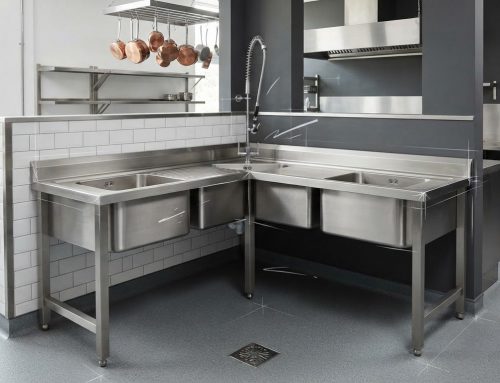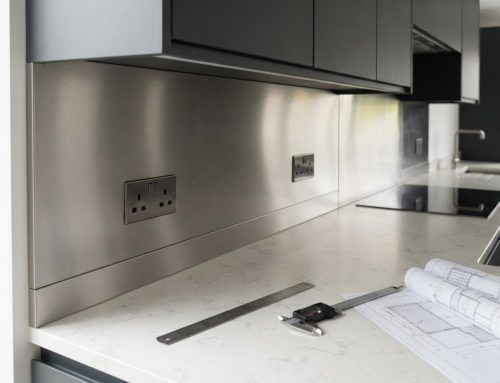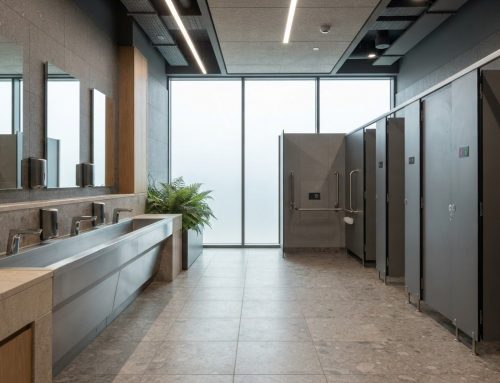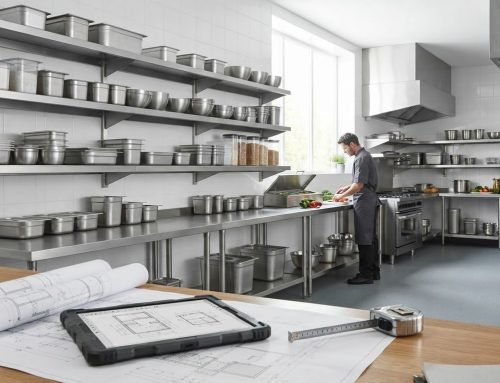

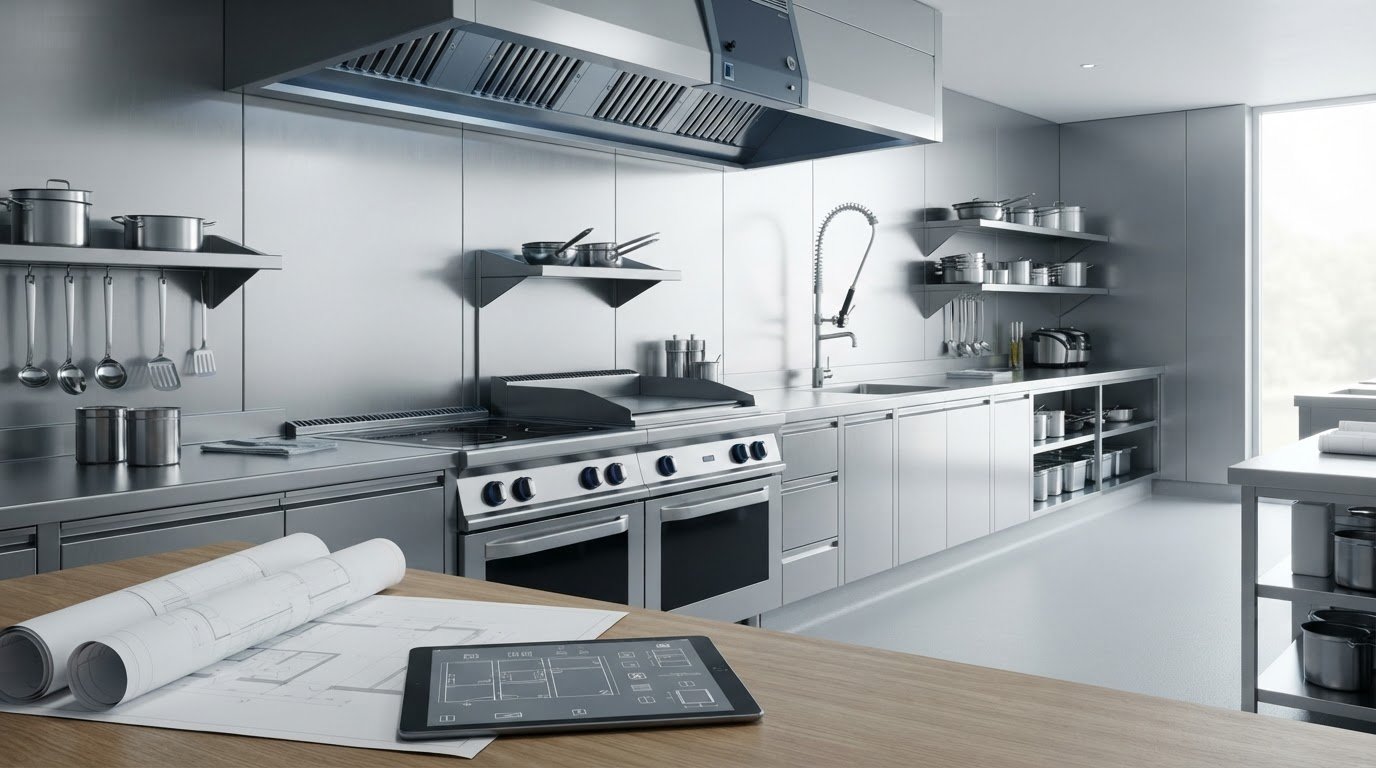
The right wall finish isn’t always the one that looks best on a sample. In a working kitchen, commercial kitchen stainless steel splashbacks need to suit the heat, moisture and cleaning demands of each zone. Their edges and junctions must also align with worktops, sinks and other fittings.
Choosing a wall-cladding material can feel difficult when hygiene, durability and design all matter. This guide compares stainless steel with alternatives such as ceramic tiles and glass, then explains how to specify panels around practical project requirements. You’ll learn what to consider when selecting a stainless steel grade and finish, coordinating dimensions and interfaces, and planning measurement and ordering. Standard sheet formats can reach 3 × 1.5 m and 4 × 1 m. Where these don’t suit the layout, made-to-measure panels offer another option. Pre-production CAD drawings give the project team a chance to review proposed details before manufacture.
Key Takeaways
- Compare stainless steel with tiles, glass and other wall finishes by considering cleaning, joints, impact and the demands of each kitchen zone.
- Specify commercial kitchen stainless steel splashbacks around their coverage, grade, finish and connections to adjoining fittings, not appearance alone.
- Use a measurement checklist to account for openings, edges and neighbouring surfaces before finalising panel dimensions.
- Standard sheet formats reach up to 3 × 1.5 m and 4 × 1 m; made-to-measure panels can suit layouts that need a different approach.
- Pre-production CAD drawings and client approval help coordinate panel details before manufacture.
Commercial kitchen stainless steel splashbacks: plan coverage by zone
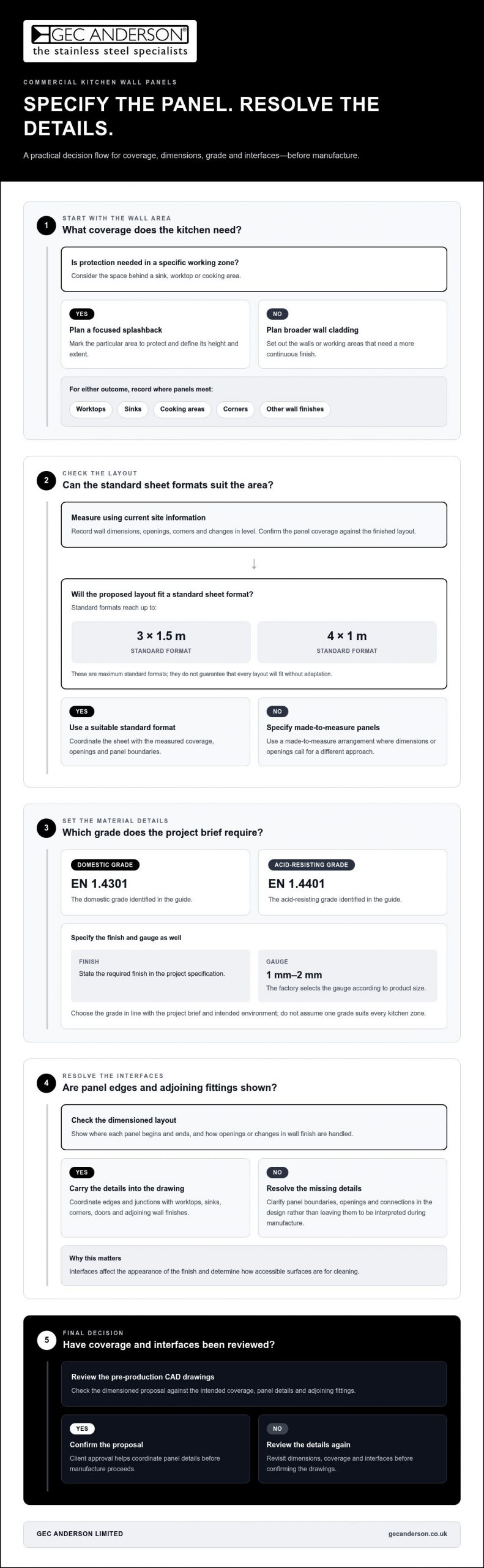
Start by identifying the wall areas that need protection, such as the space behind a sink, worktop or cooking area. Decide whether the brief calls for a local splashback or a broader run of wall cladding, then record where panels meet worktops, corners and other finishes. This makes the extent of coverage clear before dimensions and details are finalised.
What are commercial kitchen wall cladding panels, and where do splashbacks fit?
Commercial kitchen wall cladding panels are protective finish surfaces fitted to walls in working areas. They create a cleanable, durable boundary behind equipment and workstations, and can cover a broad wall area or just the locations where protection is most needed. The extent depends on the kitchen layout and project specification.
Stainless steel wall cladding is a fabricated metal wall finish designed to protect specified areas of a commercial kitchen and coordinate with adjoining surfaces and fittings. A splashback is one focused application of wall cladding, often positioned behind a worktop, sink or cooking area. The terms aren’t interchangeable: a splashback may cover a local zone, while wall cladding can extend across several walls or working areas. Plan commercial kitchen stainless steel splashbacks for their particular location rather than treating them as a default solution for every wall.
Wall cladding panels versus stainless steel splashbacks
Coverage can range from a panel behind a sink to a continuous wall finish. In either case, detail the edges and junctions with worktops, sinks, cooking equipment and adjoining finishes. These interfaces affect the appearance and determine how accessible surfaces are for cleaning. A coordinated drawing should show where each panel begins and ends, and how openings or changes in wall finish are handled.
Why stainless steel is considered for commercial kitchen walls
Professional kitchens need surfaces that can withstand frequent use and routine cleaning. Stainless steel is valued for its cleanable surface and durability, including resistance to hot pans, cutting and vandalism. Practical performance also depends on suitable project details and care. For a general overview of the properties of stainless steel, including its grades and applications, see the linked reference.
Material choice should reflect the working conditions in each zone. A panel behind a sink, for example, has different neighbouring fittings from one behind a cooking area, so consider coverage and junctions together. Stainless steel is 100% recyclable and has a typical product life-cycle of about 50 years, making longevity and end-of-life recovery relevant to the specification.
For UK food businesses, wall finishes form part of the wider hygiene plan. Stainless steel is not the only possible wall material. The task is to select and coordinate a finish that suits its location, use and cleaning requirements. Specifying commercial kitchen stainless steel splashbacks by coverage and interfaces turns a material choice into a workable wall detail.
How to specify stainless steel commercial kitchen wall panels
A clear specification connects the panel’s purpose to its dimensions, material and surrounding fittings. Use this sequence to translate the kitchen layout into details that can be reviewed before manufacture:
- Define coverage. Mark the walls and working zones to be protected, including the required height and extent of each panel.
- Measure the area. Record wall dimensions and note openings, corners and changes in level. Use current site information so the drawing reflects the finished layout.
- Select material details. Specify the stainless steel grade and required finish. Available gauges range from 1 mm to 2 mm, with the factory selecting the gauge according to product size. Relate any project-specific grade, finish or gauge requirement to the technical specification.
- Coordinate interfaces. Show how panel edges meet worktops, sinks, corners, doors and adjoining wall finishes. Resolve junctions and openings in the design rather than leaving them to be interpreted during manufacture.
- Approve the drawings. Review the dimensioned proposal and confirm coverage and interfaces before production proceeds.
Choose the stainless steel grade and panel dimensions
EN 1.4301 is the domestic grade, while EN 1.4401 is the acid-resisting grade. Select the grade in line with the project brief and intended environment rather than assuming one grade suits every kitchen zone. Standard sheet formats are available up to 3 × 1.5 m and 4 × 1 m. These are maximum standard formats, not a guarantee that every layout will fit without adaptation. Where dimensions or openings call for a different arrangement, specify made-to-measure panels. For wider workplace context, consult the HSE guidance for catering.
Coordinate edges, junctions and adjacent fittings
Set out each panel against the final positions of worktops, sinks, cooking areas, corners and doors. A dimensioned drawing should identify panel boundaries and relevant interfaces, helping align the wall finish with connected stainless steel elements. The bespoke stainless steel kitchen worktops specification guide offers a related reference for coordinating adjoining surfaces.
For commercial kitchen stainless steel splashbacks, these steps distinguish a focused splashback from a broader wall-cladding scheme and make the intended coverage explicit. GEC Anderson Limited supplies standard and made-to-measure panels, with pre-production CAD drawings issued for client approval. Explore stainless steel panels and splashbacks as part of developing the project specification.
Stainless steel wall cladding compared with other commercial kitchen finishes
No wall finish is right for every area. Compare materials against the cleaning routine, likely contact, extent of coverage and details at adjoining fittings. A surface that suits a preparation zone may not be the most practical choice across every wall. Use the comparison below as a starting point, then review the proposed product and installation for the project.
| Finish | Cleaning and joints | Impact, appearance and maintenance | Project detailing |
|---|---|---|---|
| Stainless steel panels | A cleanable surface; consider panel joints and edges in the layout. | Durable, with a functional metal appearance. Maintenance depends on the specified finish and care. | Panel dimensions, edges and junctions can be coordinated with worktops, sinks and other fittings. |
| Ceramic tiles | Tile faces and grout joints form part of the cleaning surface. Consider how the joints fit the cleaning routine. | Appearance varies by tile. Assess expected contact and ongoing grout maintenance for the selected installation. | Plan cuts, corners, openings and transitions to adjoining finishes. |
| Glass | Assess the surface and its edges, joints and fixing details as a complete assembly. | Offers a distinct visual finish. Confirm the selected product’s suitability for expected impact and maintenance needs. | Coordinate panel boundaries, openings and interfaces with surrounding fittings. |
| Other specified wall finishes | Performance varies by product; obtain product-specific cleaning information. | Appearance, durability and maintenance depend on the selected finish and its intended use. | Check how the finish meets worktops, equipment and neighbouring surfaces. |
Which criteria matter most in a commercial kitchen?
Start with the operating conditions: what the wall faces, how it will be cleaned, how much coverage is required and what may contact it. Then review the visual finish, joints, corners and practical implications of maintenance or future replacement. Don’t assume a material’s general reputation proves a particular product’s suitability. Verify food-safety, fire-performance and regulatory statements against relevant product evidence and authoritative guidance for the project.
When made-to-measure stainless steel panels may suit the brief
Made-to-measure panels can address unusual wall dimensions, openings or junctions where standard formats don’t align with the layout. Stainless steel offers durability, a hygienic surface and recyclability, but project performance still depends on the specification, fabrication and care. Where a sink meets a wall panel, coordinate both elements together; the made-to-measure stainless steel sinks guide provides a related reference. For commercial kitchen stainless steel splashbacks, the deciding factor is how well the material and detailing answer the brief, not a claim that one finish is universally best.
How to plan panel measurement, cleaning and maintenance
Accurate information before ordering helps panels fit the intended wall coverage and meet adjoining surfaces cleanly. Assemble the measurements and details in one place so they can be reflected in the project drawings.
Prepare accurate measurements and project information
Before finalising a panel order, record:
- the area to be covered and the boundaries of each panel
- wall dimensions, corners and changes in level
- openings, including their positions and dimensions
- edges and junctions with worktops, sinks, doors and other wall finishes
- relevant site conditions that may affect the layout.
Where installation requires it, a site visit may be arranged to establish dimensions or templates. Approved dimensions and drawings give the project team a shared reference for panel coverage and adjoining details, reducing ambiguity in the specification.
Maintain stainless steel panels without damaging the finish
For routine cleaning, apply a general-purpose cleaning material such as cream cleaner to the surface. Rub gently with a damp cloth or sponge, following the stainless steel grain. Rinse thoroughly with cold water and dry carefully with a soft cloth. Never rinse with warm or hot water or leave the surface to air dry. If discolouration remains, repeat the cleaning process.
Water or solutions containing synthetic detergents can cause discolouration or surface grime if left in contact with stainless steel. Remove chloride-containing materials such as salt promptly, as they can cause point-etching. Strong concentrated mineral or organic acids may also corrode the surface, causing dull grey discolouration or deeper cuts.
For calcium deposits, use vinegar, 10% acetic acid or diluted nitric acid at one part HNO₃ to four parts water. After using any of these solutions, rinse thoroughly with cold water and dry with a soft cloth. If using diluted nitric acid, ensure good ventilation and follow the usual rules for handling strong acids.
For recent surface rust, apply a dry cleaning powder lightly with a damp cloth or sponge, then rinse with cold water and dry with a soft cloth. If rust has persisted for an extended period and may have caused deeper, permanent damage, use a dry nylon fibre brush or diluted nitric acid at one part HNO₃ to four parts water. Rinse with cold water and dry with a soft cloth. Visible rust can originate from iron or carbon steel that has contacted the surface, or from iron in water that leaves a stain after evaporation.
Include the cleaning method in the project’s maintenance information, especially where panels meet other materials. This keeps care instructions clear across different wall zones and fittings. If the project also includes related sanitaryware, the commercial stainless steel sanitaryware guidance may help coordinate those elements.
For commercial kitchen stainless steel splashbacks, measurement and maintenance planning are connected: panel boundaries and junctions shape the finished installation, while suitable care helps preserve the surface. To develop a panel layout around your project details, explore stainless steel panels and splashbacks.
How GEC Anderson Limited develops made-to-measure stainless steel panels
GEC Anderson Limited has manufactured stainless steel products since 1962. For commercial kitchen stainless steel splashbacks and wider wall panels, its process moves from the project brief to reviewed drawings and confirmed production details. This gives the project team an opportunity to resolve coverage and interfaces before manufacture begins.
From project requirements to approved CAD drawings
Start by providing the intended coverage, panel dimensions and relevant openings, along with details of adjoining worktops, sinks or other fittings. Include material requirements and any project-specific finish or fixing details that need technical review. Whether the requirement suits a standard panel or calls for a made-to-measure arrangement, clear information helps shape the proposed layout.
GEC Anderson Limited issues pre-production CAD drawings for client approval. Review these against the project information, checking panel boundaries, dimensions and interfaces before confirming the design. Production follows approval and written order confirmation, which includes a delivery date. Technical support is available for design guidance, measurement, installation, cleaning and maintenance, helping carry the specification through from planning to use.
Why manufacturing and material life-cycle belong in the decision
Manufacturing combines automated cutting, welding and precision polishing within an ISO 9001-certified system. These processes support accurate fabrication of panels to the approved details. Drawing review is therefore an important step: production information should reflect the intended dimensions and finish, rather than leaving key decisions unresolved.
Stainless steel is durable and 100% recyclable, with a typical product life-cycle of about 50 years. This is a general material life-cycle, not a project-specific guarantee; actual service life depends on the product, its environment and its care. Consider longevity alongside the initial layout and the practical requirements of maintaining the surface.
Made-to-measure panels are worth considering where standard formats don’t suit the wall, or where defined edges and junctions need to align with adjoining fittings. Explore the GEC Anderson stainless steel range for an overview of stainless steel products. To take your project from panel requirements to an approved drawing, review made-to-measure panel options.
Make your wall panel specification project-ready
A sound wall-cladding decision starts with the working conditions and required coverage, then follows through to panel edges, openings and adjoining fittings. Comparing finishes against cleaning, maintenance and expected contact helps keep the choice grounded in the needs of each kitchen zone. For stainless steel, clear dimensions and approved drawings give the project team a shared reference before manufacture.
GEC Anderson Limited has manufactured stainless steel products since 1962. Its ISO 9001-certified manufacturing includes pre-production CAD drawings for client approval, supporting a considered route from requirements to production. Available grades include EN 1.4301 and EN 1.4401, while standard panel formats extend up to 3 × 1.5 m and 4 × 1 m. Made-to-measure panels can address layouts that call for different dimensions or interfaces.
Whether you’re specifying commercial kitchen stainless steel splashbacks for a focused work zone or planning broader wall coverage, precise details matter. Explore GEC Anderson stainless steel panels and products and take the next step towards a coordinated specification for your project.
Frequently Asked Questions
What are commercial kitchen wall cladding panels?
Commercial kitchen wall cladding panels cover and protect selected wall areas in a professional kitchen. Coverage may extend across larger wall sections or focus on working zones, depending on the layout and project requirements. Stainless steel is one material option. Specify panel dimensions, edges and junctions with adjoining surfaces so the finished arrangement suits the kitchen’s cleaning routine and fittings, rather than treating every wall as requiring the same coverage.
Are stainless steel splashbacks suitable for commercial kitchens?
Stainless steel can be considered for commercial kitchen splashbacks where a hygienic surface, durability and a coordinated finish matter. Suitability depends on the project layout and working conditions. For commercial kitchen stainless steel splashbacks, set out the intended coverage and specify the grade, dimensions and interfaces with adjoining fittings. A focused splashback protects a particular zone; it shouldn’t be assumed to provide the same coverage as a broader wall-cladding scheme.
How do stainless steel wall panels compare with tiles?
Compare stainless steel and tiles against the kitchen’s cleaning routine, joints, likely impact, appearance, maintenance and junction details. Stainless steel offers a hygienic surface and is 100% recyclable, while tiles have grout joints that form part of the surface to be cleaned. Neither finish is universally right for every kitchen. Assess the specific products and project conditions, and verify food-safety, fire-performance or regulatory claims against authoritative guidance.
What stainless steel grade is used for commercial kitchen panels?
GEC Anderson uses EN 1.4301, the domestic grade, also described as 18/8 or AISI 304, and EN 1.4401, the acid-resisting grade, also described as 18/12 or AISI 316/319. State the intended grade in the project specification and relate it to the panel’s application and environment. A general-purpose assumption isn’t a substitute for reviewing the technical specification and any project-specific recommendation.
Can stainless steel kitchen wall panels be made to measure?
Yes. GEC Anderson supplies made-to-measure stainless steel panels as well as standard formats. Provide the product reference and quantity for a standard requirement, or outline the custom dimensions, coverage, openings and adjoining interfaces. Pre-production CAD drawings are issued for client approval before production. Where installation is required, a site visit may be arranged to establish dimensions or templates, helping align the panel details with the actual layout.
How should stainless steel wall cladding be cleaned?
Apply a general-purpose cleaning material such as cream cleaner with a damp cloth or sponge, gently following the stainless steel grain. Rinse thoroughly with cold water and dry carefully with a soft cloth. Never use warm or hot rinse water or leave the surface to air dry. For calcium deposits, use vinegar, 10% acetic acid or diluted nitric acid at one part HNO₃ to four parts water. When using diluted nitric acid, ensure good ventilation and follow the usual rules for handling strong acids.
What standard sheet sizes are available for stainless steel panels?
GEC Anderson’s standard sheet formats for panels and splashbacks extend up to 3 × 1.5 metres and 4 × 1 metre. The suitable format depends on the required wall coverage, layout and details such as edges, openings and adjoining fittings. Where a standard sheet doesn’t suit the design, made-to-measure panels can be specified. Review the dimensions and interfaces in approved drawings before production.