
What if the most vulnerable point in a high-specification kitchen is not the worktop surface, but the invisible junction where the sink meets the substrate? Whilst undermount stainless steel sinks are frequently selected for their minimalist aesthetic, the technical rigour behind their specification determines whether they remain a hygienic asset or a long-term maintenance liability. You likely recognise that architectural excellence relies on precision, yet the distinction between material grades and the structural integrity of different mounting methods is often obscured by standard retail marketing.
This guide provides the technical clarity required to specify stainless steel solutions for a 50-year lifecycle. You will discover the essential differences between 304 and 316 grade steel, ensuring your selection suits the specific chemical and environmental demands of the space. We will also evaluate the functional advantages of seamless bespoke integration compared to traditional undermounting. By the end of this analysis, you will possess the professional confidence to select the correct material thickness and installation method for any premium project, prioritising both enduring utility and uncompromising hygiene.
Key Takeaways
- Learn to distinguish between mounting methods to achieve a minimalist architectural aesthetic while maintaining the structural integrity of the work surface.
- Gain clarity on when to specify EN 1.4301 versus acid-resistant EN 1.4401 stainless steel to suit the specific chemical demands of the environment.
- Understand the maintenance protocols, including the mandatory cold water rinse, necessary to preserve undermount stainless steel sinks for a 50-year life-cycle.
- Evaluate the transition from standard undermounting to seamless bespoke integration to eliminate joints and ensure an aseptic, hygienic finish.
- Discover how bespoke bowl dimensions and precision manufacturing allow for exact specification in both premium domestic and commercial settings.
Understanding Undermount Stainless Steel Sinks
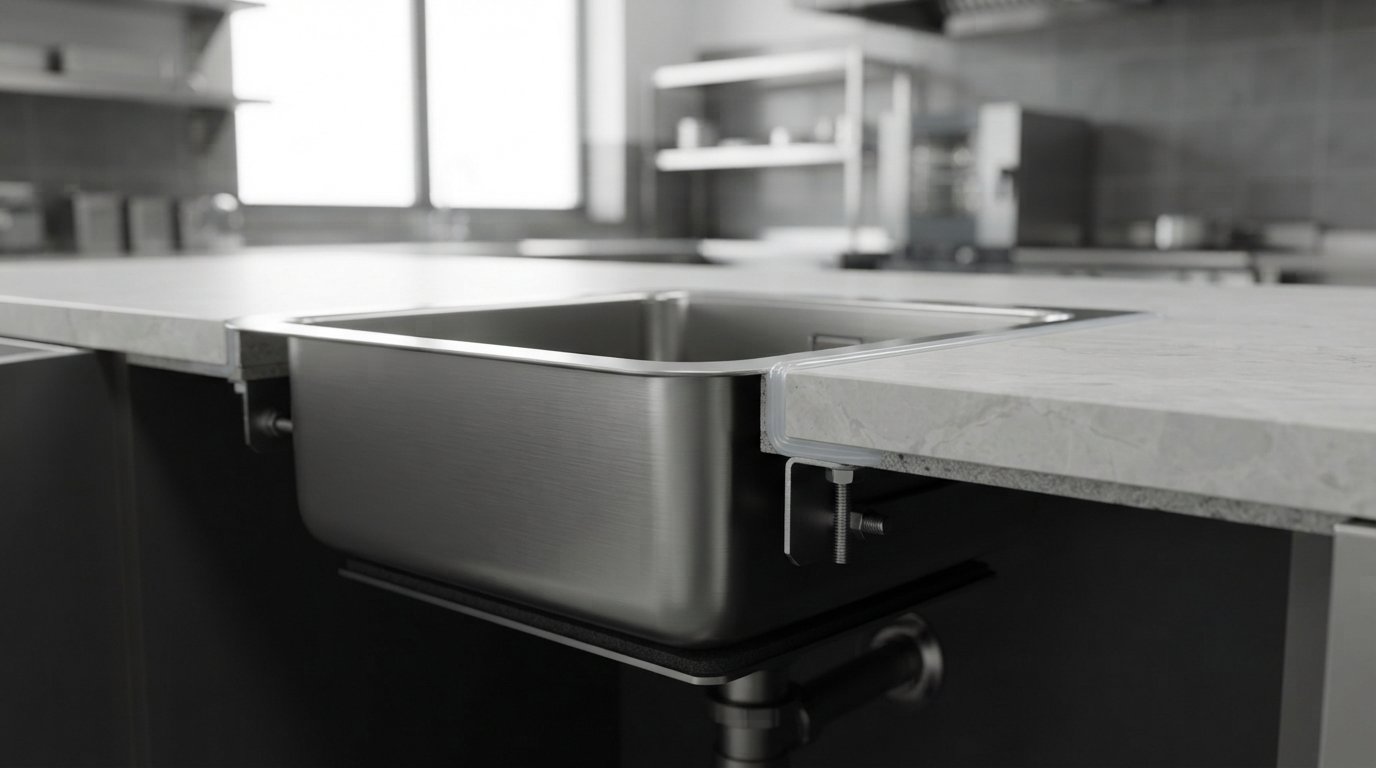
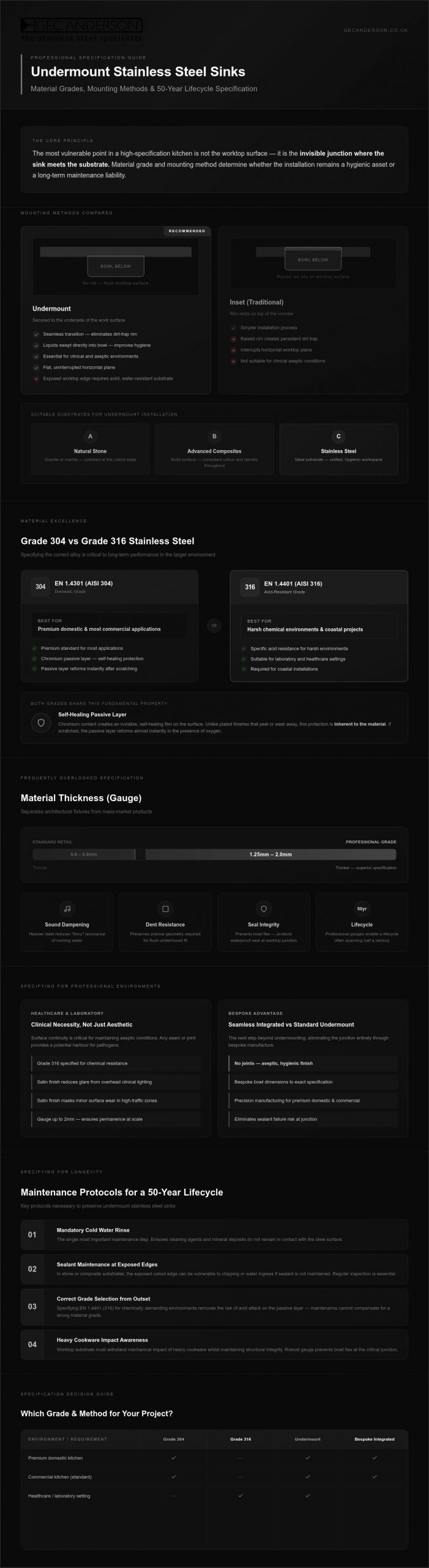
Undermounting is a structural choice that prioritises surface continuity over ease of installation. Unlike traditional inset models that rest on top of the counter, undermount stainless steel sinks are secured to the underside of the work surface. This configuration creates a seamless transition between the counter and the bowl, effectively eliminating the protruding rim that often serves as a persistent “dirt trap” in standard kitchen installations. For architects and specifiers, this choice isn’t just about fashion; it’s a commitment to minimalist “clean lines” that define contemporary high-end environments.
This installation method demands specific material properties from the surrounding worktop. Because the edge of the work surface is exposed around the sink cutout, only solid, water-resistant materials are suitable. Common pairings include:
- Natural Stone: Granite or marble that can be polished at the cutout edge.
- Advanced Composites: Solid surface materials that maintain a consistent colour and density throughout.
- Stainless Steel: The ideal substrate for creating a unified, hygienic workspace.
The Aesthetic vs Functional Debate
Designers frequently favour the hidden rim for its ability to maintain a flat, uninterrupted horizontal plane across residential and commercial interiors. Beyond the visual appeal, the functional benefits are significant. Without a raised edge to obstruct movement, liquids and food debris can be swept directly from the work surface into the bowl, simplifying daily cleaning routines and improving efficiency. It’s a design that respects the workflow of a busy kitchen.
However, the exposed edge of the worktop substrate becomes a critical point of the installation. In stone or composite surfaces, this edge can be vulnerable to chipping or water ingress if the sealant isn’t maintained. Specifiers must ensure that the chosen material can withstand the mechanical impact of heavy cookware whilst maintaining its structural integrity over decades of use. This is why the gauge and quality of the sink itself are so vital; a flimsy bowl can flex, potentially compromising the watertight seal at the junction.
Undermounting in Professional Environments
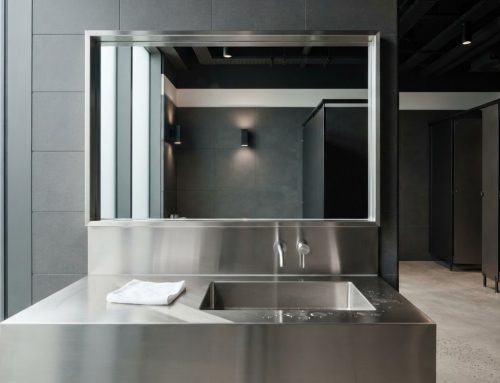
In healthcare and laboratory settings, the case for specifying undermount stainless steel sinks shifts from aesthetic preference to clinical necessity. Surface continuity is critical for maintaining aseptic conditions, as any seam or joint provides a potential harbour for pathogens. Selecting the appropriate stainless steel grades and properties is essential here. Whilst 304 grade is the premium standard for most applications, 316 grade offers the specific acid resistance required in harsh chemical environments or coastal projects.
Professional environments also benefit from the use of satin finishes. This specific texture is effective at reducing glare from overhead clinical lighting and masking the minor surface wear that occurs in high-traffic zones. When combined with a robust gauge of up to 2mm, these sinks provide a level of permanence that standard retail alternatives can’t match, ensuring a lifecycle that often spans half a century.
Material Excellence: Grades 304 and 316 Stainless Steel
The long-term performance of undermount stainless steel sinks is dictated by the alloy’s chemical composition. High-quality stainless steel relies on its chromium content to create an invisible, self-healing “passive layer” on the surface. This microscopic film acts as a permanent barrier against oxidation. Unlike plated finishes that can peel or wear away, this protection is inherent to the material itself. If the sink is scratched during heavy use, the passive layer reforms almost instantly in the presence of oxygen, maintaining the unit’s resistance to rust and staining.
Material thickness, or gauge, is a frequently overlooked specification that separates architectural fixtures from mass-market products. Whilst standard retail sinks might use 0.6mm or 0.8mm steel, professional-grade units utilise a gauge ranging from 1.25mm to 2.0mm. This extra mass provides significant practical benefits. Heavier steel offers natural sound dampening, reducing the “tinny” resonance of running water. It also ensures exceptional dent resistance, which is vital for preserving the precise geometry required for a flush undermount fit. A more robust gauge prevents the bowl from flexing, which protects the waterproof seal at the worktop junction over a 50-year lifecycle.
Domestic Grade EN 1.4301 (AISI 304)
EN 1.4301, often referred to as AISI 304 or 18/8 stainless steel, remains the industry standard for high-end residential applications. The “18/8” designation refers to the 18% chromium and 8% nickel content, a balance that provides superior durability against household acids and thermal shock. Whether subjected to boiling water or standard detergents, this grade maintains its structural integrity without discolouration. Its satin finish is particularly valued for its ability to develop a fine patina over time, masking minor surface abrasions whilst retaining a polished, professional appearance in premium kitchen environments.
Acid-Resisting Grade EN 1.4401 (AISI 316)
For environments with higher chemical demands, such as healthcare facilities, laboratories, or coastal installations, EN 1.4401 (AISI 316) is the essential specification. This grade includes molybdenum, an addition that significantly improves resistance to pitting and crevice corrosion caused by chlorides and industrial-strength cleaning agents. The choice between 304 and 316 grade steel is determined by the specific chemical exposure of the environment. In a pharmaceutical setting where aggressive sanitisation is mandatory, 316 grade ensures the sink remains aseptic and free from corrosive damage that could harbour bacteria. This makes 316 grade the logical choice for any project where undermount stainless steel sinks must endure rigorous, non-standard cleaning protocols.
Comparison: Undermount vs Inset and Integrated Sinks
Selecting the appropriate installation method is a fundamental decision that affects both the kitchen’s architecture and its long-term maintenance. Inset sinks remain the standard retail option; they’re defined by a visible rim that sits on top of the work surface. Whilst they’re straightforward to install, the protruding edge creates a visual break and a ledge where debris can collect. Undermount stainless steel sinks offer a more sophisticated alternative for solid surfaces, hiding the rim beneath the counter to achieve a minimalist profile. However, for those seeking the ultimate in durability and hygiene, integrated sink and worktop units provide a seamless solution where the bowl and surface become one.
The Hygiene Factor: Eliminating the Silicone Joint
The primary technical weakness of standard undermount stainless steel sinks is the silicone bead used to seal the junction between the sink rim and the worktop. Over time, this silicone can discolour, degrade, or harbour bacteria, particularly in high-use environments. It’s a maintenance point that requires periodic inspection and replacement to prevent water ingress. In contrast, made to measure stainless steel sinks that are integrated into a stainless worktop solve this through precision welding. By fusing the metals together, the joint is eliminated entirely, resulting in an aseptic surface that’s far easier to sanitise and maintain over a 50-year lifecycle.
Structural Integrity and Support
The structural requirements for a sink change significantly as the bowl dimensions increase. Large undermount bowls, such as the expansive Series A70, carry substantial weight when filled with water. Standard installation relies on mechanical clips or adhesive bonding to the underside of the stone or composite. This puts the entire weight of the unit on the fixings and the substrate’s tensile strength. Bespoke integrated units offer a superior structural approach. Because the bowl is welded into the worktop, the weight is distributed across the entire frame. This allows for the specification of deeper, larger bowls and heavier 2mm gauges that standard retail modules simply can’t support, ensuring the unit remains stable even under heavy commercial or domestic use.
Specifying for Longevity: Maintenance and Care
The endurance of undermount stainless steel sinks is not solely a product of their material grade; it’s maintained through a disciplined care protocol. Whilst the alloy is inherently resistant to corrosion, the surface requires specific handling to preserve its technical and aesthetic properties over a 50-year lifecycle. A common misconception in standard kitchen maintenance is the use of warm water for rinsing. At GEC Anderson, we mandate a strict “Cold Water Rule”. Rinsing with warm or hot water can lead to surface discolouration and spotting. Always use cold water for rinsing and ensure the surface is dried immediately with a soft cloth. Air drying is prohibited as it allows mineral deposits and grime to build up, compromising the aseptic quality of the steel.
Preserving the professional satin finish requires an understanding of the material’s grain. When cleaning, it’s essential to follow the direction of the grain to avoid creating cross-scratches that can dull the finish over time. In hard water areas, calcium deposits may form. These should only be treated with vinegar, 10% acetic acid, or a highly diluted nitric acid solution. Aggressive descalers or abrasive pads will damage the passive layer, leading to permanent surface degradation.
The GEC Anderson Maintenance Protocol
Maintaining the integrity of the installation involves a methodical approach. For routine cleaning, apply a specialist cream cleaner and rub gently in the direction of the grain. This should be followed by a thorough cold rinse and immediate drying. If the sink exhibits signs of “tea staining” or surface rust, it’s often due to foreign iron particles from wire wool or carbon steel tools rather than the sink itself. These can be safely removed using a dry nylon fibre brush or a diluted nitric acid solution at a 1:4 ratio. Consistent, grain-aligned maintenance is the most effective way to protect your investment. For more detailed technical guidance, you can view our full maintenance requirements.
Protecting the Passive Layer
The microscopic passive layer that protects the steel is sensitive to specific chemicals. Chloride-containing substances, such as common table salt, must be removed immediately to prevent pitting. Mineral acids should be handled with extreme caution and only used with professional ventilation. The longevity of a stainless steel sink is preserved not by aggressive chemicals, but by consistent, grain-aligned maintenance. Avoid leaving damp cloths or sponges on the surface, as these can trap moisture and chemicals against the steel, potentially leading to localised corrosion. By following these professional standards, undermount stainless steel sinks will retain their functional excellence and visual appeal for decades.
The Bespoke Advantage: GEC Anderson Solutions
Whilst standard undermount stainless steel sinks provide a visual upgrade from inset models, GEC Anderson elevates the concept through a “No Joins” philosophy. This approach eliminates the traditional seams and silicone beads that compromise hygiene and structural integrity. Our Series A collection offers a range of bespoke bowls, from the compact A18 to the expansive A70, each designed to be integrated seamlessly into a continuous work surface. This creates an aseptic environment that’s essential for both high-end domestic kitchens and clinical settings. It’s a level of precision that transforms a functional fixture into a permanent architectural feature.
Made-to-Measure Excellence
We fabricate sinks to meet the exact project requirements, moving beyond the constraints of standard retail modules. This includes non-standard widths and depths that allow for total architectural freedom in bespoke cabinetry. By combining the minimalist aesthetics of undermount stainless steel sinks with the structural strength of a 2mm gauge, we ensure the unit remains stable and durable under heavy use. Our technical support is comprehensive, providing pre-production CAD drawings and on-site measurement guidance to ensure absolute precision. Refer to our bespoke kitchen sink size guide for detailed technical dimensions. For those seeking a complete, integrated solution, our Decimetric® modular kitchen furniture system provides professional-quality flexibility, allowing for the organisation of professional kitchens with the same exacting standards.
Architectural Heritage and Trust
GEC Anderson has maintained a reputation for technical excellence since 1962. Our products are often considered “works of art” because they balance aesthetic grace with industrial-grade utility, a standard that has seen our solutions specified for major institutions like the British Library. Sustainability is a core component of our manufacturing philosophy; the steel used is 100% recyclable and designed for a typical 50-year product lifecycle. This longevity significantly reduces the environmental impact associated with the frequent replacement of lower-grade fixtures. If you’re specifying for a project that demands permanence and precision, you can enquire about bespoke stainless steel sinks to discuss your specific requirements with our technical team.
Advancing the Standard of Architectural Specification
Achieving a superior kitchen or laboratory environment requires a balance of architectural vision and technical precision. Whilst undermount stainless steel sinks offer a refined aesthetic, the choice between 304 and 316 grade steel remains a critical factor for ensuring long-term durability in specific chemical contexts. You’ve seen that true hygiene and longevity are found in the details; specifically the transition from standard undermounting to seamless bespoke integration. This approach effectively removes the vulnerability of the silicone joint and ensures an aseptic workspace.
At GEC Anderson, we support your specification process with ISO 9001-certified manufacturing and provide bespoke CAD drawings for every order. It’s the reason our solutions are trusted by major institutions such as the National Gallery and Guy’s Hospital. We invite you to explore bespoke stainless steel sink solutions that are engineered for a 50-year lifecycle. Selecting a high-specification fixture is a commitment to permanence and professional utility. We look forward to helping you realise your next project with the precision it deserves.
Frequently Asked Questions
What is the difference between undermount and inset stainless steel sinks?
Inset sinks are installed from above, with a visible rim resting on the worktop surface. In contrast, undermount stainless steel sinks are secured beneath the counter, creating a continuous level between the worktop and the bowl. This architectural choice eliminates the protruding edge, allowing for a minimalist aesthetic and easier cleaning. Whilst inset sinks are standard in retail, undermounting is the preferred method for high-specification environments using solid, water-resistant surfaces.
Can I install an undermount sink with a laminate worktop?
It’s generally not advisable to install an undermount sink with a laminate worktop. Because the cutout edge is exposed, the chipboard or MDF core of the laminate is vulnerable to water ingress, which causes swelling and structural failure. Successful undermounting requires a solid, water-resistant material such as natural stone, composite, or a bespoke stainless steel worktop. These materials allow for a watertight seal at the junction, ensuring the installation remains durable over time.
Is 316 grade stainless steel necessary for a domestic kitchen?
For most residential applications, EN 1.4301 (304 grade) is the premium standard and provides exceptional resistance to household detergents and thermal shock. 316 grade is an “acid-resisting” alloy containing molybdenum, typically specified for laboratories, healthcare settings, or coastal properties where chloride exposure is high. Unless your domestic kitchen environment is subject to extreme chemical or saline conditions, 304 grade offers the ideal balance of performance and aesthetic longevity for a 50-year lifecycle.
How do I prevent my undermount sink from scratching?
Stainless steel is a durable material that naturally develops a fine patina of micro-scratches through regular use. To minimise deep abrasions, avoid using wire wool or abrasive scouring pads. When cleaning, you must always follow the grain of the steel to ensure any minor marks blend into the satin finish. Using a protective mat or exercising care with heavy cast iron cookware will help preserve the structural integrity and visual appeal of the surface for decades.
What is the best way to clean a satin finish stainless steel sink?
The most effective maintenance involves applying a cream cleaner with a damp sponge, always rubbing in the direction of the grain. You must then rinse the surface thoroughly with cold water; never use warm or hot water as this can lead to discolouration. Finally, dry the sink carefully with a soft cloth. This prevents air drying, which is prohibited as it allows mineral deposits and grime to build up, compromising the aseptic quality of the steel.
Are undermount sinks hygienic?
They’re highly hygienic because the lack of a protruding rim prevents food debris and bacteria from accumulating on the worktop. However, the silicone joint between the sink and the counter requires regular inspection to ensure it remains intact. For the highest aseptic standards, a bespoke integrated unit is superior. By welding the bowl directly into a stainless steel worktop, the joint is eliminated entirely, creating a seamless, easy-to-sanitise surface that’s ideal for professional kitchens.
What thickness or gauge should a high-quality stainless steel sink be?
High-specification sinks typically utilise a gauge between 1.25mm and 2mm. Thicker steel provides superior structural integrity, ensuring the bowl doesn’t flex under the weight of water. This extra mass also offers natural sound dampening and enhanced dent resistance. Whilst standard retail alternatives often use thinner 0.6mm or 0.8mm steel, a robust 1.5mm or 2mm gauge is essential for an undermount unit designed to maintain its precision and performance for half a century.
How do I remove rust spots from my stainless steel sink surface?
Rust spots usually originate from foreign iron particles rather than the sink itself. For light staining, apply a dry cleaning powder with a damp sponge, rinse with cold water, and dry with a soft cloth. If the rust is persistent, use a dry nylon fibre brush or a solution of diluted nitric acid at a one-to-four ratio with water. Always ensure good ventilation when using acids and strictly follow the mandatory cold water rinse and soft cloth drying protocol.