
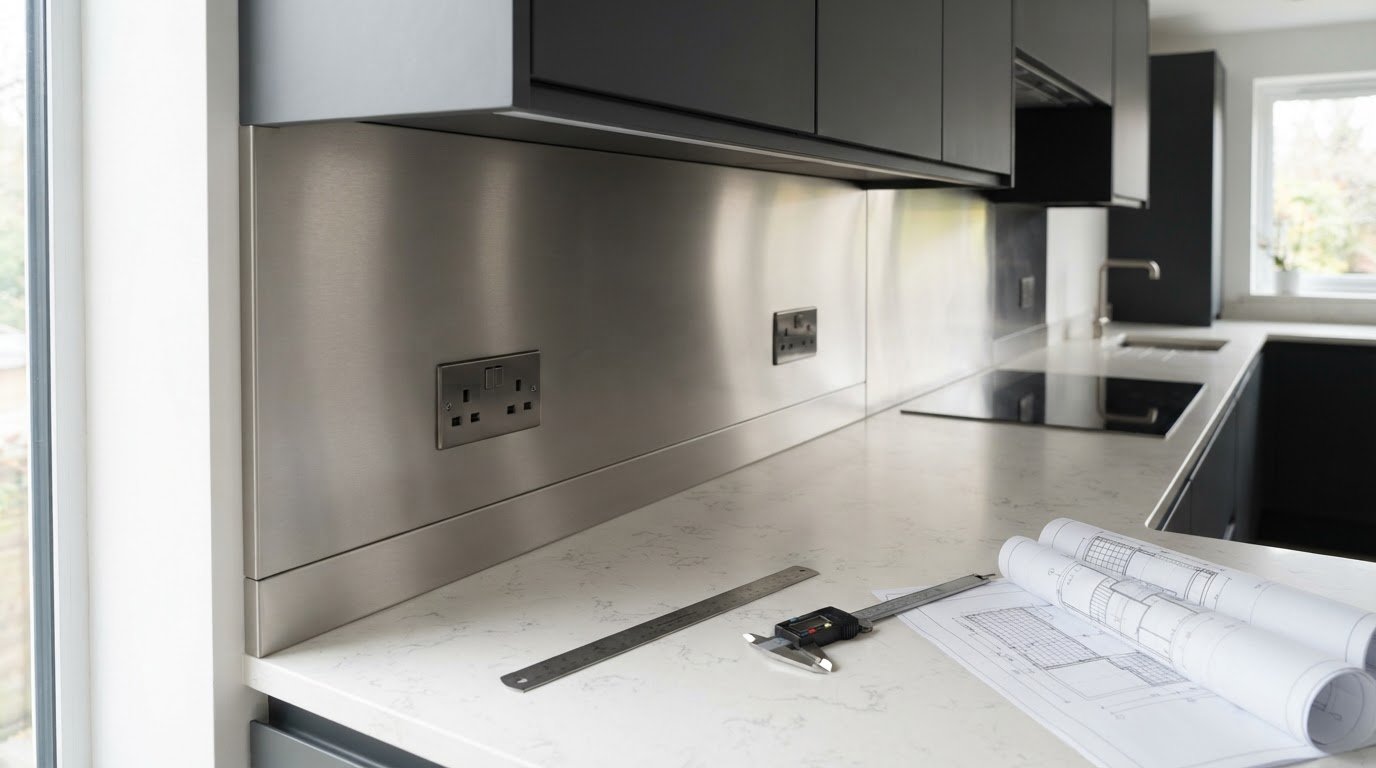
What if the details that make a splashback fit are settled before it reaches production? A stainless steel splashback cut to size needs to be specified around the measured space, including sockets, corners and adjoining surfaces. An overlooked detail can affect how the finished panel sits against the worktop or cabinetry.
Before ordering a made-to-measure panel, you need to know how to measure the area, which stainless steel grade and gauge to specify, and how the finish will look in the room. This guide explains those decisions in practical terms, helping you prepare a specification for the intended space and installation.
GEC Anderson’s ordering process brings those details together. We cover the available grades, gauge considerations and finish limits, then explain how a pre-production CAD drawing lets you review and approve the agreed design before manufacture. Careful coordination at this stage helps align the panel’s dimensions and appearance with your plans.
Key Takeaways
- Define the finished area and record sockets, switches, corners and adjoining surfaces so the panel layout reflects the installation.
- Compare EN 1.4301 domestic grade with EN 1.4401 acid-resisting grade, and consider the available gauges: 1 mm, 1.25 mm, 1.5 mm and 2 mm.
- A stainless steel splashback cut to size is specified for your project. Standard sheet dimensions are a useful reference, not a substitute for checking the layout.
- Share your requirements, review the pre-production CAD drawing and approve the design before it proceeds to production.
- For a made-to-order enquiry, outline your custom requirements. For a standard product enquiry, provide its reference and quantity.
What does “stainless steel splashback cut to size” mean for your project?
A stainless steel splashback cut to size is specified for the dimensions and requirements of a particular installation. Rather than assuming a standard panel will suit, the design takes account of the finished wall area, edges, corners, openings and intended fitting arrangement. This defines how the panel should meet adjoining surfaces and where details such as sockets need to be considered.
Made-to-measure doesn’t simply mean choosing a sheet with convenient dimensions. A project can be planned around sheet sizes of up to 3 × 1.5 m or 4 × 1 m, but those dimensions don’t determine the final panel layout. Measure and detail the installation, then agree the dimensions and technical details before production so the drawing reflects the intended result.
Where made-to-measure stainless steel splashbacks are useful
In a residential kitchen, professional kitchen or another suitable project setting, a fitted panel can provide a practical wall surface behind a work area. Designers may need to coordinate its proportions and appearance with the wider scheme. Contractors need clear dimensions and opening details for planning, while end-users need a panel suited to the space and its intended use. For background on what stainless steel is, including its properties and grades, see this overview.
What to decide before specifying panel dimensions
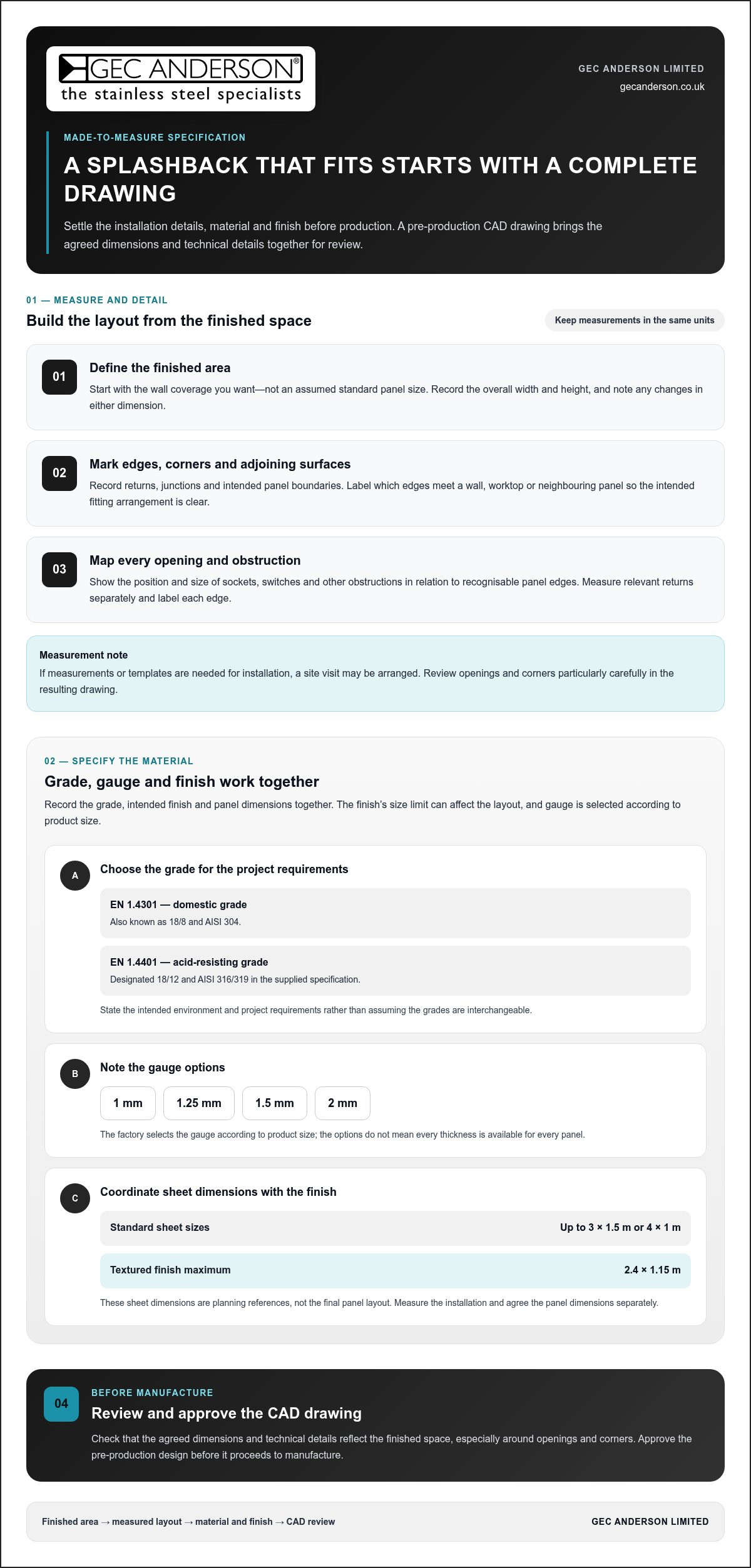
Start with the finished installation area, not an assumed standard size. Record the wall width and height, note corner conditions and identify any required openings. Consider the edges and how the panel should sit against adjoining surfaces. If measurements or templates are needed for installation, a site visit may be arranged.
- Wall dimensions: Measure the intended coverage area and note changes in width or height.
- Corners and edges: Record returns, junctions and the intended panel boundaries.
- Openings: Mark the position and size of sockets, switches or other obstructions on the layout.
- Fitting arrangement: Clarify how the panel relates to surrounding surfaces so the drawing can show the intended configuration.
These details provide a practical starting point for the specification. Review the resulting drawing carefully, particularly around openings and corners, and check that the dimensions and technical details reflect the finished space before the panel proceeds to production.
Material, thickness and finish: what to specify for a stainless steel splashback
Material, gauge and finish shape both the practical specification and the appearance of a made-to-measure panel. Consider them alongside the panel dimensions: a finish’s size limit may affect the layout, while the factory selects the gauge according to product size.
How stainless steel grade relates to the specification
GEC Anderson offers EN 1.4301 domestic grade, also known as 18/8 and AISI 304, and EN 1.4401 acid-resisting grade, designated 18/12 and AISI 316/319 in the supplied specification. These grade references help define the required material. The British Stainless Steel Association’s stainless steel grades information provides further technical context. Specify the intended environment and project requirements rather than assuming the grades are interchangeable.
Gauge, finish and sheet-size limits
Gauge options are 1 mm, 1.25 mm, 1.5 mm and 2 mm. The factory selects the gauge according to product size, so the options shouldn’t be read as a choice of every thickness for every panel. Standard sheet sizes are up to 3 × 1.5 m and 4 × 1 m; the maximum size for a textured finish is 2.4 × 1.15 m. Consider the finish and dimensions together when planning the panel layout.
| Specification factor | Confirmed detail | Project decision |
|---|---|---|
| Grade | EN 1.4301 or EN 1.4401 | State the intended environment and requirements. |
| Gauge | 1 mm, 1.25 mm, 1.5 mm or 2 mm | Gauge is selected by the factory according to product size. |
| Sheet dimensions | Up to 3 × 1.5 m or 4 × 1 m; textured finish up to 2.4 × 1.15 m | Coordinate panel dimensions with the chosen finish and installation layout. |
For a clear specification, record the required grade, intended finish and panel dimensions together. GEC Anderson’s made-to-measure stainless steel splashbacks are specified for the project, with material and dimensions considered as part of the same design.
Measuring and detailing a cut-to-size splashback accurately
A useful drawing translates the finished installation into clear dimensions and positions. Before specifying a stainless steel splashback cut to size, define the area the panel should cover, then record the boundaries, adjoining surfaces and openings. Measure consistently, use the same units throughout, and label which edges meet a wall, worktop or neighbouring panel.
- 1. Define the finished area. Identify where the splashback starts and ends, including its intended height and the surfaces it will meet.
- 2. Record the dimensions. Note the overall width and height, and measure relevant returns separately. Label which measurement belongs to each edge.
- 3. Map obstructions and junctions. Locate every socket or switch, describe corners and note adjoining surfaces that affect the panel layout.
Small details matter. Show a socket’s position in relation to recognisable panel edges rather than describing it only as “near the corner”. At an internal corner or return, clarify how the panel should meet the adjoining wall. This communicates the intended arrangement without relying on assumptions about the site.
Which measurements and details should the drawing show?
Include the overall width and height, each relevant return, and the location of every required opening. Describe edge and corner conditions in plain terms, identifying which sides meet walls or adjacent surfaces. Don’t assume a particular edge profile or cut-out arrangement; show the required detail. For complex geometry, a dimensioned sketch or template can make the intended layout easier to understand.
Approved dimensions and clearly located openings give production an agreed reference for the panel’s size and layout.
How CAD approval reduces specification uncertainty
GEC Anderson provides a pre-production CAD drawing for client approval. Review it against the agreed measurements, openings, returns and intended panel arrangement. Check that each feature is shown in relation to the correct edges, and resolve any discrepancies before approving the drawing. Production follows client approval, making this a key opportunity to align the documented specification with the intended design.
Material and finish information can sit alongside the dimensional details in the wider specification. The British Stainless Steel Association’s stainless steel specifications technical library offers further reference on the material. A clear drawing and specification give everyone involved the same agreed information.
Choosing between standard sheet sizes and a made-to-measure splashback
Standard sheet dimensions can help inform a splashback layout, but they don’t define the finished panel. GEC Anderson’s standard sheet sizes are up to 3 × 1.5 m and 4 × 1 m. Treat these as planning references, then compare them with the measured wall area, required openings, returns and edges. A sheet dimension alone doesn’t establish how a particular installation will be configured.
When a standard sheet dimension may inform the layout
For a straightforward wall area, considering the available sheet dimensions early can help shape the proposed panel layout. Whether a dimension suits the project depends on the actual width and height, corners or adjoining surfaces, and details that need to be included. A size that appears suitable on paper may not account for the finished boundaries or openings, so relate it to the project drawing rather than assuming it determines the final panel arrangement.
When project-specific dimensions need a bespoke drawing
A made-to-measure specification is useful when the dimensions or layout need to reflect a particular installation. For example, the design may need to coordinate a return, an opening and the junction with an adjoining surface. If the chosen design calls for a textured finish, include its maximum size of 2.4 × 1.15 m in the layout discussion. This is smaller than the stated maximum standard sheet dimensions.
Dimensions, finish, material grade, gauge selection and detailing work together. A change in panel layout can affect how the overall specification is resolved, while the factory selects the gauge according to product size. Consider the choices as a coordinated set, not as separate decisions. If the splashback meets a stainless steel worktop, include that adjoining surface in the design discussion. See the guide to bespoke stainless steel kitchen worktops for related specification considerations.
For a made-to-measure panel, the pre-production CAD drawing provides a defined point to review the proposed dimensions and layout before production. Check that it reflects the intended finish, openings and adjoining edges, then approve the agreed design. This keeps the specification clear without treating a sheet size as a finished-panel guarantee.
Planning a panel for a specific installation? Explore made-to-measure stainless steel splashbacks and consider the sheet dimensions alongside your project requirements.
Order a GEC Anderson stainless steel splashback cut to size
Ordering a stainless steel splashback cut to size starts with a clear project brief. For a standard-product enquiry, provide the product reference and quantity. For a made-to-order panel, outline the custom requirements, including dimensions, intended finish, material requirements and the position of any openings. If measurements or a template are needed for installation, a site visit may be arranged.
From project requirements to approved production drawing
The ordering sequence is straightforward: share your requirements, review the pre-production CAD drawing, approve the design and proceed to production. Check the drawing against the agreed dimensions, openings, edges and layout. Resolve any discrepancy between the proposed panel and the intended specification before approving the design and moving it into production.
Once the drawing reflects the agreed requirements, your approval allows production to proceed. For a standard enquiry, a reference and quantity identify the product requested. For a made-to-order enquiry, a considered outline of the custom details gives the specification its starting point.
Care and ongoing performance of stainless steel
Stainless steel provides a hygienic surface and is valued for practical use in residential and professional settings. GEC Anderson’s product information gives a typical product life-cycle of approximately 50 years and states that stainless steel is 100% recyclable. These are useful considerations alongside the panel’s dimensions, grade and finish.
Routine care supports the surface over time. Always follow the stainless steel grain when applying cleaning material. After cleaning, rinse thoroughly with cold water, never warm or hot water, and dry with a soft cloth. Don’t leave the panel to air dry.
Before submitting your requirements, gather the finished dimensions, material and finish preferences, and details of openings or adjoining surfaces. The approved CAD drawing provides a shared reference for the specified panel. To discuss a tailored splashback specification, contact GEC Anderson.
Bring your splashback specification together
A successful made-to-measure panel begins with coordinated decisions. Accurate wall dimensions, clearly located openings and details of corners and adjoining surfaces help define the layout. Grade, gauge and finish also need to be considered alongside panel size, particularly where a finish has a maximum dimension.
For a stainless steel splashback cut to size, the pre-production CAD drawing is an important review point. Check it against your agreed measurements and requirements, then approve the design before production. GEC Anderson’s ISO 9001-certified manufacturing supports this process.
Whether you’re specifying a panel for a residential kitchen or a professional environment, a considered brief helps align practical requirements with the intended appearance. Prepare your dimensions and finish preferences, then discuss your stainless steel splashback specification with GEC Anderson. With the details agreed and drawing approved, you can move forward with a clear project specification.
Frequently Asked Questions
Can I order a stainless steel splashback cut to size?
Yes. GEC Anderson supplies made-to-measure stainless steel panels and splashbacks. A stainless steel splashback cut to size is specified around your project’s dimensions and requirements, including the finished wall area, openings and intended layout. Share these details to inform the specification. GEC Anderson provides a pre-production CAD drawing for your approval, so you can review the proposed design against the agreed requirements before approving production.
What sizes are available for stainless steel splashback panels?
Standard sheet sizes for panels and splashbacks are up to 3 × 1.5 m and 4 × 1 m. For a textured finish, the maximum size is 2.4 × 1.15 m. These are sheet-size limits, not a guarantee that every dimension will suit every project layout or finish. Consider the wall area, openings and intended panel arrangement together when specifying a splashback.
How do I measure for a made-to-measure stainless steel splashback?
Measure the finished wall area, noting its overall width and height, relevant returns and corner conditions. Record the position and dimensions of openings such as sockets, relating each to the panel edges. Check the measurements against the intended installation and set them out clearly on a dimensioned sketch or template, particularly for complex layouts. A site visit may be arranged where dimensions or templates are needed for installation.
Which stainless steel grade is suitable for a splashback?
GEC Anderson’s specified options are EN 1.4301, also described as 18/8 and AISI 304, and EN 1.4401, described as 18/12 and AISI 316/319. Let the project’s environment and specification guide the choice; don’t assume the grades are interchangeable or that one is necessary for a particular domestic or professional setting. Include your material requirement in the project brief so it can be considered alongside the panel design.
What thickness can a stainless steel splashback be?
The available gauge options are 1 mm, 1.25 mm, 1.5 mm and 2 mm. The factory selects the gauge according to product size, so these options don’t mean every thickness applies to every panel. Treat gauge as part of the overall product specification, alongside dimensions, grade and finish. This keeps the choice connected to the panel being made rather than treating thickness as an isolated selection.
How does the made-to-measure splashback ordering process work?
For a standard product, provide its reference and quantity. For made-to-order work, describe your custom requirements. GEC Anderson prepares a pre-production CAD drawing for your review and approval, and production follows approval. A site visit may be arranged if dimensions or templates are needed for installation. The order process also includes written confirmation with a delivery date, without assuming a particular lead time before the project is specified.
How should I clean a stainless steel splashback?
Apply a general-purpose cleaning material such as cream cleaner, then rub gently with a damp cloth or sponge, following the grain. Rinse thoroughly with cold water and dry with a soft cloth. Never rinse with warm or hot water or leave the surface to air dry. For calcium deposits, use vinegar, 10% acetic acid or diluted nitric acid, one part HNO₃ to four parts water. When using diluted nitric acid, ensure good ventilation and follow the usual rules for handling strong acids. For recent rust, lightly apply dry cleaning powder with a damp cloth or sponge. For persistent rust, use a dry nylon fibre brush or diluted nitric acid. After cleaning, rinse with cold water and dry with a soft cloth.