
If you specify a washroom today, you shouldn’t have to revisit that decision for another five decades. While ceramic fixtures are often the default choice, they frequently fail under the pressure of high-traffic professional environments, making commercial stainless steel sanitaryware the necessary choice for those seeking true longevity. You likely recognise the frustration of managing facilities where durability and strict aseptic standards aren’t just preferences, but absolute operational requirements.
This guide provides a detailed technical framework for specifying solutions that withstand the rigours of healthcare, education, and public infrastructure. We promise to move beyond basic aesthetics to uncover how this material supports a 50-year lifecycle and ensures compliance with the latest UK Building Regulations, including the October 2024 mandates of Approved Document T. We will examine essential material grades like EN 1.4401 for clinical settings, explore the benefits of bespoke dimensions for complex layouts, and outline the precision manufacturing processes that define modern, high-performance washroom solutions. By understanding the intersection of material science and functional design, you can deliver a facility that remains hygienic, compliant, and structurally sound for its entire service life.
Key Takeaways
- Understand the technical distinctions between EN 1.4301 and EN 1.4401 grades to ensure your specification meets the specific chemical and hygiene demands of your environment.
- Identify the most appropriate configurations for commercial stainless steel sanitaryware, ranging from back-to-wall WCs to vanity-mounted basins, to optimise space and durability.
- Learn how to align washroom designs with stringent healthcare aseptic requirements and educational durability standards to significantly reduce long-term maintenance costs.
- Discover how the 100% recyclability of stainless steel supports sustainable building accreditations whilst providing a reliable, low-impact solution for modern infrastructure.
- Streamline the procurement phase by utilising detailed CAD drawings and approval processes that ensure bespoke fixtures fit perfectly within your architectural plans.
The Role of Stainless Steel in Commercial Sanitaryware Specification
Commercial sanitaryware represents a fundamental departure from domestic fittings, where aesthetic trends often outweigh structural substance. In professional environments, the specification process prioritises longevity and functional reliability above all else. Commercial stainless steel sanitaryware serves as the essential infrastructure for high traffic washroom solutions, offering a typical lifecycle that spans approximately 50 years. This permanence is a direct result of meticulous manufacturing standards, such as ISO 9001 certification, ensuring every fixture withstands continuous use without structural degradation.
Beyond its physical strength, the material provides a closed-loop environmental solution. It is 100% recyclable, allowing architects to meet modern sustainability targets whilst providing a robust physical product. Unlike composite or plastic alternatives, stainless steel doesn’t lose its structural properties over time. It remains a primary choice for specifiers who value long-term utility and professional trust over temporary convenience.
Hygiene and Aseptic Surface Performance
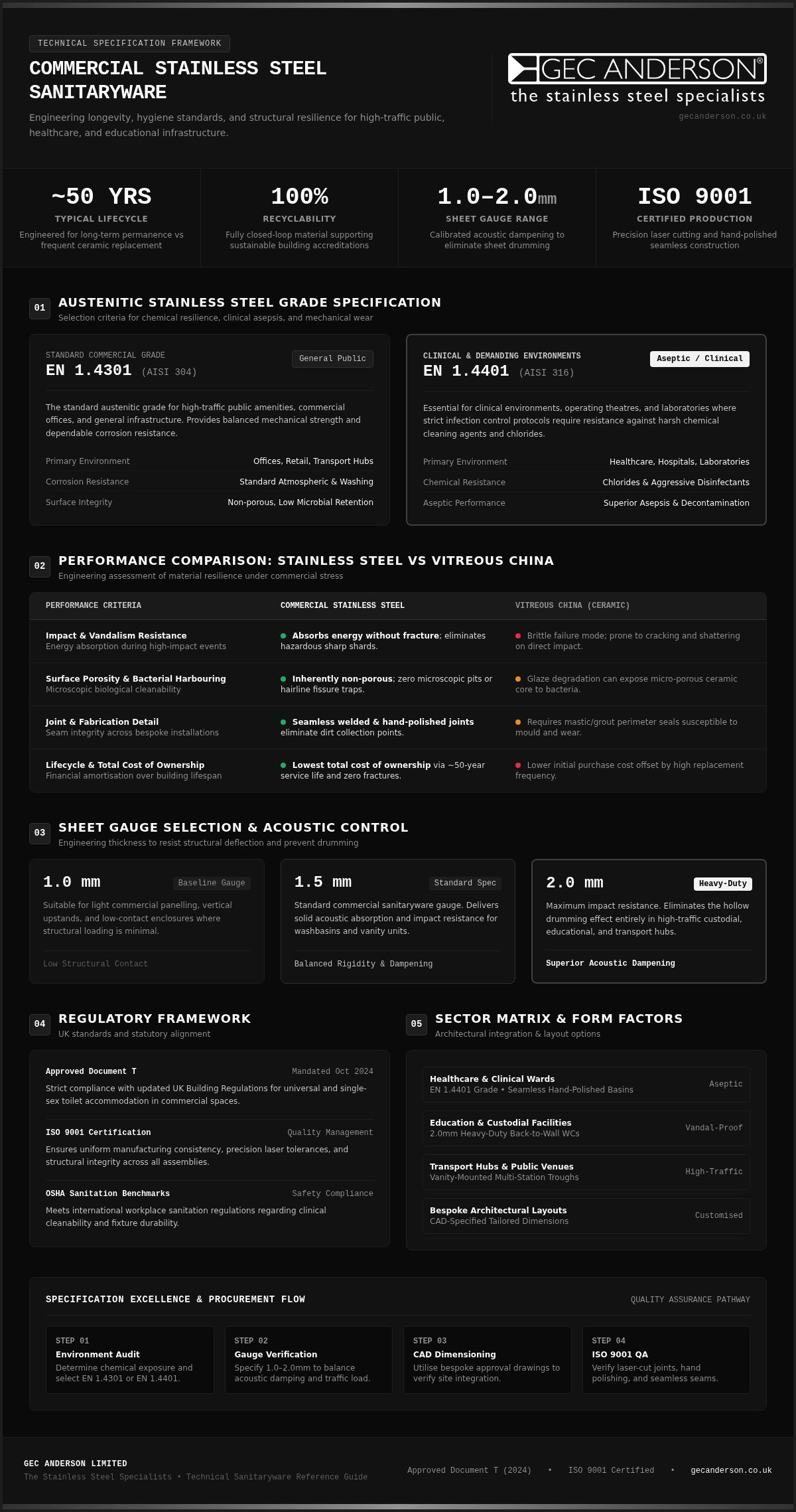
The biological cleanability of a surface is paramount in clinical and public settings. Stainless steel is inherently non-porous, which prevents the microscopic pits and cracks where bacteria often colonise in ceramic alternatives. Most specifications utilise austenitic stainless steel grades, known for their exceptional corrosion resistance and ability to maintain surface integrity under harsh chemical cleaning regimes. By employing precision laser cutting and hand-polishing, manufacturers create seamless joints that eliminate dirt traps. This ensures the fixture remains aseptic even in the most demanding healthcare environments where infection control is a critical metric.
Resilience Against Vandalism and Heavy Use
Vitreous china is inherently susceptible to impact damage, often resulting in sharp edges and immediate, costly replacements. In contrast, stainless steel absorbs energy without fracturing. This resilience is vital in high-risk environments such as transport hubs, schools, and custodial facilities where vandalism is a persistent concern. The material’s ability to resist heavy use ensures that the washroom remains operational in the face of deliberate or accidental damage. While the initial capital expenditure may differ from lower-grade alternatives, the cost-benefit analysis is clear. The drastically reduced replacement frequency and lower maintenance requirements ensure that the total cost of ownership remains significantly lower over the building’s life. It’s a strategic investment in the facility’s permanence.
Material Grades and Technical Standards for Washrooms
Specifying commercial stainless steel sanitaryware requires a nuanced understanding of metallurgy to ensure the chosen fixtures align with the environment’s specific stressors. The foundation of a high-performance washroom lies in the selection of the correct austenitic grade. The two primary variants utilised in professional specifications are EN 1.4301 (AISI 304) and EN 1.4401 (AISI 316). ISO 9001-certified manufacturing ensures that these materials are processed with absolute consistency, helping facilities meet international safety benchmarks, including OSHA workplace sanitation standards regarding the maintenance and provision of industrial and clinical lavatories.
The choice of gauge is equally critical. Standard commercial sheet gauges typically range from 1 mm to 2 mm. The thicker variants provide superior acoustic dampening and resistance to the rigours of high-traffic use, preventing the “drumming” effect often associated with thinner, inferior alternatives. Selecting the appropriate thickness ensures the structural integrity of the unit remains uncompromised over its 50-year lifecycle.
The Difference Between 304 and 316 Stainless Steel
EN 1.4301 (304 grade) is the industry standard for general commercial washrooms, providing excellent corrosion resistance for standard public and office use. However, for harsher environments, EN 1.4401 (316 grade) is essential. This grade contains molybdenum, which significantly enhances resistance to pitting and crevice corrosion. It’s the mandatory choice for coastal facilities, laboratories, and sluice rooms where exposure to acids or industrial cleaning agents is frequent. For projects requiring specific technical advice on material selection, you can explore the range of stainless steel sinks and sanitaryware available for bespoke commercial applications.
Manufacturing Excellence: Laser Cutting and Precision Polishing
Precision in manufacturing is what separates premium sanitaryware from mass-produced alternatives. Automated laser cutting allows for exacting tolerances, ensuring that every basin or WC fits perfectly within its intended architectural footprint. Whilst automation handles the complex geometry, the master craftsman’s touch remains vital during the finishing stages. Manual hand-polishing of welds creates the seamless, hygienic joints necessary to prevent bacterial growth. A satin finish is typically preferred for commercial environments; it provides a sophisticated, understated aesthetic whilst effectively masking the minor surface scratches that naturally occur over decades of heavy use. This combination of technology and craft ensures a product that is as aesthetically polished as it is functionally durable.
Core Components of a Professional Stainless Steel Washroom
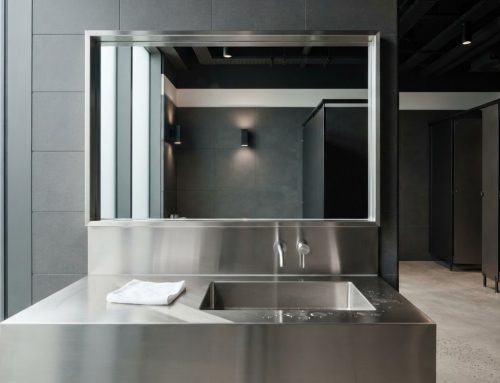
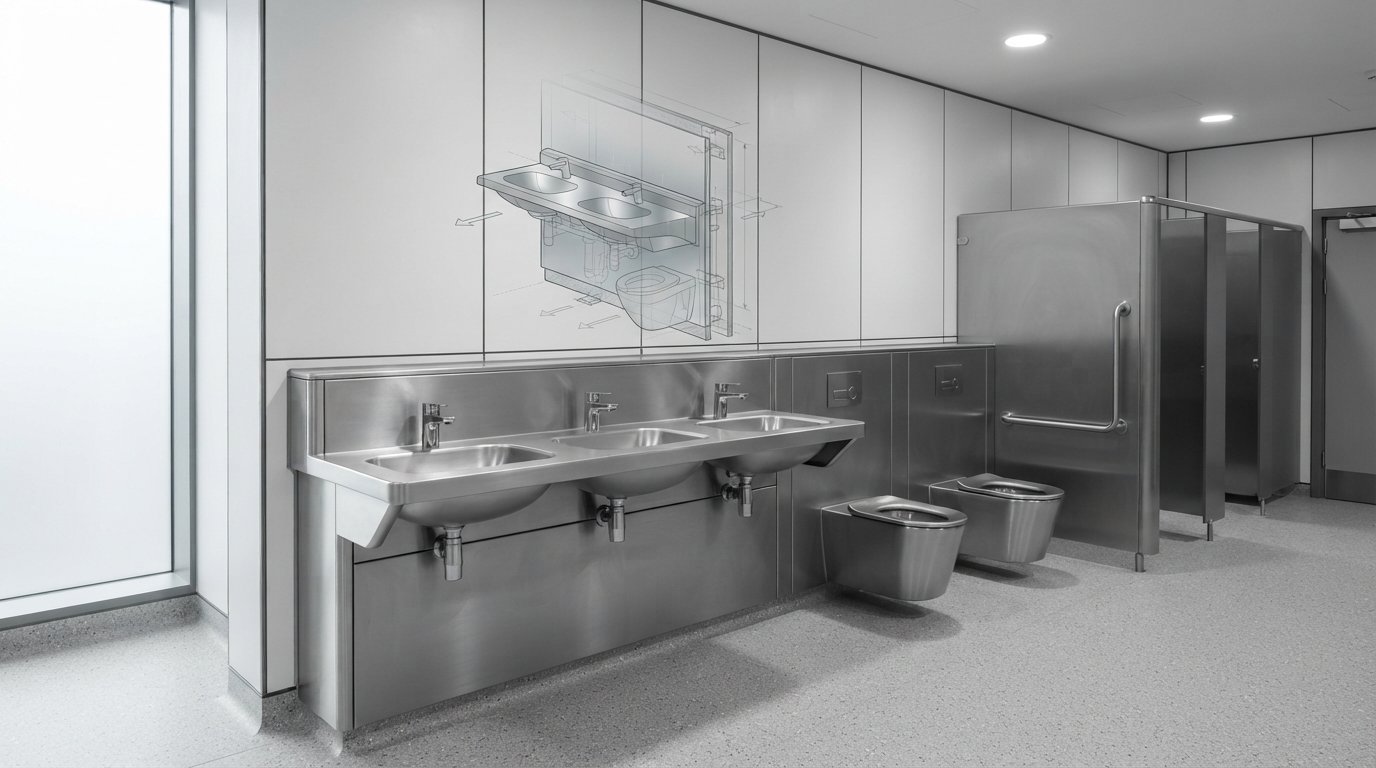
A comprehensive specification for commercial stainless steel sanitaryware extends beyond the primary fixtures to encompass an entire ecosystem of functional elements. The selection of these components must account for both the architectural footprint and the specific traffic patterns of the building. Whilst standard vitreous china often limits a designer to fixed dimensions, stainless steel offers the flexibility of both modular and bespoke configurations. This versatility ensures that every element, from WCs to specialist disposal units, contributes to a cohesive and durable environment. A professional washroom suite typically includes floor-standing or back-to-wall WCs, urinals, washbasins, and troughs, alongside ancillary items such as mirrors, waste bins, and stainless steel shelving systems.
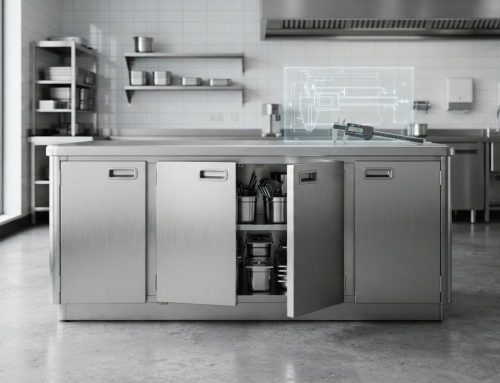
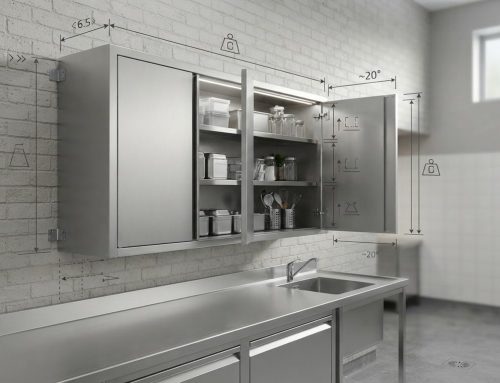
To maintain order and hygiene, the integration of matching cabinets and shelving is essential. These elements, such as the Stortidy System, provide organised storage that mirrors the longevity of the sanitaryware itself. Specifying a complete suite that includes well-engineered stainless steel storage systems ensures that the entire facility adheres to the same 50-year lifecycle and maintenance requirements, simplifying the long-term management of the building’s assets. By specifying a complete suite of stainless steel components, you ensure that the entire facility adheres to the same 50-year lifecycle and maintenance requirements, simplifying the long-term management of the building’s assets.
WCs and Urinal Systems for Public Spaces
The design of modern stainless steel WC pans focuses on high-performance hydraulics and water efficiency. These units are engineered for dual-flush operation, typically utilising 4/2.6 or 6/4 litre cycles to meet BREEAM water targets. Configurations range from floor-standing models for high-impact areas to back-to-wall designs that facilitate easier floor cleaning. Urinal systems are available in pod, bowl, or trough styles, with the latter being particularly effective in high-capacity transport hubs. Compliance with international accessibility benchmarks, such as ADA standards for commercial plumbing fixtures, ensures that installation clearances and dimensional criteria for water closets and basins are met with precision. Integrating these fixtures with concealed cisterns and sensor-flush technology further enhances infection control by reducing physical contact points.
Healthcare and Laboratory Specialist Fixtures
In clinical settings, the requirements for sanitaryware shift towards aseptic performance and chemical resistance. Sluice sinks and janitorial units are indispensable for the safe disposal of clinical waste and the maintenance of ward hygiene. These units are often manufactured from EN 1.4401 (316 grade) stainless steel to withstand the aggressive cleaning agents used in hospital environments. For facilities requiring non-standard configurations, referring to a Made to Measure Stainless Steel Sinks: A Technical Reference Guide can assist in specifying dimensions that maximise floor space whilst maintaining clinical efficiency. Whether it’s a bespoke laboratory basin designed for chemical resilience or a specialist bath for a care facility, the focus remains on creating a seamless, non-porous surface that prevents bacterial colonisation.
Designing for Specialist Sectors: From Healthcare to Education
The versatility of commercial stainless steel sanitaryware allows it to transition from high-traffic transport hubs to sterile clinical wards without compromising on performance. Whilst the material’s core attributes remain constant, the specific design requirements vary significantly between sectors. In transport infrastructure, such as the London Underground, the primary focus is on vandal-resistant fixtures that maintain their integrity under constant use. Conversely, in industrial and scientific settings, the emphasis shifts to chemical resilience, where EN 1.4401 grade material resists the corrosive effects of laboratory reagents. For a comprehensive overview of specifying fixtures that endure relentless public footfall, our guide to high traffic washroom solutions for durable specification provides detailed sector-specific guidance. This adaptability ensures that each specification meets the unique operational pressures of the environment.
Sanitaryware for Hospitals and Clinics
In healthcare environments, the specification of sanitaryware is governed by strict hygiene standards, primarily the Health Building Note (HBN) 00-10 Part C. These regulations mandate aseptic surfaces that prevent bacterial growth and facilitate effective infection control. Stainless steel is the preferred material for these applications because it can be manufactured with seamless joints, leaving no crevices for pathogens to colonise. Our experience includes providing specialist solutions for high-profile institutions such as Guy’s Hospital and Birmingham Children’s Hospital, where the integration of sinks into medical worktops must be absolute. For surgical departments in particular, specifying compliant hospital scrub up troughs UK clinical teams depend upon is a critical element of infection control, requiring precise trough fall, tap alignment, and seamless fabrication to suppress biofilm and protect patient safety. These fixtures don’t just provide a utility; they are a critical component of the hospital’s clinical safety framework.
Educational and Public Sector Requirements
Schools, colleges, and universities present a different challenge, requiring a balance between child-friendly safety and extreme durability. Educational washrooms must withstand heavy, often unsupervised use, making the impact resistance of stainless steel far superior to traditional ceramic. For younger users, radiused edges and anti-scald technology are essential considerations. Beyond the classroom, public institutions like the National Gallery require fixtures that reflect the building’s prestige whilst managing high visitor volumes. When specifying for these environments, it is often useful to consider how the sanitaryware aligns with other architectural elements. You can find more detail on this in our Bespoke Stainless Steel Kitchen Worktops: The Architect’s Guide to Specification, which explores the synergy between functional surfaces and professional design.
Whether you’re designing for a laboratory, a primary school, or a transport terminal, the choice of material defines the facility’s long-term success. To ensure your project benefits from over six decades of technical expertise, view our range of specialist sanitaryware or contact our advisory team for bespoke requirements.
Longevity, Maintenance, and Specification Excellence
Success in specifying commercial stainless steel sanitaryware depends on the precision of the initial design and the rigour of subsequent maintenance. Whilst standard components suffice for many projects, complex architectural layouts often require a more tailored approach to ensure seamless integration. By aligning manufacturing capabilities with specific site requirements, specifiers can achieve a level of functional efficiency that standard domestic fixtures cannot match.
Bespoke Design and Specification Support
Choosing between modular systems, such as the DECIMETRIC® range, and fully bespoke solutions is a strategic decision based on the facility’s needs. Made-to-measure units offer the significant advantage of eliminating unnecessary seams and joins, which is essential for maintaining aseptic standards in clinical settings. Custom worktops can be manufactured in lengths up to 5 metres, whilst splashbacks are available in dimensions up to 3 metres by 1.5 metres. To ensure absolute precision on-site, the GEC Anderson Limited ordering process includes the provision of detailed CAD drawings for client approval. This consultative approach allows specifiers to verify every dimension and connection point before manufacturing begins, significantly reducing the risk of installation delays or misalignments.
Correct Maintenance Procedures for Stainless Steel
To preserve the material’s satin lustre and ensure it reaches its 50-year lifecycle, following established care protocols is mandatory. A common error in facility management is the use of warm water for cleaning, which can lead to surface streaking or the acceleration of mineral deposits. Correct maintenance of commercial stainless steel sanitaryware requires strict adherence to the following rules:
- Always rinse the surface with cold water after cleaning; never use warm or hot water for rinsing.
- Never leave the cleaned surface to air dry, as this promotes the formation of water spots and limescale.
- Always dry the surface immediately with a soft cloth to maintain the integrity of the finish.
- Always clean in the direction of the grain to avoid micro-scratching the surface.
If calcium deposits occur, they should be treated with vinegar or 10% acetic acid. For more persistent issues, such as surface rust caused by external contaminants, a dry cleaning powder or a solution of diluted nitric acid (one part HNO3 to four parts water) may be used with caution. By avoiding aggressive chemicals and adhering to these precise methods, the structural and aesthetic integrity of the installation remains uncompromised, reflecting a commitment to technical excellence and professional trust.
Securing Long-Term Value Through Technical Specification
Specifying the correct fixtures is a commitment to the building’s future performance. By selecting commercial stainless steel sanitaryware, you ensure that your facility benefits from a material that is both 100% recyclable and capable of a 50-year lifecycle. We’ve explored how the distinction between material grades and the application of precise maintenance protocols can prevent common pitfalls like surface degradation or bacterial colonisation.
GEC Anderson Limited brings over 60 years of British manufacturing expertise to every project, providing ISO 9001-certified quality that is trusted by the NHS and the London Underground. Whether you require standard modular units or bespoke, made-to-measure solutions backed by precision CAD drawings, our technical team is ready to assist. Investing in professional-grade stainless steel isn’t just about durability; it’s about establishing a standard of hygiene and reliability that lasts for generations.
View our comprehensive range of commercial stainless steel sanitaryware to find the ideal solution for your next project. We look forward to helping you achieve specification excellence.
Frequently Asked Questions
What is the difference between 304 and 316 grade stainless steel for sanitaryware?
EN 1.4301 (304) is the industry standard for most professional washrooms, providing excellent durability and hygiene for general use. In contrast, EN 1.4401 (316) contains molybdenum, which offers superior resistance to pitting and corrosion. This acid-resisting grade is essential for laboratories, clinical sluice rooms, or coastal environments. Selecting the correct grade of commercial stainless steel sanitaryware ensures that the installation remains resilient against the specific chemical or environmental stressors it will encounter.
Can commercial stainless steel sanitaryware be made to bespoke dimensions?
Yes, providing bespoke solutions is a primary facet of the service offered by GEC Anderson Limited. We specialise in made-to-measure basins, worktops, and specialist sinks that are tailored to the exact requirements of your architectural layout. The process involves issuing pre-production CAD drawings for your approval, ensuring that every dimension is verified before manufacturing begins. This bespoke approach eliminates the need for unsightly on-site modifications and ensures a seamless, hygienic finish.
How do you remove stubborn limescale from a stainless steel urinal?
To remove stubborn calcium deposits, you should use vinegar, 10% acetic acid, or a solution of diluted nitric acid at a ratio of one part HNO3 to four parts water. It is important to rub gently with a damp cloth or sponge following the grain of the metal. Once the limescale is removed, the surface must be rinsed thoroughly with cold water and dried with a soft cloth to prevent new deposits from forming or discolouration from occurring.
Why is cold water recommended for rinsing stainless steel surfaces?
Cold water is mandated for rinsing because warm or hot water can react with cleaning agents to cause dull greyish discolouration or persistent streaking on the satin finish. Using cold water ensures the surface remains stable and retains its aesthetic integrity. Furthermore, you must never leave the surface to air dry; drying immediately with a soft cloth is essential to prevent mineral deposits from the water leaving visible spots on the fixture.
Is stainless steel sanitaryware truly vandal-proof in public washrooms?
While no fixture is entirely indestructible, stainless steel is engineered to be exceptionally vandal-resistant. Unlike ceramic, which fractures upon impact, stainless steel absorbs energy without breaking, preventing the creation of dangerous sharp edges. This resilience makes it the preferred choice for high-traffic or secure environments. The use of heavy-gauge material, typically between 1 mm and 2 mm, ensures that the units withstand deliberate damage whilst remaining fully functional for decades.
What is the typical lifespan of a GEC Anderson Limited stainless steel WC?
A WC manufactured by GEC Anderson Limited typically offers an operational lifecycle of approximately 50 years. This longevity is a result of ISO 9001-certified manufacturing and the inherent durability of the material. Unlike vitreous china, which can chip or crack over time, our commercial stainless steel sanitaryware maintains its structural and hygienic properties. This long service life, combined with the fact that the material is 100% recyclable, makes it a highly sustainable investment.
Are stainless steel fixtures suitable for medical and healthcare environments?
Stainless steel is ideal for healthcare settings due to its non-porous, aseptic surface that prevents bacterial colonisation. It is fully compliant with Health Building Note (HBN) 00-10 Part C standards for clinical sanitary assemblies. The ability to manufacture units with seamless joints and integrated sinks ensures there are no dirt traps, which is critical for infection control. These fixtures are trusted by major institutions, including the NHS, for their reliability and ease of decontamination.
How does the DECIMETRIC® modular system differ from made-to-measure options?
The DECIMETRIC® system by GEC Anderson Limited is a modular furniture range based on 100 mm increments, designed for rapid availability and cost-efficiency in standard layouts. It provides the same professional-grade quality as our custom fixtures but within a fixed dimensional framework. Conversely, made-to-measure options allow for complete architectural freedom, enabling the production of sinks and worktops to any specific length or shape required for unique or complex floor plans.