
The most expensive commercial fixture isn’t the bespoke architectural fit-out; it’s the off-the-shelf unit that buckles, pits, or fails an environmental health audit within eighteen months. In demanding clinical, culinary, and luxury residential environments, stainless steel storage systems succeed entirely on specification precision. Material grade, metal gauge, and sanitary seam construction dictate real-world performance long before visual styling comes into play.
Most specifiers have wrestled with the costly consequences of compromised build quality: dirt-trapping folds that breach hygiene standards, uprights deflecting under heavy loads, or surface corrosion caused by choosing standard EN 1.4301 steel where harsh sanitising chemicals demanded acid-resisting EN 1.4401. You shouldn’t have to force rigid catalogue modules into complex architectural footprints or gamble on structural longevity.
This specification guide demonstrates how to design, configure, and maintain high-performance stainless steel storage systems tailored to exacting project requirements. From evaluating modular increments against made-to-measure cabinetry to establishing the correct cold-water cleaning regimes that guarantee a fifty-year operational lifespan, here is the technical foundation for specifying with absolute confidence.
Key Takeaways
- Match material grades to operational exposure: specify standard EN 1.4301 (304) for general commercial demands, and reserve acid-resisting EN 1.4401 (316) for aggressive chemical or marine environments.
- Select the optimal configuration model by balancing the agility of 100 mm modular increments against fully bespoke, made-to-measure cabinetry for complex architectural footprints.
- Ensure clinical and culinary compliance by insisting on fully welded seams, radiused internal corners, and continuous shelving spans that eliminate dirt traps.
- Protect the integrity of stainless steel storage systems over a fifty-year lifespan by adhering to strict maintenance protocols, including cold-water rinses and immediate soft-cloth drying.
- Evaluate lifecycle economy over initial capital outlay to capitalise on superior structural rigidity, reduced replacement cycles, and complete material recyclability.
Primary Types of Stainless Steel Storage Systems in Professional Spaces
Professional environments demand an uncompromising balance between structural integrity and strict hygiene. While commodity wire racking or residential flat-pack units frequently fail under heavy operational loads, purpose-engineered stainless steel storage systems deliver the permanence required by healthcare estates, research laboratories, and commercial culinary facilities. Selecting the appropriate system typology requires evaluating airflow, particulate control, spatial efficiency, and physical accessibility.
Because premium stainless steel possesses an inert, non-porous surface, it prevents bacterial ingress while resisting mechanical damage. Specifiers generally deploy three foundational typologies across institutional floorplans: open cantilever shelving, enclosed cabinetry, and dynamic specialised racking.
Adjustable Cantilever and Upright Shelving Systems
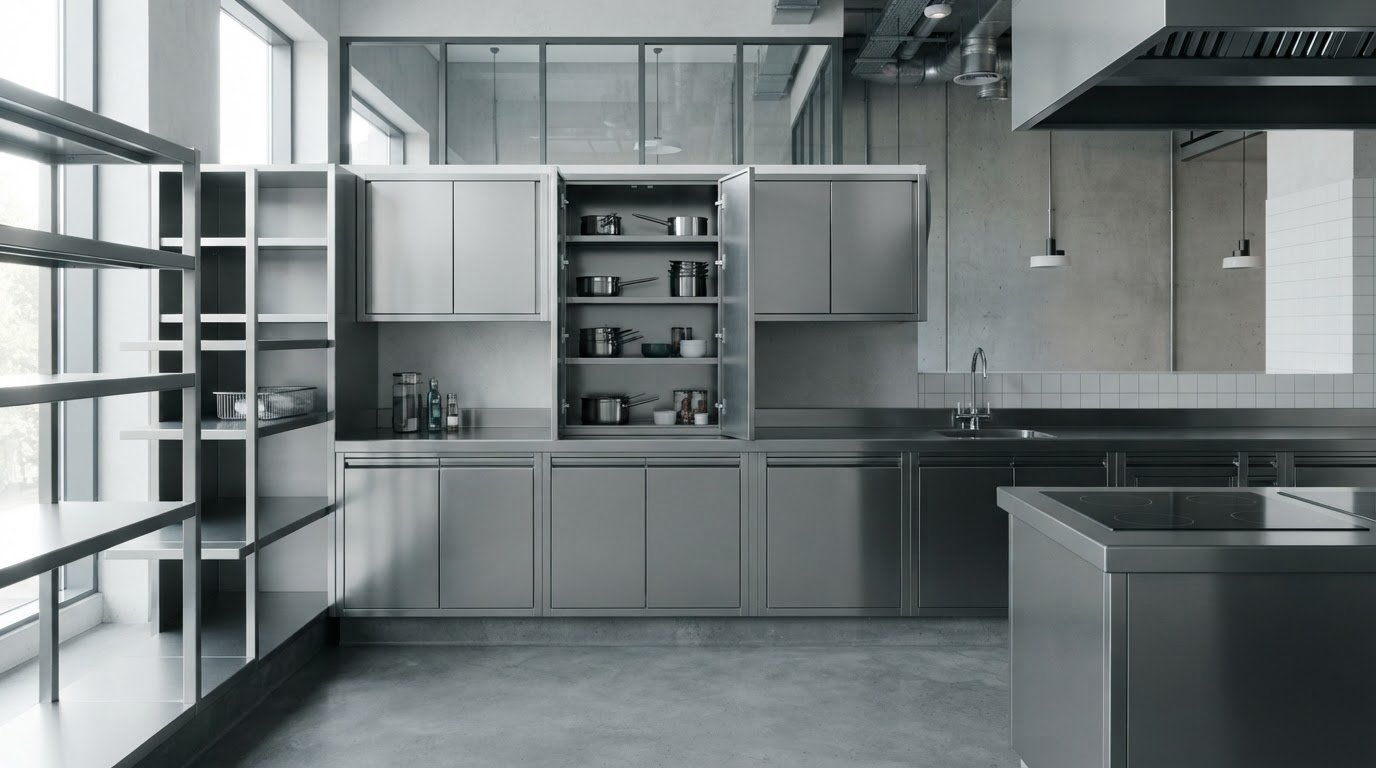
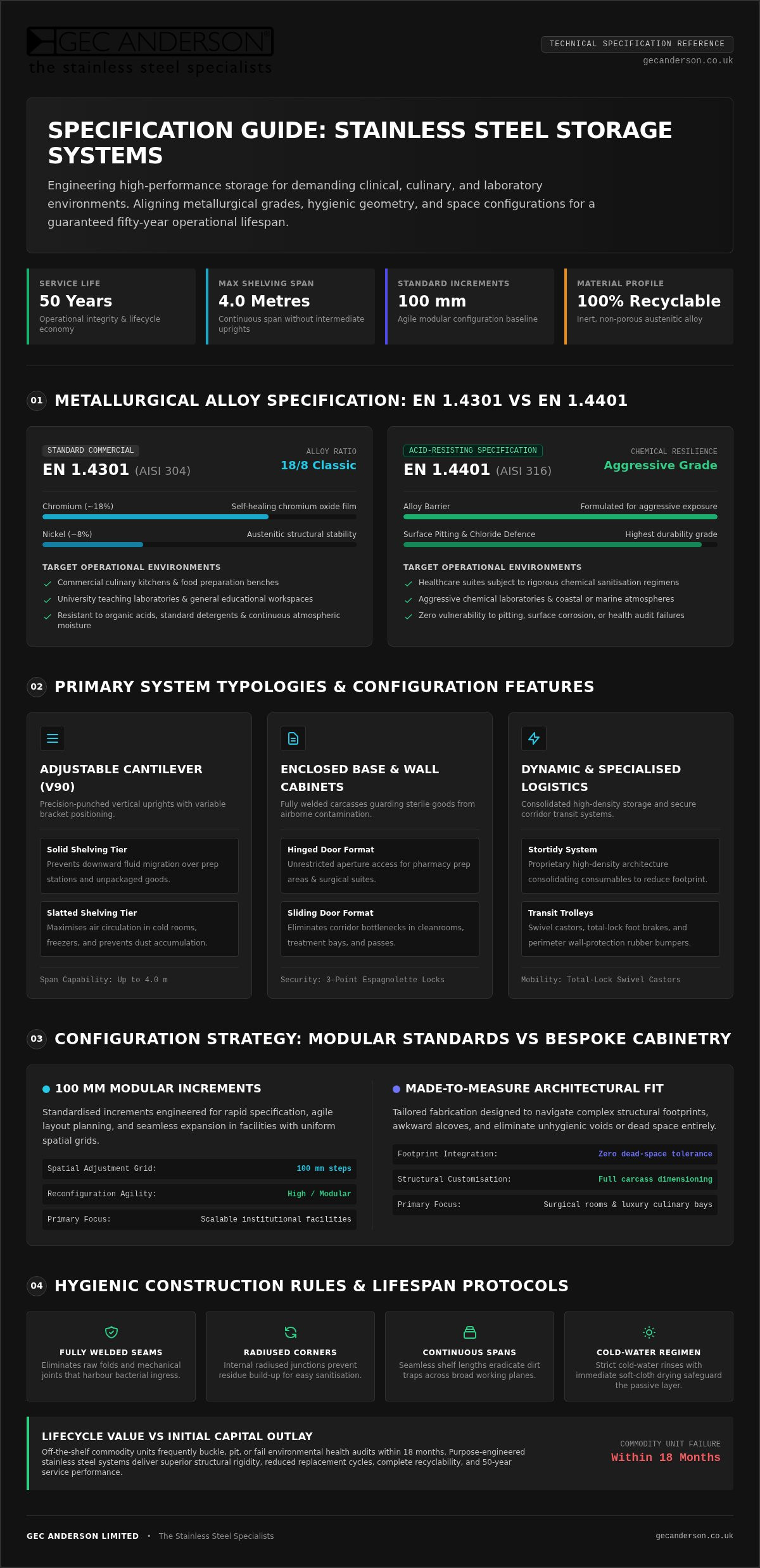
Open adjustable shelving provides rapid inventory visibility and unrestricted airflow. Systems such as the heavy-duty V90 utilise precision-punched vertical uprights that allow variable bracket positioning and support continuous shelf lengths up to 4.0 metres. Specifiers must select the correct shelf plane based on environmental exposure:
- Solid Shelving: Prevents fluid drips from migrating downward, making it essential above prep surfaces or when holding unpackaged dry goods.
- Slatted Shelving: Maximises air circulation in cold rooms, walk-in freezers, and dry stores, whilst preventing ambient dust accumulation on lower tiers.
Enclosed Stainless Steel Base and Wall Cabinets
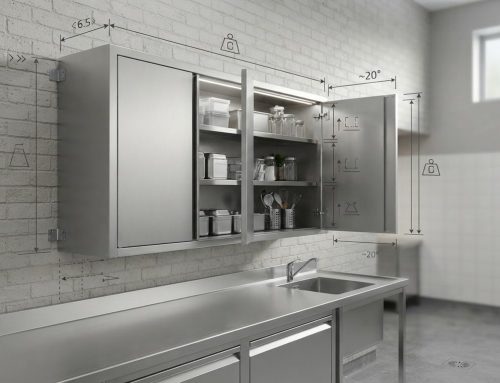
Where sterile consumables, delicate analytical instruments, or endoscope apparatus require protection from airborne contaminants, enclosed cabinetry is indispensable. Fully welded base and wall carcasses eliminate the dirt-trapping mechanical joints common to budget flat-pack alternatives. Specifiers can tailor door configurations to circulation widths. For projects where overhead storage is a priority, a detailed review of wall mounted stainless steel cabinets — covering dimensions, fixing conditions, and material grade — ensures the specification is matched to both the wall construction and intended use before installation commences:
- Hinged Doors: Provide full, immediate aperture access in spacious pharmacy prep areas or operating suites.
- Sliding Doors: Eliminate corridor bottlenecks in narrow cleanrooms, treatment bays, or busy commercial kitchen pass-throughs.
- Integrated Locking Mechanisms: Incorporate three-point espagnolette locking systems for secure containment of restricted pharmaceuticals and valuable diagnostic tools.
Specialised Storage: Mobile Trolleys and the Stortidy System
Static storage alone cannot service fast-paced facilities. High-density proprietary configurations like the Stortidy System consolidate consumables into organised, accessible modules that reduce footprint sprawl. For mobile logistics across hospital corridors and commercial prep areas, specialised trolleys require robust technical specification. They must incorporate non-marking, heavy-duty swivel castors with total-lock foot brakes, alongside integrated perimeter rubber bumpers that safeguard architectural wall linings during transit.
Stainless Steel Grades: Comparing EN 1.4301 and EN 1.4401
Material composition governs structural endurance. When specifying stainless steel storage systems, mistaking basic aesthetic sheen for appropriate metallurgical protection leads directly to early corrosion, surface pitting, and hygiene failure. Specifiers must align European standard alloy designations with the chemical reality of the installation environment to realise fifty-year longevity.
Grade EN 1.4301 for Commercial Kitchens and General Facilities
Classified under AISI as 304, EN 1.4301 represents the architectural benchmark for austenitic alloys. Its classic 18/8 composition, comprising approximately 18% chromium and 8% nickel, establishes a resilient, self-healing chromium oxide film. This passive barrier provides robust protection against common organic acids, standard detergents, and continuous atmospheric moisture. It serves as the standard specification for food service prep areas, university teaching spaces, and residential pantries where aggressive industrial reagents aren’t routinely deployed.
Grade EN 1.4401 for Laboratories, Healthcare, and Marine Settings
Environments exposed to halogens require the elevated resistance of EN 1.4401, commonly designated as AISI 316. By introducing 2% to 2.5% molybdenum into the alloy matrix, this material actively resists chloride-induced pitting and crevice corrosion. Pathology departments, hospital sluice rooms, cleanroom wash areas, and coastal facilities subject to salt air demand this acid-resisting composition. Operating theatre storage holding aggressive enzymatic disinfectants or iodine formulations will rapidly deteriorate if specified in standard grades instead of molybdenum-fortified steel.
Sheet Metal Gauge Selection and Weight Capacity
Alloy selection shields against chemical breakdown, but sheet thickness governs physical deflection. Professional storage requires robust fabrication gauges:
- 1.0 mm to 1.2 mm: Appropriate for non-load-bearing elements such as internal carcass dividers, drawer sides, and lightweight wall infills.
- 1.5 mm: The commercial baseline for cabinet bodies, doors, and standard shelving tiers supporting evenly distributed weights.
- 2.0 mm: Essential for heavy-duty spans, cantilever upright brackets, and units bearing dense clinical machinery or bulk fluid containers.
Sheet metal thickness directly dictates load capacity and deflection limits over prolonged operational lifecycles. Where standard stock profiles struggle to meet unusual loading criteria, collaborating directly with specialists like GEC Anderson allows designers to tailor metal gauges and internal box-section stiffeners precisely to institutional briefs.
Configuration Options: Modular Standards versus Made-to-Measure Systems
Architectural plans rarely present uninterrupted, orthogonal spaces. When laying out professional stainless steel storage systems, specifiers must decide between the cost predictability of standardised modular ranges and the spatial optimisation of bespoke fabrication. Making this call early prevents spatial inefficiencies, clumsy infill panels, and chronic dirt traps between mismatched carcasses.
Standardising on modular units drastically accelerates project scheduling. Conversely, bespoke construction reclaims inaccessible corners, spans structural load-bearing piers, and wraps services without creating unhygienic voids.
The DECIMETRIC Modular System: Standardised Flexibility
The DECIMETRIC system resolves spatial planning through standardised 100 mm dimensional increments. Engineered to balance production economies with layout versatility, this modular series scales up to 3000 mm overall run lengths in standard depths of 600 mm or 700 mm. Specifiers can assemble drawers, hinged cupboards, open shelving, and base units within a coordinated grid. This disciplined dimensional logic simplifies room scheduling, reduces design revisions, and ensures replacement components integrate seamlessly decades later.
Custom Made-to-Measure Storage for Exact Architectural Alignment
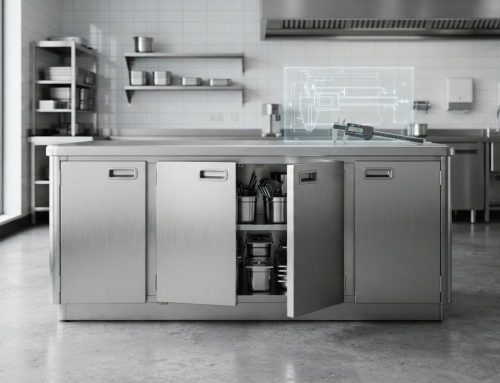
Historic structures, complex hospital layouts, and compact commercial galleys frequently present irregular alcoves, service risers, or non-standard ceiling pitches. Bespoke manufacturing bypasses the compromises of standard units. Each bespoke assembly relies on verified pre-production CAD drawings, detailing exact service cut-outs and site-specific wall interfaces before cutting commences. Continuous fabrication from perimeter wall to perimeter wall eliminates the 20 mm to 50 mm service gaps typical of catalogue units, systematically denying pests and pathogens an inaccessible breeding ground.
Continuous Integration with Adjoining Stainless Steel Fixtures
Hygienic performance peaks when storage stops behaving as loose furniture and becomes an integral part of the architectural envelope. Specifying custom cabinetry alongside bespoke stainless steel kitchen worktops establishes an unbroken, fluid boundary that resists heavy downpours during washdowns. Base storage connects directly below seamless worktops and made to measure stainless steel sinks, using identical brushed satin grain finishes for visual and structural cohesion. Extending this envelope vertically with continuous splashbacks fully contains liquids, stopping contaminated water from migrating behind cabinetry carcasses.
Hygienic Design Principles and Mandatory Maintenance Protocols
Hygienic performance in stainless steel storage systems relies entirely on manufacturing detailing that denies biological contaminants a foothold. While inferior units depend on mechanical fasteners and folded seams that trap moisture, professional installations require precision craftsmanship that withstands rigorous, routine decontamination. Without disciplined fabrication and strict maintenance protocols, even premium installations risk surface compromise.
Clinical and Food Safety Design Features
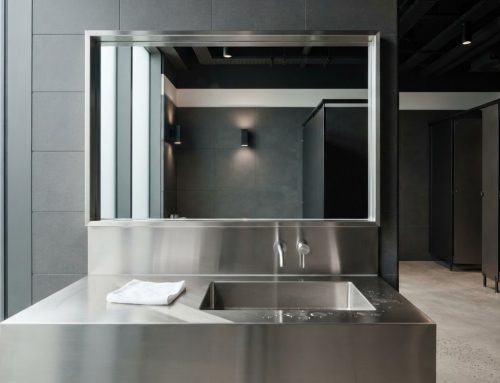
Precision manufacturing eliminates biological collection points at the drafting stage. Carcasses must feature continuous, automated seam welding and fully radiused internal coving. These curved corners allow cleaning agents to contact every internal surface without dirt lodging in right-angled folds. The non-porous alloy matrix actively prevents bacterial penetration and fungal colonisation. In clinical utility spaces and washrooms, storage standards align directly with commercial stainless steel sanitaryware protocols, creating smooth wipeable surfaces that uphold infection-control compliance.
Routine Cleaning Rules and Passive Layer Preservation
Maintaining the self-repairing passive layer of chromium oxide requires exact physical and chemical adherence. Facilities teams must never compromise this microscopic shield through improper cleaning technique:
- Application Method: Apply gentle general-purpose cream cleaners using a soft, damp cloth. Always rub strictly in parallel with the visible grain of the metal; scouring across the grain permanently scuffs the finish.
- Rinsing Protocol: Never rinse with warm or hot water, as elevated water temperatures accelerate the deposition of dissolved mineral salts. Always use cold water for rinsing after any cleaning step.
- Immediate Drying: Never leave cleaned surfaces to air dry. Standing water evaporates to leave unsightly mineral spotting and invites atmospheric contamination. Always dry thoroughly using a clean, soft cloth.
Removing Mineral Limescale and Stubborn Surface Rust
Hard water regions inevitably generate stubborn calcium scale, whilst airborne carbon steel particles from adjacent building works can induce foreign surface rust. Standard scouring pads must never be applied. For calcium deposits, specifiers should stipulate only vinegar, 10% acetic acid, or diluted nitric acid (formulated at one part HNO3 to four parts water). When handling diluted nitric acid, operators must strictly ensure ample ventilation and wear appropriate protective equipment.
For light foreign iron rust, apply a proprietary dry cleaning powder along the grain line. For persistent, deeply bonded foreign oxidation, utilise a dry nylon fibre brush or a diluted nitric acid wash to dissolve contaminants without etching the parent steel. To safeguard operational compliance across demanding estates, consult GEC Anderson for detailed sanitary maintenance schedules.
Specifying Stainless Steel Storage Systems for Fifty-Year Longevity
Procurement choices frequently stumble by prioritising initial capital expenditure over asset life expectancy. In demanding institutional estates, budget alternatives like powder-coated wire racking or composite plastic shelving deteriorate under relentless impact and thermal cycling. Purpose-engineered stainless steel storage systems deliver a functional service life comfortably exceeding fifty years, transforming high initial capital outlay into superior whole-life economy.
Life-Cycle Costing: Engineered Metal versus Disposable Fixtures
Lightweight fixtures routinely bow, crack, or shed anti-microbial coatings within three to five years of intense commercial cleaning. Conversely, precision-welded stainless steel withstands heavy trolley impacts, aggressive sterilisation procedures, and significant load stress without structural degradation. In sustainable architectural design, the alloy’s cradle-to-cradle lifecycle is unmatched. Being 100% recyclable, it never contributes to commercial landfill waste when facilities eventually undergo comprehensive operational refits.
The Architectural Specification and Ordering Process
Executing an enduring storage installation requires absolute coordination between the design studio and the factory floor. Architects initiate the process by supplying spatial envelopes, structural constraints, and intended load profiles for standard or bespoke items. Every bespoke configuration undergoes thorough pre-production CAD drafting. These detailed architectural drawings verify exact plumbing chases, skirting coves, and adjoining wall interfaces before raw steel meets the automated laser cutters. Factory-assembled sections are then scheduled for phased on-site deliveries, avoiding trade congestion on busy construction programmes. Specifiers preparing briefs for enclosed storage solutions will find the detailed guidance on industrial stainless steel cabinets — covering environment, grade, configuration, and fabrication — a practical reference for confirming dimensions, capacity, and finish before manufacture commences.
Partnering with GEC Anderson for Architectural Excellence
Precision craftsmanship underpins every successful fit-out. Established in Britain in 1962, GEC Anderson brings over sixty years of independent manufacturing heritage to complex architectural commissions. Operating under strict ISO 9001 certified quality management protocols, automated CNC laser cutting pairs with skilled manual TIG welding to secure flawless dimensional accuracy and certified weight capacities. That pedigree explains why leading healthcare institutions, research facilities, and universities routinely mandate their cabinetry. Explore GEC Anderson storage solutions to review technical specifications or consult our engineering team on bespoke layouts.
Delivering Enduring Specification Value Across Demanding Estates
Specifying high-performance stainless steel storage systems requires looking past cosmetic sheen to interrogate metallurgical grade, structural gauge, and sanitary detailing. Aligning versatile EN 1.4301 or acid-resisting EN 1.4401 alloys with environmental demands protects facilities against early degradation, whilst balancing 100 mm modular increments against bespoke fabrication unlocks maximum spatial utility without unhygienic voids.
Founded in 1962, GEC Anderson brings over sixty years of independent British manufacturing heritage and ISO 9001 certified precision to every installation. Austenitic stainless steel provides a documented fifty-year operational lifecycle alongside complete recyclability, earning the confidence of world-class institutions such as Guy’s Hospital and the Wellcome Trust. When your scheme demands unyielding durability, verified load ratings, and sanitary compliance, contact GEC Anderson for technical specification support and bespoke storage designs tailored precisely to your architectural requirements.
Frequently Asked Questions
Can stainless steel storage systems rust or corrode over time?
Yes, but visible surface marking is rarely oxidation of the parent alloy itself. Most rust stains originate from foreign carbon steel particles left by tools or high-iron tap water evaporating on the metal. Point-etching or genuine pitting occurs only when surfaces face prolonged contact with concentrated chlorides, mineral acids, or stagnant detergent residues. Establishing proper routine cleaning and prompt foreign iron removal preserves stainless steel storage systems indefinitely.
What is the main difference between EN 1.4301 and EN 1.4401 stainless steel?
The defining technical distinction is the inclusion of 2% to 2.5% molybdenum within EN 1.4401 (AISI 316). Standard EN 1.4301 (AISI 304) features classic 18/8 chromium-nickel metallurgy, offering robust resilience against common organic food soils and general moisture. The molybdenum addition in EN 1.4401 provides heightened defense against pitting corrosion caused by aggressive halogen compounds, harsh chemical reagents, and saline atmospheres.
How much weight can a commercial stainless steel shelving system support?
Structural capacity depends directly on sheet metal gauge, upright spacing, and span length. Heavy-duty designs like the V90 system support shelf spans up to 4.0 metres when uprights are spaced between 800 mm and 1000 mm apart. Deploying 1.5 mm to 2.0 mm metal gauges alongside under-shelf channel stiffeners prevents visible deflection under dense culinary containers, clinical machinery, or bulk laboratory inventory.
Is bespoke stainless steel storage better than standard modular units?
Neither is inherently superior; selection depends entirely on room geometry and project deadlines. Standard modular systems like DECIMETRIC utilise 100 mm increments up to 3000 mm lengths, providing economical planning and rapid availability. Bespoke fabrication proves essential when working around awkward building alcoves, irregular service risers, or structural pillars, eliminating unhygienic perimeter voids that standard rectangular units inevitably leave behind.
What happens if you use hot water to rinse stainless steel during cleaning?
Using hot or warm water accelerates the evaporation rate and causes dissolved mineral salts to precipitate across the surface. This rapid thermal reaction leaves stubborn limescale deposits and cloudy streaks that trap airborne contaminants. Maintenance protocols must mandate cold water exclusively for rinsing after any detergent application, followed immediately by thorough drying with a clean, soft cloth.
How do you remove stubborn limescale or calcium marks from stainless shelving?
Remove heavy calcium deposits using vinegar, a 10% acetic acid solution, or diluted nitric acid mixed at one part HNO3 to four parts water. When working with diluted nitric acid, operators must maintain good ventilation and follow standard protective handling rules. Rub along the visible grain direction, rinse immediately and thoroughly with cold water, and dry the metal completely with a soft cloth.
Can stainless steel storage systems be installed in domestic environments?
Yes, premium stainless systems are frequently specified in high-end residential pantries, utility rooms, and bespoke kitchens. Residential schemes benefit from the identical hygienic, fireproof, and non-porous characteristics demanded by hospitals. When paired with warm materials such as natural timber or stone, brushed satin stainless steel cabinetry delivers exceptional aesthetic longevity without warping, absorbing moisture, or harbouring domestic cooking odours.